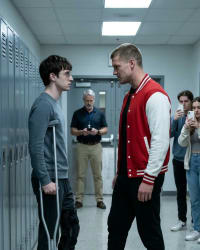
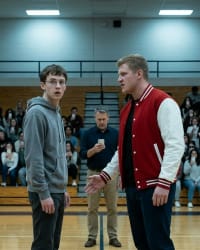
The supervisor listened without interrupting.
When Jonah finished, she looked at the students around them.

“Please stay nearby,” she said. “I may need to ask what you saw.”
A few students nodded. Others kept their phones in their hands.
Dalton stood beside the table, his jacket no longer pulled tight.
He glanced at Jonah’s open hands, then toward the serving area.
The supervisor asked whether anyone had recorded what happened.
A student near the windows raised his phone.
“I started when Dalton pressed his head down,” he said.
The supervisor stepped closer and watched the clip.
Jonah could see only a pale screen and a moving blue sleeve.
The student played it again, then showed her another short clip.
The supervisor watched both without speaking.
She looked at the tipped stool, the tray, and Dalton.
Then she asked the students to share their recordings with the school.
Nobody was asked to surrender a phone.
The first student opened a sharing screen and waited for her instructions.
Another student moved closer to show the moment Jonah stood.
The clips had caught Dalton’s palm on Jonah’s head and the shove.
They had also caught Jonah taking hold of the jacket.
Jonah felt the warmth of the fabric again across his knuckles.
He let his fingers uncurl at his sides.
Dalton gave a small laugh.
“Those clips don’t show the whole thing.”
The supervisor looked at him.
“What part is missing?”
Dalton’s mouth opened, then closed.
One of his friends shifted beside the table.
The friend kept his eyes on the floor.
The supervisor asked Jonah whether he needed the nurse.
He flexed each hand and looked down at his palms.
“No. I’m all right.”
“Did you hit your head?”
“No.”
She glanced once more at the stool.
Then she asked another student to help set it upright.
The student moved carefully, checking that its legs were steady.
Jonah’s green tray had tipped near the table.
A fork lay under the edge.
He reached for it, but the supervisor told him to leave it.
A cafeteria worker came to collect the tray.
Jonah stepped back to give her room.
The room began making ordinary sounds again.
A chair scraped. Someone cleared a throat.
At the serving counter, a tray clattered against a metal shelf.
No one returned to their lunch right away.
The supervisor asked Jonah to wait near the end of the table.
Dalton was told to stand by the serving doors.
A few feet separated them.
Dalton’s hands hung at his sides.
He looked at the students who had filmed.
None of them lowered their phones.
Jonah watched the supervisor speak quietly to a cafeteria worker.
Her voice stayed level, and she pointed toward the office.
The worker nodded and went to find another staff member.
Jonah’s chest still stung where Dalton had shoved him.
He pressed his palm there, then let it fall.
The hard tile and tipped stool stayed in his view.
He had expected his hands to shake after releasing the jacket.
They did not.
His pulse still thudded high in his neck.
He adjusted his glasses with two fingers.
The frame sat crooked, but the lenses were clear.
Dalton looked over again.
“You think this makes you tough?”
Jonah held his gaze.
“I think you pushed me.”
Dalton’s cheek twitched.
The supervisor turned from the serving doors.
“Dalton, wait there.”
He looked toward her, then away.
Jonah could see the cream sleeve of his jacket move as he folded his arms.
The students remained where they were.
Their attention moved between Dalton, Jonah, and the supervisor.
A minute passed. Then another.
The bell had not rung yet.
The lunch supervisor returned with a staff member from the main office.
She spoke to him in a low voice, then pointed to the student with the first video.
The staff member asked the student to show him the recording.
The phone screen turned toward him.
Dalton made a sound through his nose.
Jonah did not answer it.
The staff member watched the clip and asked whether more students had recorded.
Three hands rose.
He wrote down their names on a small pad.
Then he asked them to share the videos with the school.
The first student nodded.
One of the others asked if he would have to give up his phone.
“No,” the staff member said. “Just send the recording.”
The student’s shoulders eased.
The supervisor turned to Jonah.
“Could you come to the office after lunch?”
He nodded.
“Can I finish putting my things away first?”
“Yes. We’ll walk over together.”
Dalton looked toward the doors.
The staff member stepped into his line of sight.
“Stay here for now.”
Dalton’s jaw tightened.
He did not move.
Jonah gathered the carton and napkin from the table.
The cafeteria worker had already cleared the tray and fork.
He slid his lunch bag under one arm and straightened the strap.
The supervisor stayed close enough to speak if he needed her.
The people around the table began moving again.
Their voices returned slowly, unevenly.
Jonah heard his name once from across the room.
He did not turn toward it.
He had learned that a room could make a person feel watched long after everyone looked away.
The office had two chairs beside a counter.
Jonah sat in one while the staff member took notes.
The lunch supervisor stayed near the doorway.
She asked him to tell the events in order.
Jonah described the palm, the shove, the warning, and the jacket.
He also described letting go.
The staff member asked if Dalton had touched him after that.
“No.”
“Did you touch him after you released the jacket?”
“No.”
The questions were plain and slow.
Jonah answered each one plainly.
He did not try to make the story sound better for himself.
When the staff member asked about the youth club, Jonah explained that he had wrestled there since he was nine.
The staff member paused over his notes.
“You’ve been doing that for nine years?”
Jonah nodded.
“My coach taught us to control a grip. Not show off.”
The lunch supervisor glanced toward the hallway.
She had heard the same lesson before, but Jonah had never said it at school.
The staff member asked whether he had practiced wrestling at school.
“No.”
“Did you plan to grab Dalton’s jacket?”
“No.”
He looked down at the edge of the chair.
“My hands moved before I knew what I was going to do.”
The staff member wrote that down.
Jonah watched the pen move across the paper.
No one asked him to call it courage.
No one asked whether he was afraid.
When they finished, the supervisor walked him back toward the cafeteria.
The lunch period was almost over.
Students were clearing tables and carrying trays to the bins.
Dalton was no longer near the serving doors.
Jonah did not know where he had gone.
He put his lunch bag in his backpack and checked the bent corner of his notebook.
A few students passed without speaking.
One boy tapped Jonah’s shoulder lightly as he went by.
Jonah turned.
“Glad you’re okay,” the boy said.
Jonah nodded.
The boy kept walking.
The school coach came in before the bell.
He asked Jonah to walk him through what happened.
Jonah told him all of it, including the part where he had grabbed the jacket.
The coach listened, then asked the students who had filmed to share their videos.
Before lunch ended, he turned to Dalton.
“You’re out of Friday’s game pending review.”
Dalton said nothing.
At the end of lunch, Jonah went toward his next class.
The corridor outside the cafeteria smelled faintly of soap and warm bread.
The floor tiles had pale blue squares every few feet.
Students moved through the hall in loose groups.
Jonah kept to the right and held his backpack strap.
He could still hear the cafeteria behind him.
A burst of laughter rose, then faded as the doors swung shut.
He reached the science wing and turned toward the stairwell.
The bell had not sounded yet.
A few students stood near the trophy case, talking.
Jonah recognized Dalton’s friends from the lunch table.
There were three of them, all wearing school sweatshirts.
Dalton stood with them, his letterman jacket still on.
He had been watching the corridor.
When Jonah appeared, the conversation stopped.
One friend looked from Dalton to Jonah and back.
Another shifted his backpack higher on one shoulder.
Jonah slowed, then continued.
The friends opened a little space around Dalton.
Nobody called Jonah’s name.
Dalton stepped into the hall.
“Walk away again,” he said.
Jonah stopped several feet from him.
The trophy case glass reflected both of them.
Dalton’s face looked red under the fluorescent lights.
His jacket collar sat flat against his chest.
Jonah kept his hands loose beside his thighs.
“What do you want?” he asked.
Dalton gave a short laugh.
“You grabbed me in front of everyone.”
“I let go.”
“You think that fixes it?”
Jonah glanced at the friends behind him.
They were close enough to hear.
One held a phone down by his leg.
The dark screen reflected a strip of ceiling light.
Dalton noticed the glance.
His eyes narrowed.
“Look at me.”
Jonah looked back.
Dalton came closer.
Jonah could see a small crease in the cream sleeve where the leather bent at his elbow.
Dalton raised one hand, then let it drop.
“You made me look weak.”
Jonah said nothing.
Dalton’s friends stayed quiet.
A student crossing the hall slowed near the trophy case.
She stopped with one hand on her binder.
Dalton looked past Jonah at the growing audience.
His chin lifted.
“You don’t get to walk off after that.”
Jonah felt his shoulder blades draw together beneath his hoodie.
He let them settle.
“I’m going to class.”
Dalton stepped in front of him.
The friends moved a fraction closer, but none touched Jonah.
Dalton’s right hand closed around the shoulder of Jonah’s hoodie.
The fabric pulled against his collarbone.
Jonah’s breath stopped for a beat.
The hallway narrowed to Dalton’s hand and the blue tiles under their shoes.
He remembered the youth club mat beneath his bare feet.
He remembered his coach correcting his stance until he could stay balanced without leaning forward.
He remembered the lesson about the grip.
Control. Not showing off.
Dalton pulled the hoodie toward him.
Jonah did not yank free.
He shifted his weight onto both feet and watched Dalton’s shoulders.
Dalton’s stance tipped forward with the pull.
Jonah moved with it.
He turned his hips, guided Dalton’s arm across his own center, and stepped through.
His foot blocked Dalton’s step.
The movement was quick, close, and controlled.
Dalton’s balance went past his shoes.
Jonah guided him down.
Dalton landed on his side and back, one hand striking the tile.
His jacket bunched beneath his shoulder.
The sound cracked through the corridor.
Nobody moved.
Jonah released the arm at once and stepped back.
His hands opened beside him.
Dalton stared up at the ceiling.
His mouth hung open, and his eyes were wide.
The three friends stood frozen behind him.
The student with the binder held it against her chest.
A phone rose near the trophy case.
Jonah kept his distance.
“Are you hurt?”
Dalton blinked at him.
Then he looked down at the floor beside his shoulder.
“No.”
His voice had lost its edge.
Jonah did not reach for him.
He stood with both feet planted and his hands visible.
Dalton pushed himself onto one elbow.
His friends still had not moved.
The nearest one started to step forward, then stopped.
Dalton sat up by himself.
He touched the back of his head, checked his palm, and looked at Jonah.
There was no blood.
His face had gone pale beneath its redness.
The corridor stayed silent.
The bell rang.
Its sharp buzz filled the hall, but no one moved immediately.
Dalton rose slowly, using the trophy case frame for balance.
Jonah stepped farther back to leave him room.
Dalton’s eyes stayed on Jonah.
He looked as if he expected another move.
Jonah lowered his hands.
“I’m done.”
Dalton’s gaze flicked to the friends.
The friend with the phone lowered it halfway.
The screen remained pointed toward them.
One of the others looked embarrassed, but said nothing.
The girl with the binder turned toward the stairwell.
A teacher appeared at the far end of the corridor.
She had heard the fall.
“What happened?”
No one answered right away.
Jonah kept his voice level.
“Dalton grabbed my hoodie and pulled me toward him.”
The teacher looked at Dalton.
“Is that what happened?”
Dalton glanced at his friends.
One nodded once.
The other looked down at the blue tile.
Dalton swallowed.
“I grabbed him.”
The teacher walked over, eyes moving between them.
“Did either of you hit your head?”
“No,” Dalton said.
Jonah shook his head.
“Anyone hurt?”
“No,” Dalton said again.
The teacher asked them to wait by the trophy case.
She sent a student to find the lunch supervisor.
Jonah stood a few steps from Dalton.
Neither of them spoke.
The phone video had caught the hallway from the moment Dalton stepped forward.
Jonah had not seen when the recording began.
The student lowered his phone and looked uncertain.
The teacher asked him to keep the video available.
She said the school might need to see it.
He nodded and put the phone in his pocket.
Dalton’s jacket looked rumpled at one shoulder.
He brushed at the wool, though there was nothing on it.
His friends remained beside him.
They no longer looked like an audience.
One rubbed the back of his neck.
Another stared at the trophy case glass.
The lunch supervisor arrived with the coach.
The coach’s whistle hung on a blue cord around his neck.
He looked from Jonah to Dalton, then at the teacher.
“Everyone all right?”
Both boys said yes.
The coach asked them to come to a nearby office.
Jonah followed without looking back.
Dalton followed too, slower.
The coach asked what happened in the hall.
Jonah told him Dalton had grabbed his hoodie and pulled.
He described stepping through, guiding Dalton down, and letting go.
He did not leave anything out.
The coach listened, his hands resting on the desk.
Then he asked Jonah whether he had struck Dalton.
“No.”
“Did you hold him after he landed?”
“No. I let go right away.”
The coach nodded.
He turned to Dalton.
“Did you grab Jonah?”
Dalton looked at the tabletop.
“Yes.”
“Why?”
Dalton rubbed his thumb over one jacket cuff.
“I was angry.”
The coach waited.
Dalton glanced toward the door.
His friends were not inside, but he knew they were nearby.
“I wanted him to stop walking away.”
The coach folded his hands.
“You had already been told to stay away from him.”
Dalton did not answer.
The lunch supervisor placed the cafeteria incident notes on the desk.
She said several students had shared recordings of the shove.
The coach asked the hallway teacher to add the second incident to the report.
The student’s video would be included if he agreed to share it.
No one raised their voice.
No one had to.
The coach looked at Jonah.
“You used what you learned to keep the situation under control?”
Jonah thought of the collar beneath his fingers.
He thought of the quiet space after he let go.
“I tried to.”
The coach nodded once.
“Good. Keep your distance from him while we review this.”
Jonah said he would.
The coach turned to Dalton.
“You were already out of Friday’s game. Now it stays that way until the review ends.”
Dalton’s shoulders dropped.
The coach continued before he could answer.
“The school will review both incidents and the recordings.”
Dalton looked at his hands.
The lunch supervisor gathered her notes.
The teacher had already returned to the hallway.
Jonah could hear students passing outside the office.
Their footsteps moved toward class.
The coach asked Jonah to walk him through the first incident once more.
Jonah did.
He spoke about the hand on his head, the shove, and the words.
He spoke about taking the jacket and releasing it.
Then he spoke about the corridor.
He described the grip on his hoodie and the step that took Dalton’s balance.
He did not call it a fight.
The coach did not ask him to.
When Jonah finished, the coach thanked him for being direct.
The meeting ended without a speech.
The office door opened onto the hall.
Dalton was already gone with one of his friends.
The other friend waited near the stairs.
He moved aside when Jonah came out.
Jonah walked to class beside the coach.
At the classroom door, the coach stopped.
“Do you need anything before you go in?”
Jonah shook his head.
The coach studied his face for a moment.
“Tell me if you do.”
Jonah went inside.
The class had started.
He took his seat near the windows and opened his notebook.
His pen rested between his fingers.
The first line on the board was a date and a question about weather.
He copied both down.
His handwriting leaned slightly to the right.
For the rest of the period, he listened.
He answered once when the teacher called on him.
His voice sounded ordinary.
After the bell, a student from the hall caught up beside him.
“I saw what happened,” she said.
Jonah adjusted his glasses.
“Thanks.”
She nodded and went ahead.
The day moved forward in pieces.
A class, a hallway, a worksheet, the next bell.
Jonah did not see Dalton again before dismissal.
The coach spoke with the lunch supervisor.
Students who had recordings sent them to the school.
The staff reviewed what each clip showed.
By the end of the day, the first shove and the second grab were documented.
The Friday game remained pending review.
No one called Jonah a hero in the halls.
No one asked him to repeat the takedown.
That suited him.
The friend who had filmed the second moment passed Jonah near the front doors.
He asked if Jonah wanted a copy of the video.
Jonah paused before answering.
“If the school needs it, send it there.”
The student nodded.
“I will.”
Outside, late sunlight lay across the sidewalk.
Jonah walked toward the bus line with his backpack on one shoulder.
The cafeteria felt far away, though the day had not ended.
His hands were empty.
He flexed them once, then let them rest.
The coach’s lesson had not been about winning.
It had been about knowing when to release.
Jonah had let go of Dalton’s jacket.
He had let go again when Dalton reached for him.
Tomorrow, he would still have to walk through the same halls.
He could not decide what everyone would say.
He could decide what his hands did.
Which moment should count more: the moment Jonah grabbed back, or what he did next?