Chapter 1
The pie was still warm when it hit the bottom of the trash bin.
I heard it before I understood it.
A dull thud, like a door closing somewhere far away, in a house I used to live in.
I’m 72.
I want to tell you how I ended up standing at a garden gate with my hands held out and nothing in them, while my own son looked at me like a stranger.
And I want to tell you what happened after.
That’s the part nobody on that lawn got to see.
My husband Hank and I ran a hardware store in town for forty years.
The sign said Marsh Hardware.
Nobody ever read it.
Everybody in town just called it Hank’s.
Nails by the pound.
Keys cut while you wait.
A coffee pot by the register that was never empty and never very good.
Hank did the talking.
I did the books.
Under the register he kept a green cloth ledger he called the trust book.
Young roofers, plumbers, kids with one truck and no credit would come in needing more than they could pay for.
Hank let them take it, and he wrote it in the trust book in pencil.
Most of them paid him back.
A few never did.
He never once called a single one of them.
“Somebody carried me once,” he’d say.
“That’s all the book is.”
Hank died two years ago, in his sleep, in the chair by the window.
Forty-six years married.
I still set out two mugs some mornings and have to put one back.
When I cleaned out the store, I kept that green book.
It lives in my kitchen drawer, next to the good scissors.
Three years ago, our son Curtis lost his restaurant.
He’d put everything into it.
His savings, a second loan, then a third.
When it closed, the bankruptcy ruined his credit.
No bank in the state would give him a mortgage.
He tried six of them.
I know, because he called me after every one, and every call was shorter than the last.
Hank had carried half the county on a handshake.
Nobody would carry his son.
Last spring Curtis found a big house on the lake.
Glass across the back, a deck as wide as my whole yard, a lawn that ran right down to the water.
He drove me out to see it on a Tuesday.
He walked me through every empty room like a boy showing off a tree fort.
“Mom, it’s the one,” he said, standing in the bare kitchen with the sun on his face.
“Lily could grow up here.”
He wanted it so badly I could hear it in his breathing.
So I sold the store.
I took Hank’s life insurance and every dollar the two of us had saved, and I bought that house.
Cash.
The deed had to be in my name.
There was no other way to do it.
Curtis said so himself, quietly, looking at the carpet of the title office.
Then, out in the parking lot, he asked me for one thing, about his wife, Whitney.
“Please don’t tell her, Mom. Let her think I did this.”
I stood there holding my purse strap in both hands.
The asphalt was hot through my shoes.
He wouldn’t look up from his keys.
Whitney had never thought much of me.
At their wedding she seated me at the table nearest the restrooms.
Her own mother, Donna, sat there with me.
Donna was a sweet, nervous woman who talked all night about her church’s bake sale and the casserole she’d brought to the rehearsal dinner.
Whitney didn’t come to our table once.
Since then she has called my cooking “rustic.”
She means it the way you’d mean “sad.”
So Curtis told her the house was financed through his new business partner, a builder named Doug Abbott who’d hired him to design restaurant kitchens.
She believed him.
She wanted to.
I said yes to him.
I’m his mother.
I told myself it was only a piece of paper.
I even made a plan.
In June I had my lawyer, Ruth, draw up a new deed with Curtis’s name on it.
And next to his, Whitney’s.
It sat unsigned in a blue folder in my hall closet.
I was going to sign it at Christmas, once his credit had healed a little.
He could give it to her himself, wrapped, under the tree.
She’d never need to know where it came from.
That’s how small I was willing to make myself.
I thought it was love.
They moved in in August.
The only person Curtis ever told was their daughter, Lily.
She’s eight.
He told her at bedtime, the first night, when she asked why the house was so big.
“This is Grandma’s house. We’re lucky she lets us live here.”
Lily told me that herself, on the phone, very proud to be trusted with a secret.
Kids keep secrets the way a basket keeps water.
The housewarming was on a Saturday in October.
I wasn’t invited.
I found out because Lily called me on her mom’s old phone, the one she’s allowed to use for games.
“Grandma, you have to come. Bring the cherry pie.”
“Did your mom say I could come, sweetheart?”
“Daddy said everybody’s coming. You’re everybody.”
After she hung up I sat on the stool by my phone for a long time.
The kitchen clock ticked.
The refrigerator clicked on and off.
I should have called Curtis.
I didn’t.
I was afraid of what he’d say, and more afraid of how long he’d take to say it.
I don’t drive at night anymore, so I took the four o’clock bus.
On my lap, wrapped in a dish towel, was the pie in my mother’s blue dish.
That dish is older than Curtis.
My mother baked in it every Sunday of my childhood.
I’ve made every one of his birthday pies in it since he was a baby.
Cherry, always.
He used to pick the lattice off first.
There’s a little chip under the rim on one side.
My mother did that the morning I was born, setting it down too hard on the stove when her pains started.
She told me so every birthday.
The bus lets you off at the bottom of the lake road.
I walked up the hill with the pie held in front of me like something in church.
There’s no sidewalk on that road.
Cars passed slow and close, full of people dressed for the party.
Nobody stopped.
I could hear it before I saw it.
Music.
Glasses.
That high, bright laughter people do when they want to be overheard.
The front door had a man with a clipboard, so I went around the side.
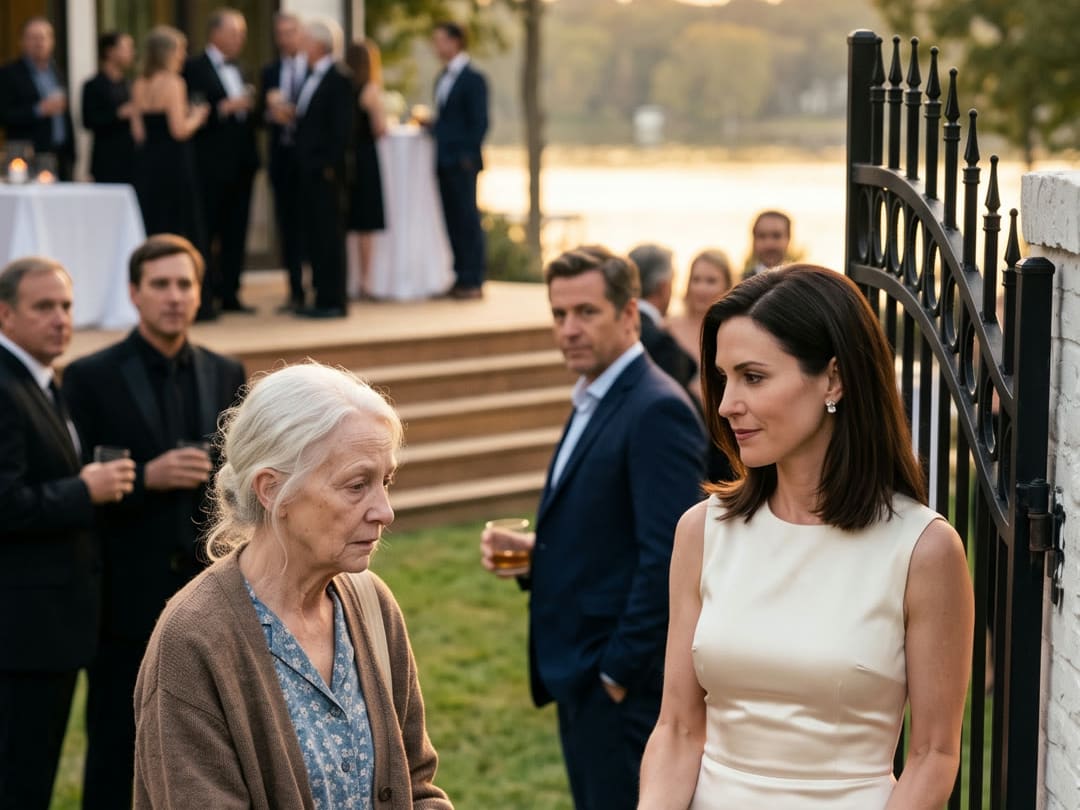
There’s a black iron garden gate in the stone wall there.
I came in through the garden gate.
The lawn was full of people in black.
String lights zigzagged over the grass.
Candles flickered in glass lanterns on the tables.
The lake was going dark blue behind it all.
My house.
I’d paid for every blade of that grass.
I stood just inside the gate and felt like I’d walked into a stranger’s wedding.
Whitney saw me first.
She was standing by the caterer’s station in a cream satin dress, right next to the gate, a thin diamond bracelet catching the candlelight.
She didn’t say hello.
She looked at my cardigan.
Then at my shoes.
Then at the pie.
Then she reached out and took the pie right out of my hands.
For one second I thought she was going to set it on a table.
She held it over the caterer’s trash bin instead.
She looked straight at me.
And she let go.
Dish and all.
That was the thud.
She brushed her palms together, twice, like she’d touched something dusty.
“We don’t do church-bake-sale food here.”
My hands were still out in front of me, where the dish had been.
I couldn’t make them come down.
They just stayed there, palms up, like I was waiting for change.
“That was my mother’s dish,” I said.
It was the only thing I could think of to say.
The lawn had gone quiet in the way a party goes quiet, starting with the people closest and spreading out like a ripple on the lake.
A woman in pearls leaned toward Whitney.
“Who is she?”
“The help’s mother,” Whitney said.
“She’s lost.”
Somebody near the bar laughed, then stopped, unsure whether he was supposed to.
Then I found my son.
He was standing on the lawn, maybe ten steps away, with a glass of something amber in his hand.
He’d seen all of it.
I could tell by how still he was holding the glass.
He looked right at me.
For one second he was six years old again, the boy who hid behind my legs at the store when the big contractors came in.
The man next to him, a heavy man in a dark suit, nodded toward me and asked him something.
I watched my son’s eyes leave mine.
“I don’t know her.”
And he turned his back.
I didn’t fall.
I want you to know that.
I didn’t cry, and I didn’t fall.
I just felt my knees lock, the way they do on a bus when it brakes too hard.
I have been hurt in my life.
I buried my parents.
I buried my husband.
Nothing has ever gone into me as deep as those four words did.
Whitney wasn’t done.
She took a twenty-dollar bill out of her little clutch and folded it in half, then in half again.
She dropped it into my open hands.
She didn’t touch me.
She didn’t say a word.
She just pointed at the gate, toward the road where the bus stops.
So she’d seen me walk up the hill.
Two of her friends laughed out loud behind their hands, the way people laugh when they want you to hear it.
I looked down at the little green square in my palm.
Then I closed my fingers around it.
I don’t know why.
Forty years at a register, maybe.
You don’t leave money lying on a counter.
I stood there with her twenty in my hand.
That’s when Lily came running down the deck steps.
Yellow dress.
Braids flying.
White sneakers slapping the wood, one hand sliding down the railing the way I taught her.
People stepped out of her way and smiled at her the way people smile at children at parties.
She grabbed my other hand and looked up at me with the biggest smile.
“Grandma! Daddy said this is your house!”