Chapter 1: The Rope Toy in the Mud
The kennel yard at Fort Halden smelled like wet gravel, dog food and bleach.
It was ten to nine on a grey Tuesday in October, cold enough that every bark came out as a cloud.
I was standing at the chain-link fence on the east side of the yard with a bucket of rinsed water bowls at my feet and my right hand in my jacket pocket.
My name is Mara Quinn. I’m 30 years old.
For three weeks, everyone on that base had believed I was the new kennel assistant.
I swept the runs. I scrubbed the bowls. I wore a plain olive work jacket and rubber boots that were never dry.
Nobody asked me anything, and I answered nothing.
That was the job.
My fingers were closed around a piece of rope.
It was grey, frayed at both ends, knotted in the middle, and it had seen better decades.
I had been carrying it for four years.
It was the first toy I ever handed to a Belgian Malinois puppy named Rook.
He had been eight weeks old and the size of a loaf of bread.
He had chewed on one end of it for an hour and then fallen asleep with the other end in my hand.
I did not take it out in the yard.
I didn’t have to. Rook knew exactly where it was.
Every morning at feeding, he went still when I walked past his run.
His whole body stopped, the way a compass needle stops.
His nose pointed at my right pocket, and his eyes followed the rest of me.
Nobody else on the base had noticed.
I had been counting on that.
I looked at the dog now.
Rook was in the third run from the end, standing against the steel mesh with his chest out and his ears up.
He was a lean, fawn-colored dog with a black mask, and he was four years old and he was beautiful.
He was also, according to every file I had read, the most dangerous animal on the post.
Nine handlers had been paired with him.
All nine had quit.
The official reason in every report was the same: aggression, non-responsive to correction.
I had read those reports until I could recite them.
I did not believe a word.
Four years ago I stood on this same gravel, a captain with a notebook and a budget nobody wanted to give me.
I started the K9 program on this base from nothing.
I wrote the first handbook. I trained the first six dogs myself.
Then I took a bad turn in a truck on a range road, and my left knee came apart.
They flew me out in the dark.
I did not get to say goodbye to anybody, and I especially did not get to say it to Rook.
By the time I could walk without a cane, the program had new people.
They had a new handbook, with page after page of shouted commands and standard corrections.
They had a dog nobody could hold.
Last month the regional command called me in.
There was a folder on the desk with the program’s numbers in it: dogs washed out, handlers reassigned, money spent.
There was a question under the numbers.
Is this program worth keeping?
“We could send an inspector,” the general at that desk told me.
“They’d see the yard swept and the paperwork perfect, and they’d leave.”
“Yes, ma’am,” I said.
“You’d see what they don’t.”
She slid a second page across the desk.
It was a photocopy of a letter, no name, block capitals.
The kennel log is the only honest thing on that post. Somebody should read it.
So they gave me sealed orders and a plain work jacket.
The base commander was told that an outside evaluator would be embedded in the program for a month.
He was not told a name.
He signed the approval without asking.
His name was Colonel Haskell, and I had not looked him in the eye in three weeks.
Every morning at nine he crossed the kennel yard on his way to the kennel office.
In three weeks I had never once seen him stop for anything in it.
That morning I stood at the fence and watched the other handlers prepare for the day.
Specialist Yoon was filling a water trough. Specialist Fenn was hanging leashes on the hooks by the kennel door.
Corporal Hatch was wiping down the whiteboard where the day’s sessions were listed.
Hatch was the quiet one.
He was twenty-six, with big hands and a habit of checking the kennel log every time he walked past it.
He did it the way a man checks a bad tooth with his tongue.
He caught me looking and dropped his eyes.
Sergeant First Class Marlowe, who ran the kennels, was at a regional meeting until Thursday.
That left one man in charge of the yard.
The steel door of the kennel office banged open.
Staff Sergeant Brandt came down the steps like he was walking onto a stage.
He was thirty-three, broad through the shoulders, with a heavy jaw and hair cut to the skin.
A small black camera was clipped to the center of his chest.
It was one of my rules, from the handbook I had written.
Every handler wore one for every session. It protected the dogs and it protected the people.
I had put it on page two, in a paragraph nobody had ever tried to change.
Brandt had a short black leash in his left fist.
At the other end of it, Rook was no longer standing against the mesh.
I want to describe what Rook looked like on that leash, because the reports got it wrong.
He wasn’t snarling.
He was pulling, and it was a straining, high, desperate pull.
His mouth was open and his barks came in a rush, one on top of the next, like a dog who had been asking the same question for months and had stopped expecting an answer.
His eyes went to my pocket, and they stayed there.
“Hey, kennel girl,” Brandt called.
“Eyes down. Stay on the fence.”
That was what he called me. Kennel girl.
In three weeks he had never once used my name, and I had never once offered it.
I picked up my bucket, which was the only thing I could do.
Brandt walked toward the fence with Rook hauling at his side.
He was grinning at the yard, the way a man grins at a room he thinks belongs to him.
“Watch this,” he said to nobody.
“Nine of them couldn’t do it. I’m the only one who can hold this animal. Everybody should be taking notes.”
Yoon looked at the water trough.
Fenn looked at the leashes.
Hatch looked at the whiteboard, and his marker had stopped moving.
Brandt stopped two feet from me.
He looked at my right pocket.
Out of the corner of it, a little frayed end of grey rope was showing.
I hadn’t noticed it come loose.
I have thought about that for a long time since.
Three weeks of careful cover, and a piece of rope the length of my thumb gave it away to the one man I least wanted watching.
“What’s that?” Brandt said.
“It’s nothing, Staff Sergeant.”
“It’s something.”
His right hand moved.
It was quick, and he didn’t ask.
His fist closed around the rope and pulled it halfway out of my pocket.
My left hand came up on its own, fingers open, reaching for his wrist.
I stopped it an inch short, because the second I touched a staff sergeant in front of the whole yard, my cover was gone and so was the assessment.
His smirk widened.
It was the cold kind, with nothing in it you could call friendly.
“A dog toy,” he said, loud enough for the whole yard.
“On the kennel staff. In my yard.”
He pulled the rest of it out.
Rook went wild, a high shriek of a bark, claws scraping the gravel, his eyes fixed on the rope in Brandt’s fist.
“Staff don’t touch my dog’s gear.”
He swung his arm back and threw it.
The rope went up, over the top of the fence, and out of sight.
I heard it land.
A wet, heavy slap, the sound of something falling into mud.
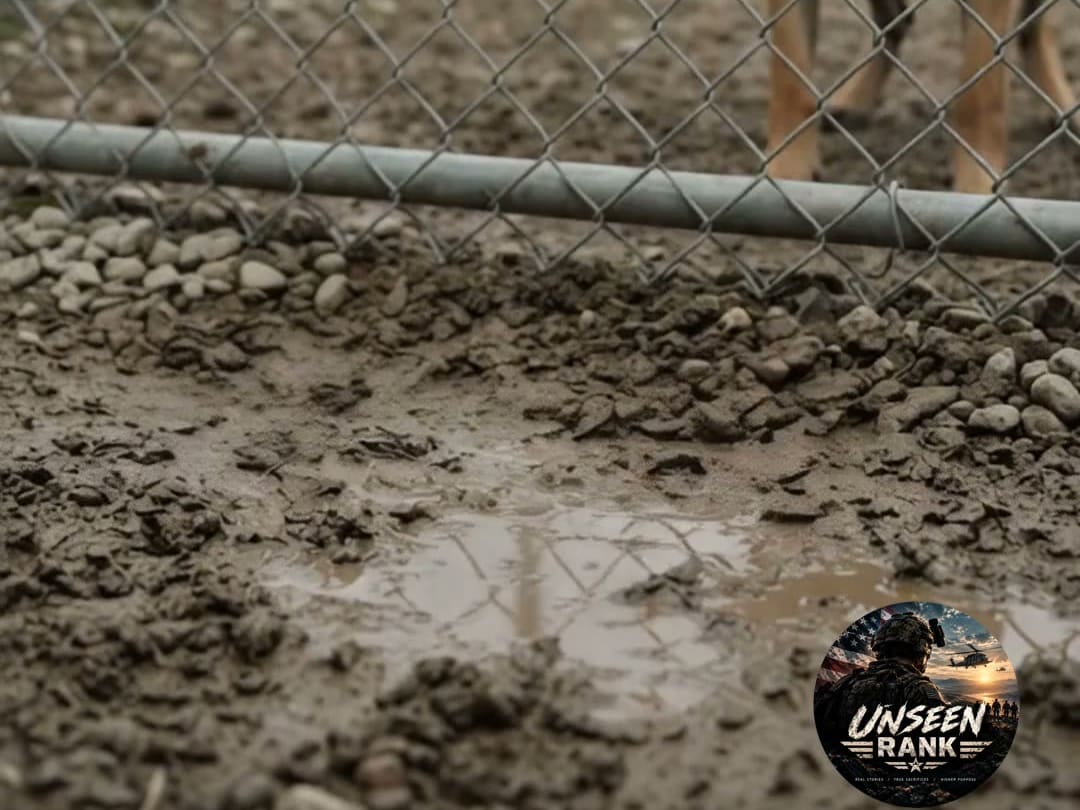
Beyond the fence was a drainage patch that never dried out.
It was brown and churned from three days of rain, with a shallow puddle in the middle the color of tea.
I turned my head.
The rope was lying in the puddle, half sunk, the loose fibers drinking up the water.
It was four years of my life, and it was also the only thing in the world that Rook believed was safe.
For a second I could not breathe.
My chest felt like somebody had stepped on it.
My hand was still held out, open, in front of me, shaking just a little, and I made myself put it down.
Brandt watched me do it.
He seemed to enjoy that.
“Don’t cry about it,” he said. “It’s a piece of string.”
Then he laughed, short and flat, and it was the first sound in that yard besides the dog.
I looked at Rook.
He had stopped barking.
I wish everybody on that base had looked at the dog just then, because Brandt didn’t.
Rook was standing completely rigid, every muscle locked, his head turned toward the fence.
His ears had gone forward and his mouth was shut.
He was looking at the mud.
He wasn’t looking at the man who’d thrown the rope, and he wasn’t looking at me.
He was looking at the thing that was his.
“Staff Sergeant,” Hatch said from the whiteboard.
His voice was thin. “He’s, uh. He’s looking at it.”
“He’s looking at nothing,” Brandt snapped.
“Marker, Hatch. Write.”
Hatch wrote.
His hand shook a little, and I saw that, and I filed it away.
Brandt leaned in close to me.
I could smell coffee and the chemical edge of the dog shampoo he liked to use for show.
“You know what the old program chief used to do?” he said, low.
“That Quinn. The founder. Whispered at the dogs, like some kind of witch. Parlor tricks. The handbook doesn’t have it anymore, and neither does this yard.”
I kept my eyes on his chest camera.
The little black rectangle. No light. No lens that I could see.
“Yes, Staff Sergeant.”
“Good. Learn the difference between a handler and a girl with a bucket.”
Then he did what he’d come out to do.
He turned to the dog.
He let the leash slide through his fist, a foot, then two, then three.
The slack paid out between us like a rope across a well.
“Show the kennel girl who’s in charge,” he told Rook.
Rook lunged.