Chapter 1
My name is Elise Dunmore.
I’m thirty-four years old, and last Saturday I was eight months pregnant.
By then I had learned how to carry a lot of weight without letting it show.
The baby was only the heaviest part.
My husband Mark turned forty that week.
He told me about his party the way you tell a stranger about the weather.
I found out about it by accident.
His phone lit up on the kitchen counter while he was in the shower.
I was cutting an apple.
I didn’t pick it up.
I didn’t have to.
The message sat there in plain sight.
“Upstairs room is ready. Can’t wait to see you there.”
It wasn’t signed.
It didn’t need to be.
The name above it was one letter long.
V. I put the knife down.
I finished the apple, because it was already cut, and because my hands needed something to do.
When Mark came out with a towel around his neck, I asked him, lightly, whether his birthday was planned.
“It’s a work thing,” he said.
He didn’t look up from the phone, which he had already turned face down.
“Where?”
“Some restaurant. Dennis’s place.”
“Can I come?”
He smiled.
It was his charming smile, the one he uses on clients.
“Babe. It’s all sales guys and their wives who pretend to like each other. You’d be bored. And your feet would hurt.”
My feet did hurt.
They had hurt since June.
I said, “Okay.”
I had been saying okay for a long time.
Mark and I have been married six years.
We were together for three before that.
For the first four years of our marriage, I worked two jobs.
I did the books for a dental office in the mornings.
At night I did tax prep for a small firm on Lincoln Avenue.
Mark was finishing his degree and then chasing the sales job he wanted.
He called it an investment in us.
I believed him.
I believed him in a studio apartment with a radiator that knocked.
When he got the job, he cried in my arms.
He said he would never forget what I did.
For the next two years, he worked late.
Very late.
Always the same excuse, and always the same name lighting up the same phone.
Vanessa.
At first she was “a coordinator from the office.”
Then she was “just a friend from the team.”
Then she was nothing, because he stopped mentioning her.
That is how I knew.
I never made a scene.
People expect a wife in my position to scream or to throw something.
I made a folder.
It was a plain blue folder from the drugstore.
I kept it in the back of the linen closet, under the baby towels.
I put things in it.
A receipt for two dinners on a Tuesday when Mark was “at the gym.”
A hotel charge from a weekend when he was “at a conference.”
A bank letter, which I didn’t understand yet.
I’ll come back to the letter.
I wasn’t planning anything.
I was only collecting, the way you collect evidence when you aren’t ready to say what it is evidence of.
Then in September, my grandmother’s house sold.
My grandmother was Ruth Hart.
She raised me in a narrow brick house in Evanston, with a lemon tree in a pot that she dragged indoors every winter.
She died the spring before I got pregnant.
She left me the house, and nobody else.
She left it to me alone.
She wrote it in her will in plain words, because she had met Mark twice and she had formed an opinion.
“Keep it for yourself, Lisey,” she told me once, holding my hand in the hospital.
“A woman should always own one door.”
The house sold for a good price.
The money went into an account in my name only.
Mark never asked about it.
He never asked about anything that was mine.
He didn’t know the account existed.
I don’t think he ever wondered what I was doing with my days.
I had been doing my own accounting, for a change.
An old friend of ours, Dennis Cole, owned a restaurant in River North, a block off the river.
The Alder Room.
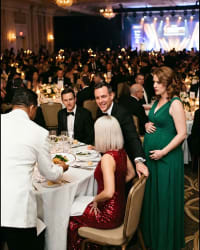
It has cream walls and tall windows and an upstairs room where the chandelier throws warm light on everyone’s face.
Dennis and his wife Carol used to feed us there for nothing when Mark and I were broke.
Four years ago, Carol got sick.
I did Dennis’s books for free for eleven months, because someone had to, and because he was drowning.
Carol died last winter.
Dennis stopped sleeping.
He had been trying to sell the Alder Room for a year.
Nobody wanted to buy a restaurant from a man who couldn’t stop crying in the walk-in.
Mark didn’t care.
All Mark knew was that Dennis let him book the upstairs room for client dinners and never sent a bill.
Mark called it “Dennis’s place,” and it was the same to him as calling it his own.
In October, I sat across from Dennis at a quiet corner table, after closing.
The chairs were up on the other tables.
One candle was still lit.
“Dennis,” I said.
“Would you sell it to me?”
He looked at me for a long time.
His hands shook on the tablecloth.
“Lisey,” he said.
“Why would you want it?”
“Because I know what it’s worth,” I said.
“And because I know what it cost you.”
He wept a little.
Then he said yes.
The papers were signed through a company called Hart Street Holdings.
My maiden name, on a street I made up for the paperwork.
Mark never saw one page.
Mark never asked.
Last Friday, he paid the deposit for his birthday party.
Four thousand dollars, from the joint account.
He paid it to a restaurant he believed belonged to his friend.
Saturday night, I put on my navy dress.
It was the only good dress that still fit me.
I looked at myself in the hallway mirror for a long time.
I took the brass key ring out of my dresser drawer, the one Dennis had put in my palm with both hands, as if it were something that could break.
One old key.
A little cream paper tag, blank.
I held it so tightly the teeth left a mark.
I did not know what I was going to do.
I knew only that I was done being told where to sit.
I took a cab downtown, because Mark had taken the car.
The driver asked if I was having a baby tonight, and I laughed.
It surprised both of us.
“Not tonight,” I said.
“Maybe next week.”
“Boy or girl?”
“Girl.”
“That’s the best kind,” he said.
“Mine ran my whole life, and I’m grateful.”
I thought about that all the way down Michigan Avenue.
The Alder Room sits on a quiet corner, with a green awning and a brass handrail on the steps.
I had walked up those steps a hundred times.
I had never walked up them as the owner.
I had visited twice since the signing, on weekday mornings, when Mark was at work.
The first time, I met the staff.
Lucas Ferrante, the general manager, stood in the dining room with his hands folded behind his back.
He was forty-eight, tall, quiet, with graying hair cut very close.
“Ms. Hart,” he said.
“I’m glad Dennis found someone who cares.”
“I don’t know much about restaurants,” I said.
“You know about numbers,” he said.
“That’s what keeps a restaurant alive. The rest I can teach.”
I liked him at once.
I asked him to keep my name off the staff list for a month.
I told him it was a family matter.
He didn’t ask what kind.
He only nodded.
“Then you’re a consultant,” he said.
“Until you tell me otherwise.”
That was the arrangement.
A consultant, with a key ring.
At the bottom of the steps, I stopped.
My hand was on the brass rail, and my back was one long ache.
Above me, through the tall windows of the upstairs room, I could see the chandelier.
I could hear a muffled wave of laughter.
I thought about the blue folder in my linen closet.
I thought about the bank letter.
It had arrived in August, addressed to me.
It said that my home equity line of credit, for one hundred eighty thousand dollars, had been approved and funded.
I had never applied for a loan.
I had stood in the hallway holding the letter with both hands.
Mark was in the next room, watching a game.
I checked the date.
I checked the signature at the bottom of the application.
It said Elise Dunmore.
It looked like mine.
It had my slanted E and the little hook on the last e.
But I had never signed it.
The house was mine.
My grandmother’s gift to me, two years before she died, deeded to me alone.
It was the only reason a bank would lend against it.
Mark knew that.
He had signed my name to borrow against my home, and then he had spent it.
I called the bank from the car, the next morning, and the woman on the phone asked if I would like to dispute the signature.
I sat very still.
“Can I think about that?”
I asked.
“Of course,” she said.
“But the sooner you tell us, the better.”
I told her I would call back.
I hadn’t, yet.
Because here is what I understood in that parked car.
If I called the bank that day, Mark would be warned.
He would lie.
He would cry.
He would say it was a mistake, he would fix it, he would never do it again.
He would be sorry in the way a man is sorry when he gets caught.
I wanted him to be sorry in a different way.
I wanted him to be sorry in front of the people he performed for.
So I found a lawyer instead.
Walter Brandt, in a small office above a dry cleaner on Clark Street.
Walter is fifty-three, with reading glasses on a cord and a voice like warm gravel.
He listened without interrupting, and when I finished, he took off his glasses and rubbed his eyes.
“Mrs. Dunmore,” he said.
“I want you to understand something.”
“Yes.”
“What he did is a felony. Forgery of a loan application. The bank will treat it seriously the moment you say the word.”
“I know.”
“And you want to wait.”
“For one day,” I said.
“Mark’s birthday is in three weeks. I think he’ll want an audience.”
Walter put his glasses back on.
“What do you need from me?”
“Be nearby,” I said.
“Bring the documents. And please don’t let me lose my temper.”
“You’re the calmest client I’ve ever had,” Walter said.
“I’m not calm,” I said.
“I’m saving it.”
He was quiet for a moment.
“Then I’ll be at the foot of the stairs,” he said.
“With a folder.”
That was the plan.
It was not a good plan.
I didn’t know yet what Mark’s face would look like, and it didn’t occur to me that he would be cruel in front of everyone.
I had only prepared for the quiet version of that night.
I climbed the green stairs of the Alder Room one at a time, one hand on the rail, one hand on my belly.
My daughter kicked, once, hard, under my ribs.
“I know,” I whispered to her.
“Me too.”
Behind me, on the street, a car door shut.
I didn’t turn around.
I went up.