Chapter 1
The message came up on Mark’s laptop on a Tuesday night, two weeks before the dinner, while he was in the shower.
The laptop was open on the kitchen island next to a bowl of clementines.
I reached past it for one, and the screen woke under my wrist.
A gray box slid into the corner.
Jenna: “Can’t wait to sit next to you on the big night.”
Behind it, in the window he’d left open, was an expense report.
One line was highlighted in blue.
“Client dinner, The Wexley, 2 guests, $412.”
The date was the Thursday he’d texted me at eleven at night: “Still at the office. Don’t wait up.”
I stood there with the clementine in my hand.
The baby kicked, low and hard, like she’d heard it too.
Upstairs, the water kept running through the old pipes.
I took a picture of the screen with my phone.
I don’t know why.
My hands did it before the rest of me had decided anything.
Then I put the clementine back in the bowl, went upstairs, and got into bed with a book.
When Mark came out of the bathroom in a cloud of steam, I was on the same page I’d been on for three nights.
“Long day,” he said.
“I bet,” I said.
I told myself it meant nothing.
People sit next to each other at dinners.
Coworkers get excited.
A client dinner is a client dinner.
I told myself that for two weeks.
I’m good at not saying things.
By then I’d been not saying one very big thing for eight years.
My father is Robert Lane.
He runs Kessmore Logistics, the company Mark has worked for since before I met him.
Nine thousand employees.
Trucks with a blue K on the side on every highway between Milwaukee and Denver.
A headquarters tower in Chicago I’d walked through maybe twice in my adult life.
I grew up as “Rob Lane’s daughter.”
Teachers were extra nice to me.
Boys were extra nice to me.
My first boss promoted me after four months, and I found out later he’d played golf with my father the weekend before.
I never knew which kindness was mine.
So when I met Mark at a friend’s birthday party in Milwaukee, at twenty-six, and he told me on our third date that he worked in Kessmore’s Milwaukee office, I went home and sat on my kitchen floor for an hour.
Then I called my father.
“He doesn’t know who you are,” I said.
“I don’t want him to. Whatever he gets there, he gets on his own.”
The line was quiet for a long time.
I could hear the clock in my parents’ kitchen, the one shaped like a sunflower.
“Not a push, not a nudge,” he said finally.
“You have my word, Em.”
He kept it for eight years.
Mark and I were married six years ago, in my parents’ backyard in Evanston.
My mother strung lights through the maple tree.
My father insisted on grilling, in an apron with “ROB” in iron-on letters, because he’d sat through too many corporate weddings to want one.
Mark shook his hand over the grill and called him Rob.
Somebody’s uncle mentioned that Rob had been in banking, which was true, thirty years earlier.
Mark decided my father was a retired banker who liked burgers.
I let him.
I didn’t want Mark’s career to be a favor.
I wanted it to be his.
So I used my married name, I never came to the office, and I never once said the word Kessmore in front of my father when Mark was in the room.
It wasn’t hard.
Mark met my father maybe six times after the wedding.
Two Christmases.
A Fourth of July.
My mother’s funeral three years ago, where Mark stayed an hour and took calls in the parking lot.
My father grew his beard after that funeral, silver and trimmed close, and stopped looking like the man in our wedding pictures.
Kessmore is private, and he hates cameras.
His letters to employees go out on paper, signed in blue ink, no photo.
Once, at dinner, Mark tossed one of those letters onto our table with the mail.
“Funny,” he said.
“Our CEO’s a Lane too. Robert Lane.”
My fork stopped halfway to my mouth.
“It’s a common name,” I said.
Mark laughed.
“Trust me, babe. Your dad doesn’t run anything bigger than a Weber.”
I laughed too.
I’ve thought about that laugh a lot since.
This year Mark worked late.
A lot.
He said it was the promotion.
Vice president for the Midwest region.
The award would be announced at the company’s annual dinner in Chicago, in front of every senior leader in the company.
He told me in July, in the parking lot outside my doctor’s office, after the ultrasound where we found out she was a girl.
I cried in the car.
Happy crying, both hands over my face, the printout of her profile on my lap.
My father called me that night.
The promotion committee had just sent him the name.
“He did it himself, Em,” he said.
His voice had gone thick.
“Nobody touched it. I didn’t see a page of that file until it was done.”
That was the night I almost told Mark everything.
I didn’t.
I wanted him to have his big night first.
I had it planned: the drive home after the dinner, my hand on his knee, “So. About Rob.”
Mark’s only real rival for the job was a senior director named Dana Whitfield.
Twenty-two years at Kessmore.
“Dana’s sweet,” Mark said, the way he says it about waitresses.
“They stuck her with the dinner committee this year. Centerpieces and seating charts. That tells you where she’s headed.”
The night of the dinner, I wore the green gown I’d bought for it.
Emerald, soft, with room for the baby.
I’d had it taken out twice.
Mark had gone down to Chicago two days early for the leadership sessions.
I took the afternoon train by myself, one hand on my belly the whole way, watching the lake go gray outside the window.
My father texted me at four.
“I’ll look for you from the stage. Wave if you can.”
The Ardley Hotel’s lobby was all marble and echo, with a chandelier the size of a car and a string quartet tucked behind a potted palm.
Mark met me in the hotel lobby by the elevators.
Black tuxedo, his good silver watch.
He didn’t kiss me.
He looked me up and down, slowly, the way you look at a couch you’re not sure will fit through the door.
“You look… big,” he said.
I waited for the smile that would turn it into a joke.
It didn’t come.
He was already checking his phone, thumb moving fast.
“We’re at the head table,” he said, not looking up.
“If you get tired, just slip out. Don’t make it a thing.”
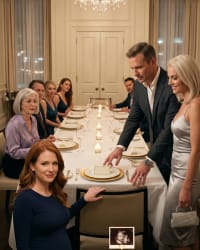
The ballroom was dark gold and full of the sound of two hundred people in black tie talking at once.
Round tables in white cloth.
Candles in glass.
At the far end, a lit stage with a wooden podium, a microphone, and a glass award on a stand that caught every light in the room.
The head table sat on a low riser in the middle of the floor, so the whole room could watch the nominees’ faces when the name was read.
The head table had our names on little cards.
Each one was printed in neat black type.
Except mine.
“Emily Carter” was handwritten in blue ink, on a card a shade whiter than the others.
Mark saw it the same moment I did.
His jaw tightened, just once, like he was biting down on something.
Then he smiled at the people already seated, and I sat down, and I decided I had imagined it.
A woman across the table caught my eye.
Fifties, short gray hair, a navy dress, reading glasses on a beaded chain.
“Dana,” she said, reaching across the candles to shake my hand.
“You must be Emily. When are you due?”
“December.”
“Good month,” she said.
“Mine was a December baby. He’s twenty-four now and still can’t find his own socks.”
I laughed, a real laugh, my first of the night.
Mark didn’t look at her once.
I sat down.
My plate came.
Salmon, small roasted potatoes, a curl of something green.
I hadn’t eaten since the train.
I picked up my fork.
Then a woman in a red sequined dress walked up behind Mark and put her hand on his shoulder.
Platinum bob.
Late twenties.
Every sequin catching the candles.
She didn’t look at me.
She looked at the back of Mark’s neck like it belonged to her.
He stood up, smiling like I wasn’t there.
He waved the waiter over.
A young man in a white jacket, hardly older than a college kid, a folded towel over his arm.
“Could you take that plate, please?”
The waiter looked at me.
Then at him.
Then he lifted my plate away.
I was still holding my fork.
I set it down on the bare tablecloth very carefully, like it might break.
Mark put a hand on the back of my chair.
“Em. Up a sec.”
I stood.
I thought he needed to get past.
When you’re seven months pregnant, people are always needing to get past.
Mark pulled my chair out for her.
She sat down in it.
She crossed her legs and smoothed the red sequins over her knee.
“That’s Jenna’s seat now,” he said.
He said it to the table, not to me.
The way you’d announce a change in the schedule.
Nobody moved.
Somewhere behind me a glass touched a plate and stopped.
The string quartet in the corner kept playing something light and French that had nothing to do with anything.
I stood there with my hand on my stomach.
The baby had gone completely still.
People at the table looked at their glasses.
All of them but one.
Dana looked straight at Mark, then at me, and set her napkin down beside her plate like she was about to stand.
I put my other hand on the back of the chair.
My chair.
The gold paint was chipped under my thumb.
Mark had sat back down beside her.
He was reaching for his wine.
I looked down at him, and my eyes burned, and I made them stay open.
“Congratulations on your promotion, Mark,” I said.
My voice came out quiet and level.
I didn’t know I had that voice.
Jenna let out a little breath through her nose, almost a laugh.
Mark didn’t look up.
“Thanks,” he said.
“There’s room at nineteen. By the kitchen.”
Nineteen.
He knew the number.
The ballroom lights went down.
A spotlight came on and found the podium.
Up on the stage, the lights came on, and the CEO walked to the podium to present the award.
Silver hair.
Trimmed silver beard.
Black tuxedo, reading glasses folded in his breast pocket.
He walked a little stiffly, the way he had since his knee surgery, and he set one hand flat on the podium the way he used to set it on the kitchen counter before he said grace.
I looked at the stage.
Mark didn’t.
He was leaning toward Jenna, saying something into her hair.