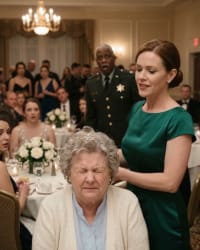
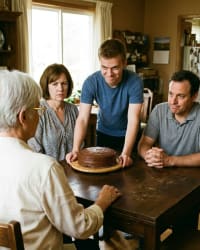
The doorbell rang as the last of them were reaching for their coats.
It was a deep, round chime, the kind that tells the whole house somebody has arrived.
Vanessa, who had not moved since the phone went dark, turned toward the hall like an animal that hears its name.
“Don’t,” she said.
It was the first word I had ever heard her say in a small voice.
“Garrett, don’t answer that.”
“Why not?” my son said.
“It’s your guest.”
I understood then.
I had been so careful, in all the time since I sat down, not to think about the plate.
A plate was a plate.
I had thought it was only spite.
But she had said it plainly, in front of everyone, in her bright carrying voice, and I had not listened.
Guest needs your seat.
She had set a place for someone, at the end of the table by the kitchen door, and she had meant to put him there.
Garrett crossed the hall.
His shoes were very loud on the marble.
I rose from my chair, and I followed him, because my knees told me to and my heart told me to, and because I wanted to see.
He opened the front door.
A man stood on the step, in a camel coat, with a bottle of wine in one hand.
He was about fifty, tall and tanned, with silver at his temples and an easy smile that came a little late.
I knew him.
I had seen him come out of the brick house on Layton Street for as long as he had owned it, which was six years.
His name was Dale Brandt.
“Garrett Mercer,” he said, and held out his hand.
“Dale. We’ve talked on the phone. I hope I’m not early, Vanessa said six.”
Garrett looked at the hand.
He did not take it.
“Come in,” he said.
“Thank you. Vanessa mentioned you wanted to go over the Layton lot. Your mother’s property. She said the family had come to a decision.”
He stepped into the hall, and he saw me.
I stood in my gray cardigan under the chandelier with my hand on the banister.
I do not know what my face did.
“Mrs. Mercer,” he said, and the smile went out of his eyes, though it stayed on his mouth.
“Mr. Brandt,” I said.
“Rose,” said Vanessa, behind us, in a thin voice.
“Rose, please.”
Nobody looked at her.
“The family has come to a decision,” Garrett repeated.
“Who told you that?”
“Why, your wife did.”
Dale’s smile was slipping now.
“She’s been a great help with the arrangements. We’ve been in touch since the spring.”
“Since the spring.”
“Mr. Mercer, is this not a good time?”
“Please finish,” my son said.
Dale Brandt looked at the bottle in his hand as if it had suddenly become heavy.
“She told me your mother was ready to sell,” he said slowly.
“That she was too much on her own, that she was getting forgetful, that there was a very nice place waiting for her at Sunrise Gardens. She said the family would take care of it.”
Garrett said nothing.
“I sent her a twelve thousand dollar deposit for the finder’s work,” Dale said.
“Two weeks ago. To a business account she gave me. I assumed you knew.”
He saw Garrett’s face then.
I watched him see it.
“I assumed,” he said again, very quietly, “that everyone knew.”
The hall was very still.
Behind me I heard the click of Vanessa’s heels, one step, then none.
“Thursday night,” said Garrett, not turning around.
“At your house, Mr. Brandt?”
Dale Brandt closed his mouth.
He is not a stupid man.
He had been a salesman for thirty years.
He knew what a door looked like when it was closing on him.
“I don’t,” he said carefully, “discuss my guests.”
“Your guest left at six in the morning,” I said.
It was out before I could stop it.
My voice was small and dry.
“She sat in her car for a long time with her head back. Then she drove away. I watched her from my front window.”
He turned to look at me.
“Mrs. Mercer,” he said, and for the first time, I think, he saw me as an actual person.
“I had no idea you were awake.”
“I am always awake,” I said.
He put the wine bottle down on the hall table, very gently, as if it might break.
“I think,” he said, “I’ll go. Mr. Mercer, I’m sorry. I was told one thing. It seems it was another.”
“You were told what she wanted you to hear.”
“Yes.”
“And you paid for it.”
“I did,” said Dale Brandt.
“I’ll be having a word with my attorney about that.”
He went out.
The door closed behind him with the same deep chime, only softer.
Nobody moved for what seemed like a long time.
Then Vanessa spoke, and what she said was not what I expected.
“I only wanted it to be easier,” she said.
She was standing in the doorway to the dining room, with one hand on the frame.
Her mascara had run a little at one corner.
“The house is too big for her,” she said.
“That whole street is going to be bought up anyway. I only wanted the family to get something out of it. I only wanted,” and her voice broke on the word, “what’s fair.”
“Fair,” Garrett said.
“For Wyatt. For our family.”
“You moved her chair,” my son said.
“What?”
“You moved my mother’s chair, three years in a row. I let you. I thought it was the draft, and the table, and Bradley’s knee. I thought you were being practical.”
He looked at me, then, and his eyes were wet.
“I never looked,” he said.
“I never once looked at where she was sitting.”
Garrett drove me home himself that night.
He said nothing for the first ten minutes.
The car smelled of leather and of the pie, which he had wrapped in foil and put on the back seat, tin and all.
It was dark, and the road wound down the hill in long slow bends.
At the second light he said, “Mom.”
“Yes.”
“I’m sorry.”
“For what?”
“All of it. For the chair. For not seeing. For letting her talk about you as though you were a, as though you were a problem to be managed.”
“I am a woman of seventy-four,” I said.
“I am sometimes a problem.”
He laughed, once, a short wet sound, and took a hand off the wheel to wipe his eyes.
“You’re not a problem,” he said.
“I’m sometimes a problem,” I said.
“But I am not confused.”
“No,” said my son.
“You’re not.”
We turned onto Layton Street at a quarter past ten.
The brick house was dark.
There was no car in front of it.
My own small house stood beside it with the porch light on, the way I leave it, and the green door looked black in the dark.
Garrett came up the walk with me, carrying the pie.
I put the key in the lock.
My hands were not quite steady, and he saw it, and he did not say anything.
My kitchen was as I had left it.
A blue cloth on the table, the radio, the kettle, Harold’s reading glasses on the windowsill where I had never moved them.
“Sit down, Garrett,” I said.
“I’ll make tea.”
He sat in his father’s chair.
I saw him notice it, and I saw him not say so.
I put the kettle on.
I took the biscuit tin down from the top of the refrigerator and set it on the table in front of him.
“What’s this?”
“Open it.”
He opened it.
There were five cream-colored envelopes, from Brandt Holdings, each with its heavy paper and its tidy typed numbers.
He read the first one.
Then the second.
He read the fourth twice.
I watched his lips move at the bottom line.
For questions, your family contact is V. Mercer.
Under it was a phone number.
He knew the number.
Of course he did.
It was his wife’s.
“How long have you had these?”
“Since March.”
“Mom. Why didn’t you tell me?”
I poured the tea.
My hand shook a little, and the cup rattled in the saucer.
“Because I wasn’t sure,” I said.
“And because she is your wife.”
He put his hand over his mouth.
“And because,” I said, “I thought if I said it, you would have to choose.”
The kettle ticked as it cooled.
A truck went by on the road beyond the Hendersons’.
“I didn’t want you to have to choose,” I said, “between me and a person you loved.”
My son put his head down on his folded arms on my blue tablecloth, as he had done at nine years old over a spelling test he could not get right.
He wept without sound.
His shoulders shook, and I sat beside him, and I put my hand between his shoulder blades.
I did not say anything.
There was nothing in all the world to say.
When he lifted his head his eyes were red, and his face was older, and there was something in it I had not seen there before.
It was not anger.
It was a sort of terrible clearness.
“I’m going to fix it,” he said.
“You can’t fix all of it.”
“I can fix what’s mine.”
“Yes,” I said.
“That I believe.”
He looked at the letters again, at the typed numbers and the cream-colored paper.
“The twelve thousand,” he said.
“She said she was paying the landscapers.”
“Garrett.”
“I read every statement,” he said, to the tablecloth.
“I read every line of every account in that house. I have never once looked at hers.”
“Because you trusted her.”
“Because I was stupid.”
“Because you were kind,” I said.
“It’s not the same thing. It only looks the same from outside.”
He drank his tea.
It was the only thing he said for some time, and the radio muttered in the corner, a man’s voice reading a weather report that did not matter.
At midnight, he rose, and kissed me on the forehead.
“I’m going to sleep in the study tonight,” he said.
“Wyatt’s with Pauline. I’ll bring him to you tomorrow, if that’s all right. After school.”
“I would like that.”
“And Mom.”
“Yes?”
“Would you come to dinner next Sunday? At your house?”
I looked at him.
“I’ll bring the food,” he said.
“I’ll bring everything. You sit wherever you like.”
“I always sit by the window,” I said.
“Then that’s where you’ll sit.”
He went out.
I heard the car start, and idle, and go.
I stood in the doorway of my kitchen, with the porch light on and the street empty, and I did not sit down by the window that night.
For the first time in four winters I went to bed, and I slept until it was light.