The telephone rang at eight on Monday morning.
I was standing at the stove with an egg in my hand.
I put the egg down and answered.
“Mrs. Mercer?”
A man’s voice, careful, polished.
“This is Dale Brandt.”
I said nothing.
“I wanted to apologize,” he said.
“I don’t generally call people before nine. I did not sleep well.”
“Neither did I,” I said, which was not true, and was the first untrue thing I had said in a week.
“Mrs. Mercer, I have withdrawn the offer on your property. All of it. I’ve written to you today, and a copy is going to your son.”
“Thank you.”
“I have also stopped payment on the deposit. My attorney says it may take some days to recover. That is my concern, not yours.”
“Mr. Brandt,” I said.
“Why are you telling me this?”
There was a pause.
“I’ve been in real estate thirty years,” he said.
“I’ve done a lot of things I’m not proud of, and I’ve always told myself it was business.”
“But?”
“But I stood in your son’s front hall last night, and a woman I’d never met told me what she’d seen from her window. And I thought, my God, she was awake the whole time.”
“I was,” I said.
“I’d like to sell the brick house, Mrs. Mercer.”
“That’s your business.”
“I’d like to sell it to someone who’ll be a good neighbor to you.”
I did not know what to say.
I looked out the window, at the brick house with its black shutters and its door.
“I’d like that,” I said.
I hung up.
I stood for a moment with my hand on the cold receiver.
That was Monday.
By Tuesday, the rest of it had begun to arrive, as the rest of it does.
Garrett called his attorney.
He called the bank.
He called the man at the firm who handles his accounts, and he sat in his study with the door closed for three days, reading every page.
He told me later what he found.
There were four deposits to a business account I had never heard of, in Vanessa’s maiden name, over eleven weeks.
The smallest was five thousand dollars.
There was a charge for a gold bracelet, in March, to a store in the city.
There were charges for dinner for two at a restaurant across the river, on three Thursdays in a row.
“I was at the office those Thursdays,” my son said, in a flat voice.
“Every one.”
I did not ask him what that meant.
I could hear that he knew.
On Wednesday, Vanessa came to the house on Layton Street.
I saw her car pull up from my front window.
The silver one, with the dent in the bumper and the green dinosaur in the back glass.
She sat in it for a long time with her hands on the wheel.
I thought she would drive away.
I think she thought so too.
Then she got out and walked up my path in her good black shoes, and knocked on my green door.
I opened it.
She stood there without her diamonds, without her bracelet, in a gray coat.
Her hair was pulled back, and I saw for the first time that she had a small scar above her eyebrow.
She looked very young, and very tired, and not at all polished.
“May I come in?” she said.
I stepped aside.
She sat at my kitchen table, in the chair across from Harold’s, and she looked at the blue tablecloth as if she had never seen one.
I made tea.
I do not know why.
It is what I do.
“I came to say I’m sorry,” she said.
“All right.”
“That’s all. I don’t expect you to say anything.”
“All right.”
She put both hands around the cup.
“I grew up in a house with a table like yours,” she said, without looking up.
“A small one, in a kitchen, with a blue cloth. My mother cleaned offices. We had a plain plate each, and one good chair.”
I said nothing.
“When I married Garrett, I swore I’d never sit at that table again. I swore I would be the person at the head of a long one.”
“I see.”
“And then I met you, and you were the table. You were everything I had run from. You sat there in your cardigan, so quiet and so content, and I could not stand it.”
She lifted her eyes.
“I wanted you out of my sight,” she said.
“I wanted you farther down the table every Sunday, until you were out of the house altogether. I wanted to forget what I came from.”
“That’s not a reason,” I said.
“No.”
“It’s a reason for being sad. It’s not a reason for what you did.”
“I know,” said Vanessa.
“I know that. I knew it when I did it.”
She drank her tea.
The cup shook in her hand.
“Garrett has asked me to leave the house,” she said.
“By the end of the month. He’s seeing an attorney. I will have Wyatt on alternate weekends.”
“That’s for the two of you.”
“I’m not asking you to speak for me.”
“I couldn’t if I wished to,” I said.
“I’m only the woman by the window.”
She laughed, a short cracked laugh, and put her hand over her eyes.
I did not touch her.
I want to be honest, here.
I could not make my hand do it.
I sat with her until the tea was cold.
When she rose to go, she stopped at the kitchen door.
“I took the sticker off,” she said.
“This morning. Wyatt asked me not to, and I did it anyway. I couldn’t look at it.”
“Put it back,” I said.
She turned.
“He put it there for you,” I said.
“For your birthday. It was a gift. It was the one honest thing in that car.”
Vanessa looked at me for a long moment.
Then she nodded, once, and went out.
I watched from the window as she got into the silver car.
She took a small green square from her coat pocket, and with careful fingers, she pressed it back against the glass.
She drove away, with her lights on, in the daytime.
The brick house sold in November, to a young couple with a baby and a very old dog.
The dog’s name is Biscuit.
He sleeps on my porch most afternoons, because it is warmer than theirs.
Dale Brandt wrote me a letter at Christmas, on cream-colored paper.
It said only, “With thanks, and in apology.”
I put it in the biscuit tin with the others, and I did not tell Garrett.
It is the one thing I have kept from my son.
I think he would forgive me.
The following Sunday, as he had promised, Garrett came to Layton Street with the food.
He brought a roast, and potatoes, and green beans in a foil pan.
Wyatt came behind him, carrying the pie, which Garrett had made himself, from my recipe, and which was a disaster.
“It’s the crust,” Garrett said.
“I can’t get the crust.”
“It’s the butter. It must be cold.”
“I put it in the freezer.”
“Then it’s the hands,” I said.
“You have your father’s hands. They run warm.”
Wyatt laughed.
It was the first time in a week.
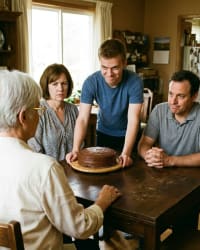
I had cleared the old kitchen table, the one with the scorched ring in the middle where Harold once set down a hot pan and swore, in front of his mother.
It is small, and square, and seats four if nobody is particular.
I put Garrett on my left and Wyatt on my right, and I sat at the end by the window, where the light comes in.
Nobody pointed.
Nobody explained.
I had set out three plain plates and one good chair.
“Grandma,” Wyatt said, while his father carved.
“Which one is yours?”
“This one.”
“It’s the chair by the window.”
“It always was.”
He looked at it for a while.
He is a thoughtful boy, with his father’s way of going quiet.
“It has the best draft,” he said, solemnly.
“It has the worst draft,” I said.
“I like it.”
Garrett set the carving knife down and looked at me across the little table, with my husband’s scorched ring between us.
I think he was going to say something.
I think it was a long speech, composed in the car.
He opened his mouth.
Then he only reached across and took my hand, and held it, with the roast going cold.
Wyatt looked from one of us to the other.
“Can we eat now?” he said.
“Yes,” said Garrett, and his voice shook.
“Yes. Let’s eat.”
We ate.
The window was open a little, and the evening came in with the smell of wet leaves.
A light went on in the brick house next door, and a baby cried, and was hushed.
I took a bite of my son’s potatoes, which were lumpy, and which were the best I had ever had.
That was a month ago.
Vanessa has Wyatt on alternate weekends, as she said, and she brings him back on Sunday evenings at six, exactly on time.
She does not come to the door.
She sits in the silver car with the green dinosaur in the back glass, and waits until he is inside.
Last week, when I was bringing in the milk, she lowered her window.
“Rose,” she said.
I stopped.
“He’s doing well, isn’t he? Wyatt?”
“He is.”
“Good,” she said.
She looked at the wheel.
“I only wanted to know.”
She raised the window and drove away, slowly, down the short street, past eleven houses, to the end.
I do not know what will become of her.
I find that I think of her more than I expected.
I do not forgive her.
I want to be plain about that.
But I have lain awake for four winters thinking about people who were never going to be sorry, and I find it a great relief to have met one who was.
Garrett brings me a dinner every Sunday now, and every Sunday it is a little less of a disaster.
Wyatt sleeps in the back room on the nights he stays, and sometimes, at three in the morning, I hear him come down the hall in his socks.
He sits on the floor beside my chair by the front window, with his blanket, and does not say anything.
We watch the street together.
The paper boy goes by on his bicycle.
The raccoon crosses the Hendersons’ lawn.
“Grandma,” he whispered once.
“Why do you stay up?”
“Habit,” I said.
“Your grandfather used to sit with me.”
“Do you miss him?”
“Every night.”
He leaned against my knee, and was quiet for a while.
“I can stay up with you,” he said.
“If you want. Until you sleep.”
I put my hand on his sandy head, and I looked at the dark, empty street, and for the first time in a long time it did not look empty.
I have thought about that Sunday more than I like.
About the plate, and the chair, and the voice that carried so well down the long table.
About the car that I knew, and the thing I said out loud, in front of everyone, when I had kept it to myself for three days.
I could have waited.
I could have taken Garrett aside after the pie, in the kitchen, and told him gently, with nobody listening.
He would have believed me, I think.
He is a good man.
But I will tell you what it is to be moved down a table, a chair at a time, for three years, in front of people.
It makes a woman want to be heard in the same room.
I am seventy-four, and I do not sleep much, and I have buried a husband and nearly lost a son.
I do not claim to know the right thing.
I only know what I did, and what came of it, and what is still sitting in the chair by the window.
Was I right to say it in front of everyone, or should I have waited and told Garrett alone?