Chapter 1
At seven-fifteen on a Tuesday morning, the overhead brass chandelier in our Oakridge Manor kitchen cast a warm glow across the white marble island.
I stood near the espresso machine in my crisp navy-blue button-down dress shirt with the sleeves rolled to my forearms and tan khaki chinos.
Today, a cancelled seven o’clock client call had brought me downstairs ten minutes earlier than my usual routine.
My wife of fourteen months, thirty-four-year-old Yvonne, stood on the far right side of the wide marble island in a fitted coral-pink silk blouse and tailored white trousers.
Her shoulder-length wavy dark brown hair was brushed neatly over her collar, and her gold charm bracelet clinked softly against the stone countertop.
In front of her sat a bright red lunchbox packed for her nine-year-old son, Lucas, overflowing with turkey-and-cheddar triangle sandwiches, fresh hulled red strawberries, and an apple juice box.
Right beside it on the left side of the marble counter sat a blue plastic lunchbox belonging to my seven-year-old son, Milo.
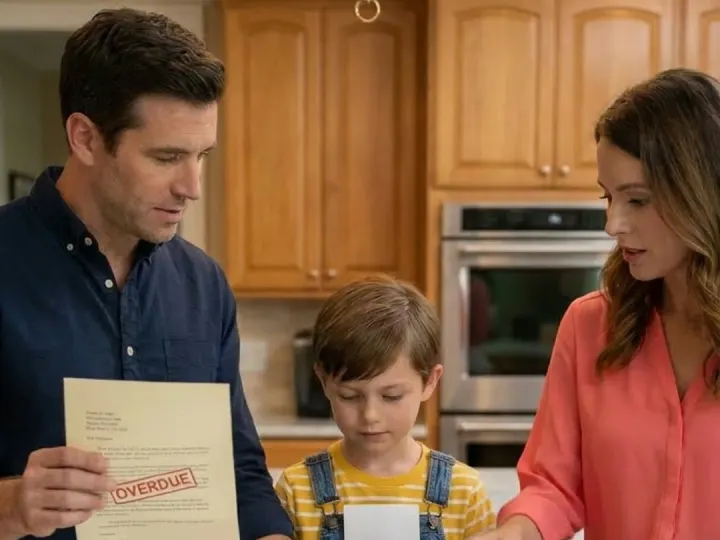
Milo stood quietly between us in the center of the kitchen in his yellow-and-white striped cotton crew-neck t-shirt and blue denim overalls.
Over the last three weeks, I had noticed Milo bolting straight to the pantry after school to eat dry saltine crackers with trembling hands.
Before picking up my car keys, I stepped up to the left side of the white marble island and snapped open the hinged lid of Milo’s blue plastic lunchbox.
Instead of sandwiches and fruit, I stared at bare, scratched blue plastic.
Milo simply kept his chin lowered and pressed his lips flat together.
I snapped my head toward Yvonne on the right side of the island and pointed my right index finger straight down at the bare plastic container.
“Why is Milo’s lunchbox empty?”
Yvonne lifted her right shoulder in a quick, dismissive shrug and tapped her manicured fingertips lightly against the rim of her son’s packed red lunchbox.
“That’s for my son. Eat at school.”
Before I could answer, Milo reached his small right hand into the front bib pocket of his blue denim overalls.
With a crisp rustle of paper, Milo pulled out an unfolded sheet of heavy cream school stationery with a bold red ink stamp and held it up toward me in both small hands.
“I’m barred from the cafeteria line.”
Yvonne’s eyes narrowed sharply at the sheet of cream paper in Milo’s hands.
Milo tilted the unfolded cream paper teacher’s note slightly higher in both small hands so I could see the red overdue stamp clearly.
“Teacher said my account’s canceled.”
My brow furrowed deeply as I reached out with my left hand and took the unfolded cream paper note from my son’s small fingers.
Two weeks ago, I had personally logged into the district portal from my office computer and deposited three hundred dollars into Milo’s cafeteria meal account.
Right below the red stamp, the printed ledger line showed that Yvonne’s linked debit card had cashed out all three hundred dollars the very next afternoon.
For nine straight school days, my seven-year-old son had been walking into his elementary school cafeteria with an empty blue plastic lunchbox and a canceled meal PIN.
When the cafeteria cashier gently told him his account had zero funds, Milo had been too embarrassed in front of his second-grade classmates to say a word to me.
I snapped my gaze up from the red-stamped paper in my left hand and locked eyes with Yvonne across the marble counter.
All the color drained from her face as she pulled her hands back from the red lunchbox and swallowed hard.
“You withdrew his three hundred dollars?”
Yvonne opened her mouth, her lips parting in silent panic as she searched for a lie that could explain away an official school ledger.
Before she could invent an excuse, Milo rested his empty small hands on the edge of the white marble island and looked up at me with a tear rolling down his cheek.
“She said food’s for her kids.”
Those six quiet words hit me harder than any physical blow I had ever taken in my life.
Every small detail from the past three weeks suddenly clicked into sickening focus, from the padlocked pantry freezer to the way Milo waited until I got home before asking for water or crackers.
Still gripping the unfolded cream paper teacher’s note in my left hand, I reached out with my right hand toward the open packed red lunchbox.
I slid the packed red lunchbox straight across the marble island until it rested directly in front of Milo under both of his small hands.
Then I locked an ice-cold, unyielding stare onto Yvonne, who stood pale and frozen on the far side of the counter.
“Pack your bags now, Yvonne.”
For two seconds, the kitchen was so silent I could hear the low hum of the stainless-steel refrigerator and the ticking of my wristwatch.
I thought back to the evening fourteen months ago when Yvonne had stood in this very room holding a glass of sparkling cider after our courthouse wedding.
Back then, she had looked me in the eye and sworn that a child who had lost his biological mother deserved twice as much warmth at the family table.
She had insisted on taking over the household debit card and the school district parent portal so I could focus on my engineering partnerships without worrying about domestic errands.
Every single week since March, she had sent me text messages at noon claiming she had just dropped off hot homemade lunches or replenished the boys’ school meal balances.
I had worked fifty-five hours a week designing commercial bridges and transferring four thousand dollars every month into our household budget, believing my son was cared for and safe.
All the while, she had been pocketing the household cash, locking the pantry shelves behind my back, and leaving a seven-year-old boy to sit in the elementary school cafeteria with an empty tray.
Even worse, she had looked my polite, soft-spoken little boy in the eye and told him the food inside his own father’s refrigerator did not belong to him.
Yvonne looked down at the red lunchbox in front of Milo, and then the frozen shock on her face twisted into sudden, desperate rage.
Instead of turning toward the stairs to pack, she lunged three feet to her right along the marble counter toward her structured beige leather designer handbag.
“You can’t throw me out of this house, Zane!” she hissed, her voice cracking as she shoved her right hand deep into the open top of her purse.
She yanked out her smartphone with such frantic force that the silk lining of her handbag caught on a folded yellow bank receipt and a thick manila envelope inside.
Both papers flew out of the handbag, fluttered over the edge of the marble island, and landed face-up on the hardwood kitchen floor right beside my shoe.
Yvonne dropped to one knee to snatch them back, her gold charm bracelet scraping loudly against the marble base.
Before her fingers could reach the paper, I stepped forward and planted the sole of my shoe firmly over the corner of the yellow bank slip.
“Don’t touch that,” I said, keeping my body positioned squarely between her and Milo.
I bent down with my right hand, picked up the yellow thermal bank receipt and the open manila lease folder, and stepped back toward the breakfast nook.
A single glance at the thermal receipt from First Midwest Bank made the blood roar in my ears.
Not only had Yvonne deposited the three-hundred-dollar school cafeteria refund into an external checking account yesterday afternoon, but right above it was a wire transfer confirmation for eighteen thousand dollars.
She had drained eighteen thousand dollars out of our joint household emergency savings account less than twenty-four hours ago.
And clipped inside the manila folder was a freshly signed twelve-month luxury apartment lease at Harborview Terrace in the name of her ex-husband, Marcus Vance, with Yvonne listed as the co-guarantor.
“You’ve been stealing Milo’s lunch money and draining our savings to pay your ex-husband’s rent?” I asked, my voice dropping to a lethal whisper.
Yvonne scrambled back to her feet, her dark brown hair wild around her flushed cheeks and her chest heaving beneath her coral-pink silk blouse.
“Marcus is my son’s father, and he needed help getting back on his feet!” she shrieked, backing toward the stainless-steel wall ovens with her phone clutched tightly in both hands.
“You make plenty of money, Zane! What difference does eighteen thousand dollars make to you, or a few lunches for a kid who barely eats anyway?”
“He is seven years old!” I said, my knuckles turning white around the bank receipt and the school note.
“You left a seven-year-old boy with an empty plastic box while you bought brioche and strawberries for Lucas and wired eighteen grand to your ex!”
Cornered and realizing she could never explain away the bank wire, Yvonne’s eyes darted toward the front foyer where her son Lucas had already gone out to catch the neighborhood carpool five minutes earlier.
Then a cold, calculating look crossed her face.
Before my eyes, she lifted her left hand, raked her own fingernails sharply down the side of her wrist until red welts appeared on her skin, and tapped three numbers into her phone screen.
She put the phone on speaker and held it up as the emergency dispatch ringtone echoed through the kitchen.
“Nine-one-one, what is the address of your emergency?” a female dispatcher’s voice came through the speaker.
“Help me, please!” Yvonne sobbed on cue, forcing a violent tremor into her voice while staring straight at me with dry, defiant eyes.
“I’m at forty-two Oakridge Drive! My husband Zane Ziegler just attacked me in the kitchen and grabbed my arm, and now he’s threatening to throw me out on the street!”
Beside me, seven-year-old Milo gasped and clutched the edges of the red lunchbox with both small hands, his eyes wide with terror at the lie she was telling.
“Stay on the line, ma’am, two patrol units are three blocks away on Oakridge Boulevard and are en route now,” the dispatcher replied briskly.
Yvonne ended the call after giving our gate code and lowered the phone, her lips curling into a bitter, triumphant sneer as she smoothed down her coral-pink silk blouse.
“By the time those officers walk through that front door,” Yvonne whispered coldly, “you’ll be in the back of a squad car under an emergency protective order.”
“And I’ll have temporary possession of this house for the next ninety days.”
She thought she had just sprung an unbeatable trap in a kitchen with no adult witnesses.
What Yvonne did not know was why the little amber status light inside the recessed smoke-and-carbon-monoxide detector directly above the brass chandelier had been blinking steadily since six-thirty that morning.