Chapter 1
The brass service elevator at the back of St. Jude Banquet Hall smelled of lemon polish, damp wool coats, and old radiator steam.
I stood in the corner of the narrow car, holding a round silver serving tray against my black waist apron while the floor numbers clicked downward from the second-story prep kitchen.
In the center of my tray sat a single steaming white porcelain bowl of Sunday fennel-and-veal ragù.
That chair belonged to Rosa Carmichael, and Rosa Carmichael had been dead for twelve years.
Yet at every family dinner, holiday table, and formal banquet Dorian hosted, a single place setting was left untouched directly to the left of his head chair.
At the center of the elevated head table sat Zelda Blackwood, Dorian’s thirty-one-year-old fiancée.
She wore a sleeveless emerald-green silk evening gown that caught the low chandelier light every time she turned her head, her dark brown hair pinned into a sleek, immaculate low updo.
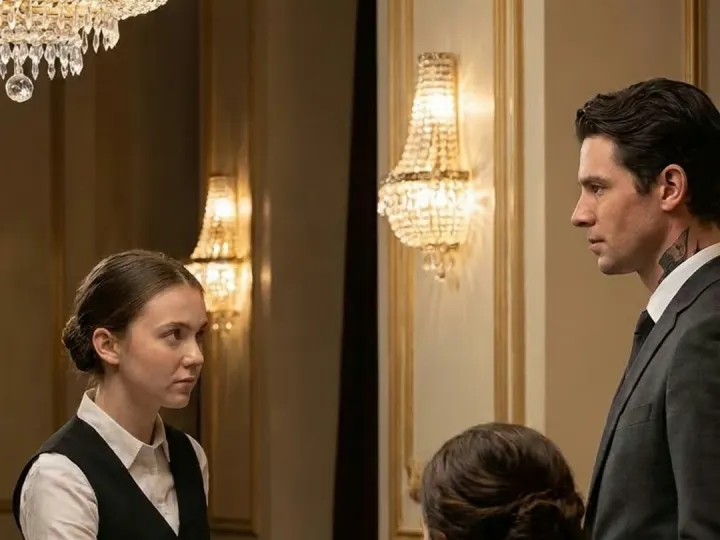
Dorian himself stood half a step behind Zelda’s chair in a tailored charcoal-grey suit jacket over a crisp white dress shirt and dark tie, listening to an older man from the harbor union.
With steady hands, I stepped up to the empty memorial chair beside Dorian’s place setting.
I lifted the steaming white porcelain bowl of red fennel-and-veal ragù from my round silver serving tray and set it gently on the white tablecloth between the silver fork and knife.
Across the corner of the table, Zelda Blackwood stopped mid-sentence.
She turned her head toward the empty memorial chair, her cold gaze dropping to the porcelain bowl and then snapping up to my fitted black server vest.
Before I could take a step back, Zelda reached her left hand across the white tablecloth.
With a sharp, sudden sweep of her arm, she shoved the steaming white porcelain bowl straight across the linen toward me.
The heavy porcelain base scraped across the cloth and clinked hard against the lowered rim of my silver serving tray,
A hush fell over the nearest three seats at the head table.
Zelda curled her left fingers against the white tablecloth and glared up at me with icy contempt.
“Take that cheap bowl away.”
Instead, I lowered the round silver serving tray against my hip with my left hand and reached out with my right hand to steady the warm white porcelain bowl on the tablecloth.
I looked straight across the table corner at Zelda and spoke in a quiet, even voice.
“His mother always salted the fennel twice.”
She snapped her left hand up, pointing a rigid finger toward the heavy oak exit doors at the rear of the banquet hall.
“You’re a temp waitress! Get out!”
Behind Zelda’s chair, Dorian Carmichael ended his conversation without a word and stepped forward to the edge of the head table.
Slowly, Dorian rested his right hand on the white tablecloth beside the memorial setting, his fingers brushing the heavy silver fork lying next to the bowl.
Without asking anyone’s permission, Dorian picked up the silver fork beside the porcelain bowl, dipped the tines into the thick red ragù, and lifted a single bite to his lips.
He tasted it once and froze completely still.
Dorian’s sharp jaw locked tight, a muscle bunching beneath the skin just above the dark tattoo at his collar.
She quickly lowered her left hand from pointing at the doors and laid her fingers lightly on the charcoal-grey wool of Dorian’s suit sleeve, forcing a brittle, defensive tone into her voice.
“The kitchen sent the wrong bowl, darling.”
He did not even glance at her hand on his arm; he simply shifted his broad shoulder half an inch away so her fingers slipped from his cuff.
Keeping the round silver serving tray pressed against my hip with my left hand, I slipped my right hand into the front pocket of my black waist apron.
In one smooth motion, I drew the card out and pressed it flat onto the white tablecloth right beside Dorian’s right hand.
I looked up into Dorian’s glistening eyes and spoke barely above a whisper.
“She gave me this before the fire.”
His right fingers trembled as they touched the brittle, charred corner of the recipe card, and when he lifted his eyes back to mine, his hard face had cracked open into raw, stunned disbelief.
“She died twelve years ago. Who are you?”
The words left Dorian’s throat in a low, gravelly whisper that made Alderman Blackwood set his champagne flute down with a sharp click.
Before I could part my lips to answer, Zelda leaned over Dorian’s shoulder and caught sight of the back edge of the card where the paper curled upward from the heat of the bowl.
In the corner of the scorched cardstock, half-veiled by gray soot and a smear of dried dough, two capital initials
and a four-digit brass locker number were written in Rosa Carmichael’s unmistakable blue ink. A.B. — 0419.
Zelda’s face drained to the color of chalk.
All the haughty composure vanished from her eyes, replaced by a flash of pure, animal panic.
“Get that trash off the linen!” Zelda shrieked, her voice cracking an octave higher than before.
Before Dorian or I could react, Zelda lunged forward out of her chair and swung her open palm against the tall silver candelabra standing between the white roses.
The heavy silver stand tipped sideways across the tablecloth, plunging three lit beeswax tapers straight toward the dry, flour-stained recipe card beneath Dorian’s hand.
At the same instant, Zelda twisted toward the two private Blackwood bodyguards stationed beside her father’s pillar.
“She stole that from our estate files!” Zelda screamed at her guards, her emerald silk bodice heaving. “Drag her out to the service alley and burn that paper!”
Hot wax splashed across the white linen an inch from my knuckles.
Dorian moved faster than any man his size had a right to move.
Instead of pulling his hand back from the falling flames, his left hand shot across the table and clamped around the burning central taper,
crushing the wick out between his bare palm and a damp linen napkin while his right hand swept the scorched recipe card safely into his breast pocket.
Then his left hand whipped up and caught Zelda’s wrist in mid-air as she reached for his lapel.
“Don’t touch my coat,” Dorian said, his baritone dropping so low and cold that the two Blackwood bodyguards halted mid-stride three feet behind me.
Zelda gasped, trying to wrench her wrist free, her eyes darting wildly toward her father down the table. “Dorian, let go of me! She’s a crazy kitchen temp trying to ruin our dinner!”
Dorian did not look at Zelda’s face.
He looked past her at his own chief of security, a grey-haired former detective named Corso who stood by the main archway with four west-side dockmen.
“Corso,” Dorian said evenly. “Drop the iron bars across the main oak doors and lock the kitchen freight elevator.”
“Right away, Mr. Carmichael,” Corso answered, already turning to bolt the double doors from the inside.
Alderman Arthur Blackwood pushed his chair back with a harsh scrape across the parquet floor, his florid face mottling purple beneath his silver hair.
“Now see here, Dorian,” the alderman barked, resting both knuckles on the table. “You don’t lock sixty guests inside a banquet hall over a waiter’s prank! Have this girl removed!”
Dorian slowly released Zelda’s wrist, reached into his charcoal suit jacket with his unburned right hand, and drew the flour-stained recipe card back out between two fingers.
He turned the card over so the soot-darkened reverse side faced Alderman Blackwood under the chandelier light.
“My mother wrote on the back of this card in blue fountain ink,” Dorian said, each word falling like a hammer on an anvil.
“She wrote the initials A.B., the number 0419, and the words upstairs gas key.”
A dead, suffocating silence dropped over the entire head table.
Alderman Blackwood’s mouth opened slightly, but no sound came out.
Dorian turned his head back toward me, his dark eyes searching my face from my neat low brown bun down to the small white crescent scar along the base of my right thumb.
“My mother never let anyone into the Halsted bakery before five in the morning except one man and his little girl,” Dorian said softly. “Thomas Ashford, the night oven man.”
My throat tightened as twelve years of hiding in another state pressed up behind my ribs.
“My father didn’t leave the oven room that morning, Mr. Carmichael,” I said clearly, my voice carrying down the length of the hushed banquet table.
“He was knocked unconscious behind the flour sacks before the gas line was opened.”
Zelda took a stumbling half-step backward against her gilded chair, knocking an empty crystal goblet onto the parquet floor where it shattered into bright shards.
“She’s lying!” Zelda cried out, her hands trembling against the front of her emerald gown. “Thomas Ashford died in the fire with Rosa because he left the main valve open! Everyone read the fire marshal’s inquest!”
“If my father left the valve open inside the bakery,” I said, reaching into my black waist apron pocket a second time and setting a heavy,
smoke-blackened brass key with the stamped numbers 0419 onto the white tablecloth beside the porcelain bowl,
“then why did Rosa push me through the cellar coal chute with the key to the upstairs banquet ledger here at St. Jude?”
The brass key gleamed dully against the snowy linen, its notched teeth darkened by the soot of a fire that had burned twelve winters ago.
Around the head table, the sixty invited guests had stopped pretending not to listen.
Violinists in the corner alcove lowered their bows, and men from the riverfront shipping council leaned forward over their plates.
Dorian stared down at the brass key stamped 0419, his broad chest rising and falling in slow, measured breaths.
When he spoke, his voice was quiet, yet every syllable carried to the farthest corners of St. Jude Banquet Hall.
“Delia,” Dorian said, my name sounding strange and heavy on his tongue after twelve years. “Little Delia Ashford.”
“Yes, Mr. Carmichael,” I answered, keeping my shoulders square in my fitted black server vest.
“The fire marshal told me your mother took you to Milwaukee two weeks before the blaze,” Dorian said, his eyes fixed on the white crescent scar on my thumb.
“You got that scar on the brass dough divider when you were ten. My mother wrapped it in a clean linen towel and gave you sweet ricotta on a crust.”
“My mother passed away from pneumonia three years before the fire,” I replied steadily. “It was just my father and me living in the two rooms above the coal cellar behind the Halsted Street ovens.”
Alderman Arthur Blackwood stepped around his chair, his heavy silver cufflinks flashing under the chandeliers as he gestured sharply to his two private bodyguards.
“Dorian, this is absurd,” Alderman Blackwood said loudly, trying to project calm authority to the watching room. “We are in the middle of an engagement celebration between our families.