Chapter 1
Harlan Norwood stared down at the gold-stamped leather spine of the territorial water-rights ledger.
For the first time since he had stomped through the mercantile doors, the swagger in his shoulders faltered.
“Where did you get a surveyor’s book?” Harlan demanded, his hand hovering above the oak counter.
“From the Territorial Land Office in Helena three days ago,” I said calmly.
I tapped the brass clasp on the ledger cover with one knuckle.
“Right after I rode the high timber ridge above Willow Creek and looked down into the box canyon on Section Twelve.”
Beside Harlan, Sybil took a nervous step closer to her husband’s elbow, her eyes darting between my face and the ledger.
“Harlan, who is this man?” she whispered sharply. “Ira claims he holds the mortgage on this store!”
Harlan squinted hard at me as I pushed my battered brown Stetson back an inch from my forehead.
The color drained out of his ruddy cheeks almost as fast as it had drained from his wife’s.
“Gallagher?” Harlan muttered, his voice dropping half an octave. “Emmett Gallagher of Broken Ridge?”
“The same,” I said.
At the front door, the two Circle N ranch hands exchanged a sudden, uneasy look.
Every working cowboy between Silver Creek and the Canadian line knew that Broken Ridge wintered four thousand head of prime Hereford cattle.
They also knew I paid top wages, employed twenty-four armed range riders, and never bluffed a man over boundary lines.
Before Harlan could snatch his folded abandonment paper back off the counter, a heavy fist pounded three times against the barred front door.
“Open this door, Ira!” a deep voice boomed from the timber porch outside. “It is Sheriff Vance!”
Harlan spun around toward the rear of the store.
“How did Vance know we were in here?” he snarled.
Ira Quimby adjusted his wire-rimmed spectacles and gestured calmly toward the open transom window in the back storeroom.
“My stock boy climbed out the alley window the second your men dropped the door bar, Mr. Norwood,” Ira said evenly. “We do not care for locked doors during business hours.”
I looked at the taller Circle N ranch hand standing beside the entrance.
“Lift that bar, son,” I told him quietly. “Before the sheriff takes a crowbar to my doorframe.”
The ranch hand did not wait for Harlan’s permission.
He hurriedly grabbed the iron-bound oak bar with both hands, lifted it out of the brackets, and pulled the double doors open.
County Sheriff Walter Vance stepped inside, his silver star pinned to a thick sheepskin coat and his hand resting on his belt.
Behind him stood Deputy Cole and two neighboring homesteaders who had heard the commotion from the blacksmith shop across the street.
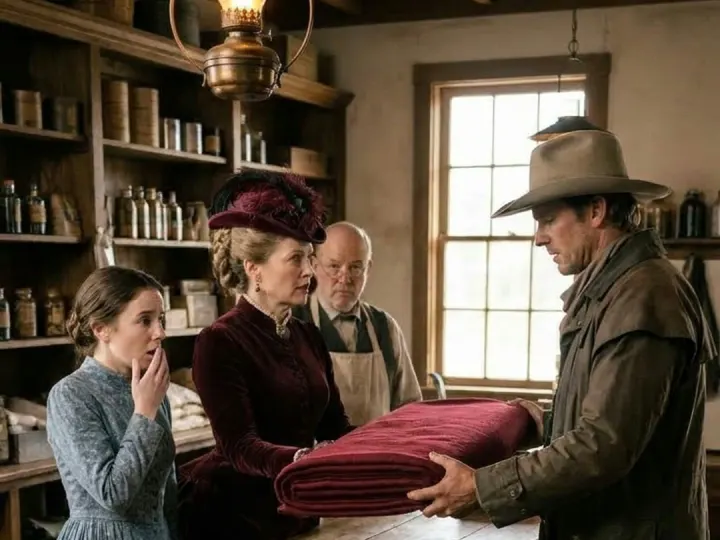
Sheriff Vance swept his gaze across the frightened townswomen, the forty-yard bolt of deep red flannel in Fern’s arms, and Harlan’s two men.
“What is the meaning of barring the mercantile doors in broad daylight, Harlan?” Sheriff Vance demanded.
Harlan tried to recover his composure, straightening his beaver-felt coat and pointing at the counter.
“This is a private civil matter, Walter,” Harlan bluffed. “The McAllister widow defaulted on her autumn ditch maintenance fee, and I came to settle the water lease.”
“That is a lie, Sheriff Vance!” Fern spoke up clearly, stepping forward with the red flannel bolt still cradled against her faded sky-blue calico dress.
“Our family has never owed a ditch fee to the Circle N,” Fern said. “Willow Creek rises on our own upper forty acres. And Mr. Norwood’s men dammed the ravine inside the canyon to starve our pasture!”
Sybil Norwood let out an indignant scoff, lifting her chin under her feathered burgundy bonnet.
“Listen to the girl rave, Sheriff,” Sybil said haughtily. “She was in here begging over flannel scraps five minutes ago, and now she accuses my husband of damming county water!”
“She is not accusing him without proof, Walter,” I said, stepping beside the sheriff at the oak counter.
Sheriff Vance turned to me, touching the brim of his hat in respect.
“Morning, Emmett,” the sheriff said. “What have you got on that counter?”
I flipped open the brass clasp of the territorial ledger and turned to the linen-backed survey map of Township Nine, Range Four.
“Last month, Clara McAllister sent word to Broken Ridge asking if I would buy her two draft mules so she could pay for winter hay,” I explained.
“That struck me as strange, because Thomas McAllister’s lower meadow always grew the thickest timothy grass in the valley.”
“Why did the grass fail this autumn?” Sheriff Vance asked, leaning over the map.
“Because the water stopped running down the south fork on October tenth,” I said, tracing the blue ink line with my forefinger.
“Harlan told everyone in town that an autumn rockslide up in the timber had choked the spring.”
“And it did!” Harlan interrupted loudly, though beads of sweat had begun to shine along his hairline. “The shale gave way after the September rains!”
“Shale does not fall in neat stacks of squared fir logs spiked together with twelve-inch iron drift pins, Harlan,” I said.
The mercantile went dead quiet again.
Even the two Circle N hands looked down at their boots, refusing to meet the sheriff’s eyes.
I reached into the side pocket of my canvas duster and pulled out a heavy twelve-inch iron drift pin still crusted with fresh pine pitch.
I set the iron spike down on the oak counter right beside my brown leather coin pouch.
“I rode up into the box canyon at dawn on Tuesday,” I told Sheriff Vance. “Thirty yards above the McAllister fence line. Someone built a six-foot timber-and-clay diversion dam across the creek bed.”
“That dam turns every gallon of spring water out of Willow Creek and sends it through a newly dug ditch straight into Harlan’s east grazing basin.”
Sheriff Vance picked up the heavy iron drift pin and weighed it in his palm.
“Wait a minute,” the sheriff said slowly, frowning at the map. “Thirty yards above the McAllister fence line is still inside the old Section Twelve homestead patent.”
“It is,” I said, turning one page forward in the ledger to a certified copy of the 1876 territorial patent.
“Thomas McAllister registered the headwaters spring and sixty yards of the upper box canyon when he proved up his claim.”
Harlan lunged half a step forward, his face purple.
“The boundary stone is at the mouth of the canyon!” Harlan shouted. “The upper thirty yards belong to the Circle N grazing lease! I have the surveyor’s receipt right here!”
Harlan snatched a folded blue paper from his vest pocket and shoved it into Sheriff Vance’s hand.
I did not even need to look at the blue paper to know what was written on it.
“Check the signature at the bottom of that receipt, Walter,” I said quietly.
Sheriff Vance unfolded the paper and held it up toward the light of the brass hanging lamp.
“Signed by Deputy Surveyor Jonas Pike, dated November third, 1882,” the sheriff read aloud.
“Now look at page forty-eight of the Surveyor General’s register,” I said, pointing to the stamped ledger entry on the oak counter.
Sheriff Vance leaned down, adjusted his collar, and read the official territorial entry out loud so every person in the store could hear.
“Deputy Surveyor Jonas Pike — commission revoked April twelfth, 1881, died in St. Louis September nineteenth, 1881.”
A collective gasp rippled from the townswomen by the flour sacks.
Ira Quimby slowly shook his head behind the counter.
Sheriff Vance lowered the blue paper and stared at Harlan Norwood with eyes as hard as flint.
“You forged a dead surveyor’s name onto a boundary receipt nineteen months after the man was buried, Harlan?” the sheriff asked.
Sybil Norwood grabbed the edge of the oak counter with both black-gloved hands, her knees visibly trembling beneath her burgundy velvet skirt.
“Harlan, tell him it is a mistake!” Sybil whispered frantically. “Tell him the clerk at the land office wrote the wrong year!”
“The clerk did not carve a fake boundary stone and drag it to the mouth of the canyon with a four-horse team, Mrs. Norwood,” I said.
I turned back to the sheriff.
“The original 1876 survey monument—a granite post chiselled with Thomas McAllister’s patent number—is still sitting in the box canyon,” I said.
“Harlan’s men piled brush and loose shale over it soFern and her mother would not spot it from the trail.”
Fern pressed a hand to her mouth above the red flannel bolt, her eyes shining with sudden tears.
“My father spent three weeks hauling that granite post up the ravine the summer I was eleven,” Fern said, her voice ringing clear across the room.
“He told me that as long as that stone stood by the spring, no cattle baron could ever drive Mother off our land.”
Sheriff Vance folded both Harlan’s fake abandonment notice and the forged blue surveyor’s receipt and slipped them into his inside coat pocket.
“Those two papers are now county evidence in a felony land-fraud investigation,” Sheriff Vance said flatly.
He looked at Harlan’s two ranch hands by the door.
“Unbuckle your gunbelts and lay those axe handles on the boardwalk, boys,” the sheriff ordered. “You are riding out to Willow Creek with Deputy Cole. And me right now to show us which one of you drove those iron pins.”
The younger ranch hand immediately unbuckled his belt and blurted out, “Mr. Norwood paid us ten dollars apiece to stack those timbers at night. Sheriff! We didn’t know the stone was inside the widow’s line!”
“Shut your mouth, Briggs!” Harlan roared, lunging toward the young rider.
Sheriff Vance stepped straight into Harlan’s path, his hand dropping to the walnut grip of his revolver.
“Take one more step, Harlan, and you will ride out to the canyon in irons,” the sheriff warned.
Harlan froze, his chest heaving beneath his beaver-felt coat while his wife stood humiliated and silent beside the bare oak counter.
I picked up my heavy brown leather coin pouch, untied the leather drawstring, and counted out four twenty-dollar gold double eagles onto the oak plank in front of Ira Quimby.
“That covers all forty yards of the deep red flannel, plus two barrels of winter flour, a sack of sugar. And four wool blankets to be delivered to the McAllister place this afternoon,” I told Ira.
“Consider it loaded on my wagon within the hour, Mr. Gallagher,” Ira said with a deep, satisfied nod.
I looked down at Fern, who was still holding the massive bolt of vivid red wool in her arms.
“Can you ride in my buckskin wagon up to the canyon with the sheriff. Miss McAllister?” I asked gently. “Your mother ought to have a McAllister standing there when that dam comes down.”
Fern lifted her chin, the fear completely gone from her freckled face.
“I wouldn’t miss it for the world, Mr. Gallagher,” she said.