By eleven o’clock that morning, a dozen riders and three buckboard wagons had gathered at the mouth of the Willow Creek box canyon.
Word had traveled down Silver Creek’s main street faster than a grass fire in August.
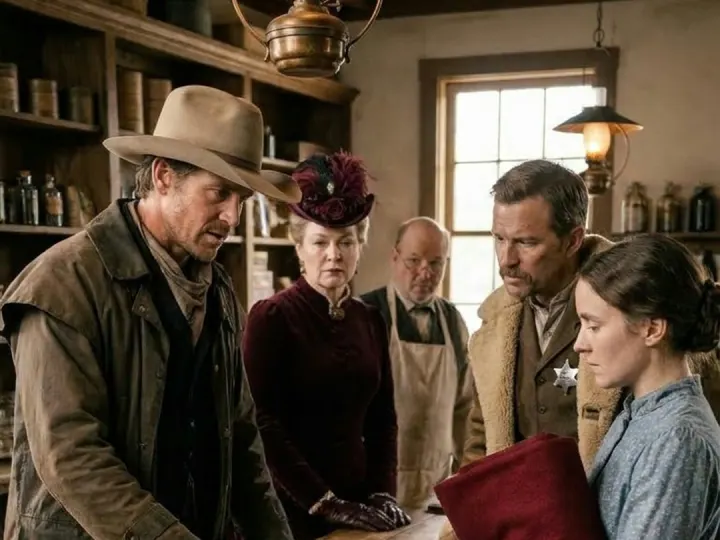
Not only had Sheriff Vance brought Deputy Cole and the two Circle N hands, but Judge Eli Pruitt.
And the county land commissioner had ridden out in a surrey to witness the inspection.
Clara McAllister was waiting for us by the lower pasture gate when Ira’s delivery wagon and my buckboard pulled up.
Clara was forty-four, wrapped in a threadbare gray wool shawl that barely kept the November wind off her shoulders.
When Fern climbed down from the wagon seat and placed the forty-yard bolt of deep red flannel into the back of their homestead cart, Clara stared in disbelief.
“Fern, child, where on earth did all this wool and flour come from?” Clara asked, her voice raspy from her winter cough.
“From a neighbor who doesn’t care for bullies, Mother,” Fern said softly, wrapping one of the new heavy wool blankets around her mother’s shoulders.
Up in the narrow stone throat of the canyon, the evidence was even plainer in the crisp midday light than it had been at dawn.
Across the rocky creek bed stood the six-foot wall of fresh-cut fir logs, packed tight with blue river clay and spiked together with iron drift pins.
Behind the dam, a deep, stagnant pool had backed up against the canyon walls.
From the northern bank, a freshly trenched ditch carried the stolen water around the ridge toward the Circle N pastures.
Below the dam, the natural bed of Willow Creek—the lifeline of the McAllister homestead—was nothing but cracked mud and dry cobblestones.
Harlan and Sybil Norwood sat stiffly in their lacquered black phaeton carriage at the edge of the trees, forced by Sheriff Vance to watch every step of the survey.
Sybil kept her feathered burgundy bonnet pulled low, refusing to look at the neighboring ranch wives who had ridden out to watch.
“Show the judge where the monument sits, Emmett,” Sheriff Vance called out.
I walked thirty paces upstream from the timber dam to a pile of dead juniper brush wedged against the canyon wall.
With two of my Broken Ridge riders lending a hand, we dragged the cut juniper branches aside and shoveled away a foot of loose shale.
There, set deep into a drilled shelf of bedrock, stood the square gray granite post.
Judge Pruitt knelt beside the stone, brushed the frost from the chiseled face with his glove, and read the carved letters aloud.
“U.S. Patent Number 4419 — Thomas McAllister — N.W. Corner, Section Twelve.”
The judge stood up, dusted his knees, and turned a cold, unforgiving stare toward Harlan’s black carriage.
“This dam sits ninety-two feet inside Widow McAllister’s legal boundary line, Harlan,” Judge Pruitt declared.
“And the diversion trench cuts across territorial timber without an easement or a water decree.”
Harlan climbed halfway down from his carriage step, his voice cracking with desperation.
“Eli, you know how dry the upper range was in September!” Harlan pleaded. “My cattle needed that water, and the widow was only running two cows!”
“Whether a landowner runs two cows or two thousand cows, the law in this territory is the same,” Judge Pruitt snapped.
“You diverted a registered homestead spring by fraud, forged a dead surveyor’s signature, and locked a nineteen-year-old girl inside a store to extort her signature.”
The judge pulled his leather court docket book from his coat and wrote rapidly with a lead pencil.
“Sheriff Vance, you will impound Mr. Norwood’s team and tools to tear down this dam before sundown,” Judge Pruitt ordered.
“Furthermore, I am issuing an immediate attachment against Circle N funds at the Silver Creek Bank for twelve hundred dollars in crop and pasture damages payable to Clara and Fern McAllister.”
From the carriage seat, Sybil Norwood let out a sharp cry of dismay.
“Twelve hundred dollars!” Sybil gasped, clutching her silver-clasped velvet reticule to her chest. “Harlan, the bank note on our town house comes due on Friday!”
Harlan sank back against the carriage wheel, his face gray and hollow.
I knew what the rest of the town was about to learn by the end of the week.
Harlan had borrowed heavily against his cattle herd in October, counting on forcing the McAllisters off their watered bottomland so he could flip the combined acreage to an eastern syndicate.
Without the Willow Creek parcel, his syndicate deal was dead.
I walked over to the timber dam where four of my Broken Ridge hands were waiting with heavy logging chains and double-bit axes.
We hooked two chains around the center king-posts of Harlan’s illegal dam and hitched the iron rings to my heavy wagon team.
“Clear the bank!” I called out, taking the leather lines in my hands.
I whistled once to my team and snapped the reins.
The big draft horses leaned into their collars, their iron shoes biting into the frozen gravel.
For a second the fir logs groaned against the clay.
Then, with a sound like a rifle shot, the center timber snapped in half and tore loose from the canyon wall.
A foaming wall of clear, icy mountain water burst through the gap, tumbling over the dry cobblestones and rushing down the natural channel toward the McAllister meadow.
Along the canyon rim, the neighboring homesteaders took off their hats and let out a cheer that echoed off the granite cliffs.
Beside the pasture gate, Clara McAllister wept openly into her hands while Fern stood tall beside her, watching the silver water fill the lower ditch.
The reckoning for the Norwoods did not end at the creek bank.
When the Helena bank learned of Judge Pruitt’s fraud attachment the following Monday, they called in Harlan’s remaining notes.
To keep her husband out of the territorial penitentiary at Deer Lodge, Sybil had to auction off her lacquered phaeton carriage.
Her silver tea service, and the three town lots she had boasted about all autumn.
Before the December snows closed the mountain passes, the Norwoods boarded the eastbound stagecoach with two trunks and left Silver Creek for good.
Two weeks before Christmas, I rode down to the lower valley with a sled load of split red fir firewood.
Smoke was curling warmly from the stone chimney of the McAllister cabin, and the frozen creek beside the barn was running deep and clear beneath the ice.
When Fern opened the cabin door, she was wearing a newly tailored winter coat made of thick, vivid deep red flannel.
Beside the hearth sat her mother Clara, her cough gone, her shoulders wrapped in a matching red flannel coat lined with warm lamb’s wool.
Stitched neatly across the worktable were six smaller red flannel jackets and four heavy quilts.
“Forty yards was far more than Mother and I could ever wear ourselves, Mr. Gallagher,” Fern said with a warm smile as she poured me a mug of hot cider.
“So we made coats for the Miller children down the road and quilts for the older ranch hands at Broken Ridge.”
That spring, Clara and Fern signed a fair five-year hay and water partnership with Broken Ridge Ranch.
Their lower meadow produced eighty tons of prime timothy hay, earning the McAllister women enough gold coin to build a new timber barn and hire two steady hands of their own.
Whenever Fern walked into Silver Creek Mercantile after that, Ira Quimby greeted her at the center of the oak counter like the finest lady in the county.
And hanging behind Ira’s desk, framed in rough oak.
Was the twelve-inch iron drift pin from Willow Creek—a quiet reminder to anyone who walked through those doors that wealth in a velvet dress means nothing next to an honest name.
Even three months after the Norwoods left the valley, folks in Silver Creek still talked about the morning the Willow Creek dam came down.
On Saturdays, when the mountain ranchers rode in for flour, salt, and winter horseshoe nails, they would stop by the oak counter just to shake Ira Quimby’s hand.
Ira had taken the old credit ledger where Harlan Norwood once kept the town merchants under his thumb and locked it away in the bottom iron safe.
In its place, we opened a fair seasonal farmers’ exchange at Silver Creek Mercantile.
Any homesteader or widow in the lower valley who needed seed oats, harness leather, or winter wool could draw against their autumn hay crop without paying loan-shark interest.
No family ever had to worry that a bad frost in October would cost them their team or their land patent.
Clara McAllister’s health returned stronger than anyone had seen since before her husband Thomas died.
With clean mountain water running full through the south fork ditch, the old orchard behind the McAllister cabin bloomed white with hardy crabapples when May came around.
Fern set up two large oak cutting tables near the south window of the cabin, where the morning sun poured straight across the floorboards.
Word had spread among the ranch wives how neatly she had tailored her mother’s deep red flannel winter coat.
Before long, women from six neighboring homesteads were bringing their bolts of calico, linen, and heavy wool to Fern to have their Sunday dresses and winter coats cut and stitched.
By mid-summer, Fern had saved enough silver dollars in her own cedar box to order a cast-iron treadle sewing machine all the way from St. Louis.
When the freight wagon delivered the crate to Silver Creek Mercantile, I helped Ira load it into the back of my buckboard so we could haul it down to the lower valley.
Fern stood on the cabin porch in a crisp new sky-blue dress—keeping her old patched calico hung neatly behind the door.
As a reminder of where she had stood that November morning.
“You didn’t have to haul this all the way from town yourself, Mr. Gallagher,” she said, her eyes bright as she ran her hand over the polished iron wheel.
“I was riding this way anyway to check the lower hay meadow, Miss McAllister,” I told her, tipping the brim of my battered brown Stetson.
And the truth was, riding down toward Willow Creek had become the best part of my week.
A frontier town takes its character from what its people refuse to tolerate when nobody powerful is watching.
That morning at the oak counter, Sybil Norwood thought a velvet dress and a purse full of gold gave her the right to strip a working girl of her dignity.
She learned the hard way that in the Montana high country, forty yards of red flannel and a quiet word backed by the truth can turn an empire of pride into dust.
When someone uses their money and status to humiliate a person who is just trying to care for their family.
Do you think stepping in publicly is the right move, or would you have handled Sybil and Harlan Norwood even harder?