Inside the locked mahogany-paneled hearing room, the two Military Police bailiffs paused between the counsel rail and the tribunal table.
Master Sergeant Garrett Cole kept one gloved hand on Major Corbin Mercer’s arm.
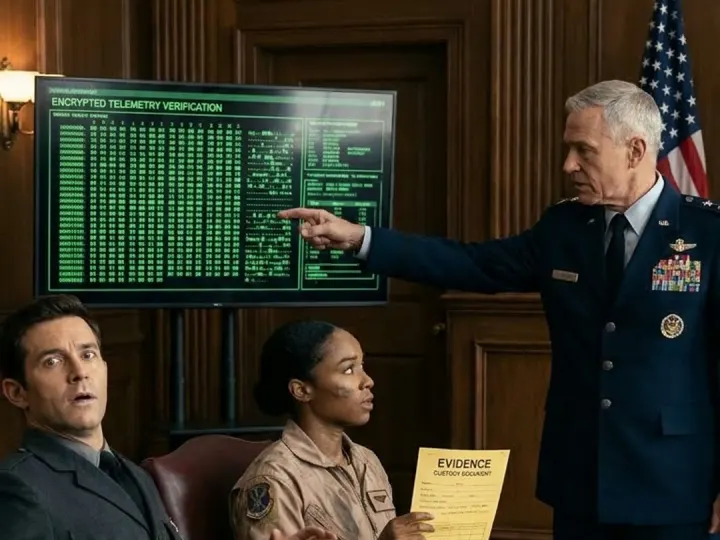
But his eyes shifted uncertainly toward Deputy Provost Colonel Alistair Sterling—the direct commander of every MP detachment at Fort Varden.
Beside his father-in-law, Major Corbin Mercer tugged his dark charcoal uniform jacket straight, sucking in a ragged breath as a desperate, vindictive gleam returned to his pale eyes.
“Tell him, Colonel!” Mercer panted, wiping a bead of cold sweat from his upper lip.
“She had fourteen months in a civilian apartment during outpatient rehab to splice my voice onto a surplus recorder! That audio is a digital fabrication!”
“You heard Major Mercer, Master Sergeant Cole,” Colonel Alistair Sterling barked, stepping up beside the bailiff and holding out his open palm toward me.
“Hand me that device so Provost technicians can take it to the laboratory for destructive testing.”
I held the scorched black tactical comms recorder firmly against the tan fabric of my desert flight suit, keeping two paces back from Colonel Sterling’s outstretched hand.
Everyone in the room knew what “destructive testing” in Colonel Sterling’s Provost laboratory meant.
Within ten minutes of leaving Hearing Room B, the scorched recorder would suffer an “accidental electromagnetic surge” during inspection, wiping the only surviving copy of the Kestrel Ridge command net forever.
“Master Sergeant Cole, if you let Colonel Sterling touch that recorder, you will be aiding the destruction of federal court-martial evidence,” I said, my voice calm, clear, and steady.
“How dare you address the Provost Sergeant when you are standing here without even a unit patch on your sleeve, Sergeant Thornton!”
Colonel Sterling roared, gesturing contemptuously at the bare frayed Velcro square on my left shoulder.
“She doesn’t have a patch on her sleeve because your son-in-law just tore it off in front of a two-star General, Colonel,” General Marcus Prescott said in a low, lethal baritone from the mahogany bench.
“Major Mercer reacted emotionally to a soldier who caused the loss of a twelve-million-dollar aircraft and then went AWOL with classified cryptography equipment!” Colonel Sterling shot back without backing down.
“Look at the official crash docket that I signed eleven months ago, General Prescott,” Colonel Sterling continued, slapping a thick blue-bound binder onto the counsel table.
“Page fourteen, Item Six: the Fort Varden Salvage Board certified under oath that the cockpit voice recorder had burned,” Colonel Sterling proclaimed.
“All tactical comms packs aboard Dustoff Six were totally consumed by a two-thousand-degree magnesium fire!”
“If everything burned on Kestrel Ridge, General, then where did Sergeant Thornton get this recorder?”
Mercer chimed in loudly, his confidence swelling behind his father-in-law’s shield.
“She bought an empty shell at a surplus store, scorched it with a blowtorch, and loaded a fake audio file onto an SD card!”
“And under Military Rule of Evidence 901, unauthenticated digital audio with a broken chain of custody is inadmissible in any military tribunal!”
Colonel Sterling concluded triumphantly, turning toward the bench. “Dismiss this hearing immediately, General, and remand Sergeant Thornton to the stockade!”
General Marcus Prescott looked down from the raised mahogany bench at me, his silver brows drawn together.
“Sergeant Thornton,” General Prescott said evenly, giving me the floor so every word would go into the permanent transcript.
“Colonel Sterling claims the Salvage Board certified this recorder destroyed, and that its chain of custody has been broken for fourteen months. Can you authenticate this hardware right now?”
“Yes, General Prescott, I can,” I answered, stepping back up to the center of the polished mahogany table.
“First, let’s address why the Fort Varden Salvage Board never found this recorder inside the wreckage of Dustoff Six,” I said, looking straight at Major Mercer and Colonel Sterling.
“Because it wasn’t mounted inside the cockpit instrument panel,” I continued.
“This is an AN/PRC-770 Crew Chief Tether Recorder,” I explained.
“It was clipped directly to my armored chest harness when I jumped back into the burning cabin to cut Lieutenant Sam Harker out of his seat straps.”
Mercer let out a loud, derisive snort. “And you expect this board to believe you hid it under your hospital pillow for ten months while the doctors treated your burns?”
“I didn’t hide it under my pillow, Major,” I replied coldly.
“When the Second Infantry ground convoy finally fought their way up Kestrel Ridge eleven hours after you abandoned us, I was unconscious from smoke inhalation and third-degree burns.”
“The trauma surgeon at the forward aid station in Bagram cut my burned flight harness off my body with trauma shears,” I said.
“He sealed everything attached to it—including this scorched recorder—inside a biohazard property bag stamped with a tungsten evidence seal.”
Colonel Alistair Sterling’s jaw tightened slightly. “A hospital property bag is not a military police chain of custody!”
“Wait until I finish, Colonel,” I said without raising my voice.
“Because that sealed trauma bag was flown with me to Landstuhl Regional Medical Center, and then transferred directly into the high-security Commander’s Vault at Brooke Army Medical Center in San Antonio.”
I reached into the zippered knee pocket of my sweat-stained tan flight suit and drew out a laminated yellow Department of the Army Form 4137.
An official Evidence Property Custody Document bearing six consecutive ink signatures and embossed hospital command seals.
“For ten months, I underwent seven skin-graft surgeries on my arms and throat surgery to repair my vocal cords,” I said, laying the yellow custody sheet before Warrant Officer Lin.
“During that entire time, the Commanding General of Brooke Army Medical Center held this recorder under continuous two-officer cryptographic lock.”
“The seal on that trauma bag was only broken forty-eight hours ago in the presence of two Army Criminal Investigation Division special agents and the Hospital Judge Advocate,” I added.
Major Corbin Mercer’s mouth opened, his eyes darting wildly to his father-in-law.
“Even—even if the bag was sealed at the hospital, anyone can fake an MP3 audio track on a voice recorder before the ambush!”
“On a civilian voice recorder, yes,” I said, turning the scorched black tactical comms unit over in my palm so the tribunal board could see the titanium serial plate riveted to the back.
“But you weren’t listening during your pre-deployment communications briefing, were you, Major Mercer?” I asked quietly.
“What are you talking about?” Mercer snapped, though a tremor returned to his voice.
“The AN/PRC-770 doesn’t record MP3 files onto a removable flash card,” I explained, my voice echoing clearly across the silent room.
“It writes raw, uneditable waveform data onto a write-once ceramic telemetry wafer paired with the National Security Agency’s Type-One Saville cryptographic algorithm.”
General Marcus Prescott leaned forward over the mahogany bench, a slow, cold look of comprehension dawning in his eyes. “The Saville combat key.”
“Yes, General,” I said. “Every time an officer keys his microphone over a tactical command net, his radio transmits a 256-bit cryptographic handshake.”
“That handshake is generated by the daily KOK-22 fill key loaded into his specific helicopter’s transponder.”
I looked straight across the half-meter gap at Major Corbin Mercer, whose face was turning a sickly shade of ash-gray.
“You cannot splice, edit, or simulate a Type-One cryptographic radio transmission without possessing the NSA master key from Fort Meade for that exact date and minute,” I told him.
“And fifteen minutes before you walked into this courtroom and ripped the medic patch off my shoulder, Major,” I said, pointing toward the court reporter’s desk.
“Warrant Officer Lin extracted the raw ceramic wafer from the back of this casing and slotted it into the tribunal’s NSA cryptographic verifier console.”
“What?!” Colonel Alistair Sterling spun toward Warrant Officer Lin’s desk, his eyes wide with sudden horror. “The casing on the table is just the secondary playback buffer?!”
“The primary ceramic wafer is sitting inside the encrypted court terminal right now, Colonel,” Warrant Officer Lin spoke up from her desk, adjusting her glasses as she looked at her monitor.
“Read the cryptographic verification readout into the record, Warrant Officer Lin,” General Prescott commanded in a voice like thunder.
“Yes, General,” Warrant Officer Lin said clearly. “Wafer Serial Number AN-770-Nine-Nine-Four-Delta. Integrity check: one hundred percent unaltered write-once ceramic matrix. Date-time stamp: 14 August, 0219 Zulu, Kestrel Valley Sector Nine.”
Major Corbin Mercer grabbed the wooden rail of the counsel table with both hands to keep his knees from buckling.
“And read the origin transponder serial number embedded in the voice packet ordering the abandonment of Dustoff Six,” I said softly.
Warrant Officer Lin tapped a single key on her terminal, and the green verification data projected onto the courtroom evidence screen on the wall behind the bench.
“Originating Radio Fill Key: Command UH-60M Tail Number 20884, Tactical Operations Seat Two, Biometric Key Token assigned to Major Corbin V. Mercer, O-4,” Warrant Officer Lin read aloud.
A collective gasp rippled through the four colonels seated on the tribunal board beside General Prescott.
“And keep reading the telemetry log for the next eleven minutes, Warrant Officer Lin,” I said, never taking my eyes off Mercer’s trembling jaw.
“Because Major Mercer didn’t just order the flight to abandon four wounded soldiers in a burning helicopter.”
“Stop the readout!” Colonel Alistair Sterling shouted, lunging toward the court reporter’s power cord before Master Sergeant Cole stepped squarely into his path with a hand on his holster.
“I object! This goes beyond the scope of the administrative board!”
“Overruled—and if you take one more step toward my court reporter, Colonel Sterling, I will have Master Sergeant Cole put you on the carpet in handcuffs!”
General Prescott roared. “Read the rest of the log, Warrant Officer!”
“At 0221 Zulu, Flight Medic Sergeant First Class Nadine Thornton keyed her emergency beacon from the burning cabin of Dustoff Six,” Warrant Officer Lin read, her voice tight with emotion.
“She transmitted: ‘Overlord Actual, I have all four casualties free of the airframe, fire is suppressed, landing zone is cold—Zero enemy fire for six minutes, request immediate hoist pickup before Lieutenant Harker bleeds out!’”
“And what was the response from Major Mercer’s radio in Command Bird 20884?” General Prescott asked in a deadly whisper.
“At 0222 Zulu, Major Mercer manually switched off the command relay repeater so the escort ship couldn’t hear Sergeant Thornton’s distress beacon,” Warrant Officer Lin read from the cryptographic log.
“And then he transmitted to Sector Headquarters: ‘Dustoff Six has suffered a secondary ammunition explosion—zero survivors on the ground, cancelling all search-and-rescue sorties until daylight.’”
The silence that followed in Hearing Room B was so absolute that you could hear the brass clock ticking on the rear wall.
The four field-grade officers on the tribunal panel stared at Major Corbin Mercer as if he were a venomous snake on the carpet.
“You turned off the relay repeater while four of your own men were bleeding in the snow two hundred feet below you,” General Marcus Prescott whispered.
Rising slowly from his chair behind the mahogany bench.
“Why did you turn off that relay, Mercer?” the General demanded, his voice rising to a roar that shook the brass lamp shades.
“If you had already pulled out, why didn’t you let the trail helicopter drop down and pick them up?!”