Chapter 1: The Two-Finger Signal on the Apron
At dawn on the Fort Overton flight line, nobody looked twice at a quiet woman in faded olive-drab coveralls hauling steel buckets of water across the concrete.
The morning mist hung low over the damp grey apron, smelling of jet fuel, wet cement, and cold steel.
I kept my head down and my shoulders squared as I walked past the yellow wheel chocks of the C-130 transport aircraft.
A smudge of dark axle grease marked my right cheek from tightening the kennel drainage valves at four in the morning.
In my left hand, the wire handle of a dented five-gallon steel bucket bit into my palm with forty pounds of icy well water.
Nobody in the Fort Overton K9 section knew my real rank, and nobody knew why my transfer orders were locked inside the installation vault.
To the young handlers on the morning shift, I was just Inez Dempsey, the thirty-seven-year-old kennel tech who scrubbed concrete runs and filled water troughs before flight call.
Thirty yards ahead of me stood the unmarked grey military cargo aircraft scheduled to carry Brigadier General Roland Pennington to Fort Belvoir at zero-six-thirty.
Beside the metal boarding stair at the open side door stood General Pennington himself, sixty-two years old, tall and lean in his dark green Army dress coat.
Rows of service ribbons sat above his breast pocket, and a single gold star gleamed on each shoulder against the pale orange band of the horizon.
Between me and the aircraft stairs stretched the pre-flight explosives sweep line.
Four young handlers in camouflage uniforms stood in a row holding taut black leather leads attached to four Belgian Malinois: Bramble, Vesper, Talos, and Kestrel.
Every one of those dogs had been raised in the concrete training bays of Fort Belvoir four years ago under my hand.
And pacing down the center of that line with a black aluminum clipboard tucked against his left hip was Staff Sergeant Keegan Strickland.
Strickland was thirty-four, broad-shouldered and thick-necked, wearing a camouflage uniform pressed so sharp the creases looked ironed with starch.
He had taken over as kennel master at Fort Overton six months ago, and he ran the flight apron like a personal kingdom.
For the past twenty minutes, I had watched him rush the four dog teams past the seven shrink-wrapped cargo pallets staged beside the aircraft ramp.
A standard pre-flight explosives and contraband sweep for a flag officer’s transport required four minutes per pallet, working upwind and downwind on a box pattern.
Strickland had pushed the handlers through all seven pallets in less than six minutes total, waving his black clipboard and barking at the men to hurry up.
In fact, he had physically pulled Corporal Mateo Reeves and the lead Malinois, Bramble, away from Pallet Four before the dog could even circle the base.
“Line up your teams on the chalk mark!” Strickland barked, checking his wrist before glancing over his shoulder toward General Pennington.
“Sir, Bramble didn’t finish the downwind corner on Pallet Four,” Corporal Reeves said quietly, his boot heels together as Bramble whined low in his throat.
“Pallet Four is sealed diplomatic communications gear signed off by Major Cross at midnight,” Strickland snapped, tapping his pen against the black clipboard.
“My signature is already on the clearance sheet, Reeves, so lock your leash and look sharp for the General,” Strickland ordered.
I stopped ten feet from the edge of the chalk line, the cold water sloshing gently against the rim of my dented steel bucket.
Under the false rubber mat at the bottom of the hydration cart back by the hangar sat my canvas field ledger.
For eleven days, I had been logging every rushed sweep, every skipped pallet, and every midnight manifest amendment signed by Staff Sergeant Strickland and Airfield Operations Officer Major Garrett Cross.
Three anonymous letters from young handlers in this unit had reached the Inspector General’s desk in Virginia last month, reporting that K9 teams were being ordered to bypass sealed cargo pallets on outbound military flights.
Because every dog at Fort Overton had graduated from the classified Anchor program I built before it was shuttered, the Directorate had sent me in under a civilian maintenance cover to observe the line firsthand.
I took two steady steps forward along the apron to set the hydration bucket near the cooldown post by Pallet Four.
As my combat boots crossed the painted yellow stripe at the edge of the staging lane, Strickland spun around.
His square jaw tightened, and his eyes narrowed as he saw my faded olive-drab coveralls and the grease smudge on my cheek within earshot of the General.
“What are you doing past the hangar line, Dempsey?” Strickland demanded, striding straight across the damp concrete toward me.
“Setting fresh water at the cooldown post for the dogs after the sweep, Sergeant,” I answered in a level, unhurried voice.
“I didn’t ask for water at the post, and I didn’t clear maintenance to walk across my apron while a flag officer is boarding,” Strickland said, his chest puffing out.
He stepped right into my personal space, smelling of heavy cologne and shoe polish, his left hand clamping the black clipboard tight against his hip.
“Sergeant, the dogs have been on the tarmac since zero-four-thirty without a drink,” I said calmly, keeping my eyes on his raised chin.
“And Pallet Four still has its downwind tarp flap unsealed from the forklift,” I added, nodding slightly toward the shrink-wrapped crate behind him.
A flicker of raw panic crossed Strickland’s eyes at the mention of Pallet Four, and it instantly soured into ugly, loudmouthed rage.
He wanted me away from those pallets before General Pennington stepped down from the boarding stair to inspect the cargo manifest.
Without a word of warning, Strickland raised his open right hand and drove the heel of his palm hard into my left shoulder.
The impact cracked against my collarbone and jolted me backward a full step toward the open concrete.
A sharp gasp tore from my throat before I could stop it as my left hand lost its grip on the wire handle.
The heavy steel bucket dropped straight down and clanged onto its side against the concrete apron.
Five gallons of icy water sheeted out across the tarmac in a wide dark wave, soaking my black combat boots and drenching the left trouser leg of my coveralls from the knee down.
Cold water dripped from the hem of my soaked coverall leg as the empty bucket rolled half a turn and rocked to a stop.
Strickland stood over the spreading puddle with his chin tilted back, a harsh, mocking snort escaping his nose so every handler on the line would hear him.
“Off my flight line, water girl,” Strickland sneered in his loud baritone voice.
The sudden crash of the steel bucket and the violent shove set off all four Belgian Malinois on the sweep line at once.
Bramble, Vesper, Talos, and Kestrel lunged forward toward me at the end of their black leather leashes, their front paws rearing off the wet concrete.
Fierce, thunderous barking echoed off the metal fuselage of the cargo plane as four sets of white teeth flashed in the grey dawn light.
Corporal Reeves and the other three handlers leaned back at a thirty-degree angle, their boots scraping on the damp apron as they strained with both hands to hold the leashes taut.
“Hold those dogs!” Strickland barked over his shoulder, though the smirk remained carved into his mouth as he watched me stand in the puddle.
“See that, Dempsey?” Strickland mocked, pointing a thick thumb toward the lunging ninety-pound dogs. “Even the dogs know you don’t belong on an active military sweep line.”
“Get your bucket and haul yourself back to the wash bay before I have the gate guards escort you off Fort Overton,” he added.
I did not bend down to pick up the dented steel bucket.
I did not step back toward the hangar, and I did not wipe the cold water from my soaked left shin.
Every muscle in my shoulders went still, and the sting in my collarbone faded behind four years of field command discipline.
Strickland thought those four dogs were barking at an intruder because they hated my coveralls.
He had no idea that high-drive Anchor dogs were trained to surge toward commotion until their primary handler gave them a stabilization cue—and he didn’t even know the cue existed.
Slowly, with the barking roaring across the concrete apron, I raised my dry right hand to shoulder height.
I held my index and middle fingers extended together, my ring and little fingers curled tight under my thumb against the grey dawn sky.
I kept my gaze locked twenty degrees past Strickland’s shoulder toward Corporal Reeves and the three straining men on the line.
“Let them see my hand,” I said in a low, icy voice that cut straight under the barking.
“What did you just say to my handlers?” Strickland snapped, his brow knotting as he half-turned his head. “Don’t nobody loosen a leash—“
Corporal Reeves didn’t loosen his leash, because he didn’t have to; he simply shifted his shoulder half an inch so Bramble had a clear sightline to my raised right hand.
All four Belgian Malinois caught the silhouette of my two extended fingers against the pale horizon.
In one firm, silent motion, I tilted my index and middle fingers forward and down forty-five degrees toward the concrete.
I did not speak a word, and I did not blow a whistle.
At the exact instant my two fingers angled down, the barking chopped off as if someone had thrown a master switch on the flight line.
All four Belgian Malinois folded their front and hind legs at the exact same heartbeat and dropped flat onto their bellies against the concrete apron.
Their chins rested flat between their front paws, their ears folded back in total, silent submission, and their dark eyes stayed locked on my right hand.
All four handlers jerked forward half a step as the black leather leashes went completely slack in their gloved hands.
Across the wide concrete expanse of the Fort Overton flight line, nothing made a sound except the distant whine of an auxiliary power unit and the wind across the wet tarmac.
Strickland’s mouth snapped shut, his head whipping from the four flat dogs back to my lowered hand.
“What the hell is that?” Strickland stammered, taking half a step sideways as his boots splashed in the spilled water. “Reeves! Why are those dogs on their bellies? Bring them to heel!”
“They won’t move on a verbal heel right now, Staff Sergeant,” Corporal Reeves whispered, staring down at the slack leather lead in his hands. “They’re locked in an override drop.”
Three meters beyond us, at the foot of the metal boarding stair, the scrape of polished leather dress shoes sounded on the concrete.
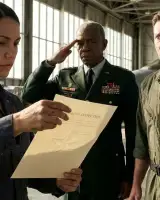
Brigadier General Roland Pennington had stopped with one hand on the stair rail, his tall frame completely motionless inside his dark green Army dress coat.
His lined, weathered face was frozen as he stared past Strickland at the four Belgian Malinois lying flat and silent on the wet apron.
I stood on the left side of the puddle with my hands empty at my sides, while Strickland stood on the right with his black clipboard still clamped in his left hand.
Slowly, General Pennington drew in a sharp, stunned breath through his teeth, his eyes still fixed on the four dogs before lifting to my face.
“That signal died with the Anchor program,” General Pennington said, his gravelly baritone carrying across the silent concrete.
Strickland blinked rapidly, looking from the General’s silver stars to my faded olive-drab coveralls. “Sir? The Anchor program? That was shut down at Fort Belvoir three years ago—“
I lowered my right hand smoothly to my side, keeping my eyes locked straight on Strickland’s paling face.
“I built the Anchor program, Sergeant,” I said.
The silence that followed my words was heavier than the steel bucket lying on the concrete.
General Pennington’s silver eyebrows rose a fraction of an inch as he studied the grease smudge on my cheek, the tight low bun of my hair, and the way I stood balanced on the balls of my feet.
“Dempsey,” General Pennington said quietly, the recognition locking into place across his stern features. “Master Sergeant Inez Dempsey. Fort Belvoir Special Kennel Directorate.”
“Reporting as ordered under Inspector General seal, General Pennington,” I replied, my voice calm and even.
General Pennington looked from the spilled water soaking my left coverall leg to the dented steel bucket on the tarmac, and then his eyes cut like cold iron to Staff Sergeant Strickland.
Strickland’s smirk was completely gone, his square jaw slackening as the blood drained out of his cheeks.
General Pennington turned his eyes back to me and gave one crisp, authoritative nod.
“Take his flight line, Master Sergeant,” General Pennington ordered.
Strickland’s chest hitched in a quiet, startled gasp, and his left fingers uncurled in shock.
The black aluminum clipboard slipped straight out of his hand and clattered flat onto the wet concrete puddle at his boots.
I didn’t look at him, and I didn’t wait for him to pick it up.
I walked straight past Strickland’s left shoulder, my soaked combat boots stepping onto the sweep line toward the four waiting dogs.