Chapter 1
The rain had been falling on Chicago since noon.
It was the kind of October rain that does not pour.
It leans on a city, patient and cold, until every window is a smear of light.
Gideon Marsh stood on the sidewalk outside the Carraway Grand with a cardboard drawing tube under his left arm.
He was forty-one years old.
He wore a tan work jacket with the cuffs gone soft, a gray sweater, and jeans he had owned for six winters.
His son stood beside him, holding two fingers of his jacket the way he had since he was three.
Caleb was seven.
He wore a red hooded sweatshirt and blue sneakers that were already soaked through.
“Is this it?”
Caleb asked.
“This is it,” Gideon said.
“It’s really big.”
“It was bigger when I drew it. It was only a piece of paper then.”
Caleb looked up at the building.
Twenty-two floors of pale stone and glass, lit from below, with a canopy of glass over the entrance like a held breath.
Gideon had not stood in this spot in eleven years.
He had told himself it was because of work.
A firm in Lisbon, then one in Denver, then the long dull years of small projects, a library, a school gym, a parking structure with a nice roofline.
That was not the real reason, and he knew it.
The real reason was a woman named Dorothea Vandermeer.
Eleven years ago she had owned four small hotels and one big dream.
She had walked into the one-room office he rented above a dry cleaner, and she had put a stack of rejected drawings on his desk.
“Three firms have told me this lobby cannot be done,” she said.
“They said it cannot be done for the money I have.”
“What do you want it to be?”
Gideon asked.
She thought about it.
She was fifty-two then, with a silver bob and a plain wool coat, and she did not waste a word.
“I want a person to walk in from the street,” she said, “and feel that someone expected them.”
He had drawn for nine months.
He had slept in that office more nights than at home.
When the lobby opened, she had found him standing at the back, in the one suit he owned, trying to be invisible.
She had put a card in his hand.
It had a single phone number on it, handwritten in blue ink.
“My private line,” she said.
“It rings on my desk and nowhere else.”
“Mrs. Vandermeer, I couldn’t.”
“One call, Mr. Marsh. That is all it ever takes. If you ever need anything, you make one call.”
He had put the card in his wallet.
He had never used it.
Then, in a rush of years, he had stopped coming around.
He stood in the rain now and felt the old shame come up through the soles of his shoes.
Two years ago her husband had died.
Leonard Vandermeer, the quiet man who had driven a red sports car to every site meeting and never once said a word about money.
Gideon had been in Denver.
He had sent flowers.
He had not gone to the funeral, because he had a deadline, because he had a child with a fever, because there is always a reason.
A card had come in the mail a few weeks later.
Three words in blue ink.
Come see it.
D. He had not answered that, either.
“Dad?”
Caleb tugged his jacket.
“Are we going in?”
Gideon looked down at the boy.
He looked at the tube under his arm.
Inside it was the original drawing, rolled tight.
It was the one he had never framed, never shown anyone, because it was too personal to be called a plan.
And folded inside the drawing, soft with age, was a paper napkin.
“Yes,” he said.
“We’re going in.”
He did not tell his son what the napkin was.
He was not sure he could have said it yet.
He pushed open the glass door, and the warm air of the lobby came out to meet them.
The first thing Gideon felt was relief.
The lobby was exactly as he had drawn it.
The floor was pale marble, polished until it held the pendant lights in long gold ribbons.
The front desk was dark wood, low and honest, with no glass wall between the staff and the guest.
And the staircase.
It rose from the center of the room in one long curve, white stone with a brass handrail, turning like a hand opening.
Caleb stopped walking.
“Dad,” he whispered.
“That’s the one you showed me.”
“That’s the one.”
“It’s even better than the picture.”
Gideon had to look away for a moment.
He pretended to check the rain on his sleeve.
Near the entrance, under the glass canopy where cars could pull in out of the weather, sat a red sports car.
It was a 1967 coupe, low and wide, the paint so deep it looked wet.
The chrome was bright.
The leather inside was the color of dark honey.
It was not parked like a car.
It was parked like a piece of sculpture.
Gideon knew it at once.
He had stood beside that car on a rainy site visit a dozen years ago, while Leonard Vandermeer, in a flat cap, wiped a raindrop off the fender with his handkerchief.
“Beautiful line, isn’t she?”
Leonard had said.
“Beautiful,” Gideon had answered.
He had meant it, more than he showed.
Now the car stood there alone, and he felt something close in his chest.
Caleb had seen it too.
“Dad, look at the car.”
“I see it.”
“Dad. Look at the side. It goes like the stairs.”
Gideon looked.
The boy was right.
The curve along the front fender and down the flank, one long unbroken line, was the same line that rose through the lobby behind them.
He had told Caleb once that he drew that stair from “something beautiful that I loved.”
He had never said what.
Caleb had worked it out in two seconds, at seven years old, in wet sneakers.
“Don’t touch it, buddy,” Gideon said softly.
“Just look.”
“I’m just looking.”
“I know.”
Caleb stepped closer.
He tilted his head.
His whole face was open with the thing that children feel when something is perfectly made.
He lifted one small hand.
Gideon saw it start, and he had time to say, “Caleb,” and not enough time to say anything else.
The boy touched the fender with the tips of two fingers.
Just once.
The way you touch a sleeping animal.
It was the gentlest thing in the room.
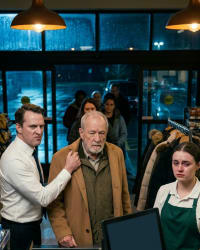
Gideon heard boots on marble.
They came fast, heavy and even, crossing the lobby in four strides, and a hand shot out and closed on the red sleeve of Caleb’s sweatshirt.
“Hey!”
Caleb gasped.
His hand flew back from the fender as if it had been burned.
The man who held him was broad and heavyset, in a black security uniform, with a buzz cut and a radio clipped to his shoulder.
He was forty-five.
He had a flushed, hard face, the face of a man who has been told all his life that rules are the only thing standing between order and a mess.
“Keep him off that car!” the guard barked.
“I was just looking at it,” Caleb said.
The words rang off the marble.
At the front desk, two guests turned around.
Gideon stepped forward.
He kept his voice low.
“I’m sorry. He only touched it with his fingers. He didn’t mean any harm.”
“I don’t care what he meant.”
The guard did not let go of the sleeve.
“That car is not a toy.”
“I understand. Would you let go of his arm, please?”
The guard looked at Gideon.
He took in the worn jacket, the tube, the soaked sneakers.
His mouth tightened.
It was not the look of a man who had made a mistake.
It was the look of a man who had just decided who he was dealing with.
“Is this your kid?” he said.
“Yes.”
“Then tell him not to touch anything again.”
Caleb had gone very still.
Gideon had seen that stillness only a few times, at the doctor’s office, once when a dog had barked in his face.
The boy was not crying.
He was holding his breath, trying to become as small as possible.
Gideon felt something hot move behind his ribs.
He put it away.
He had a long habit of putting it away.
He gently drew his son’s sleeve out of the guard’s hand and pulled the boy against his leg.
“We’ll go,” he said.
“We didn’t mean to cause any trouble.”
“You’re not going anywhere yet.”
The guard planted himself between them and the glass door, one arm out across it.
His name tag, printed on a small black plate, said BOYD.
Gideon could not read the rest.
“Sir,” Gideon said.
“Please.”
“One more incident,” Boyd said, “and I’m throwing both of you out.”