Chapter 1: The Receipt In Her Apron
The black conveyor belt held a crumpled paper grocery bag.
Jordan, eighteen and three hours into the closing shift, cleared the belt before the next customer reached the register.
The screen stayed blank until she tapped her code.
She kept the motions small and steady: scan, bag, thank, reset.
At closing, the line always seemed to grow just when she hoped it might shrink.
A man wanted to know whether the deli was still open.
A woman asked if the coat rack was part of the sale.
Jordan answered each question without looking toward the clock.
She was eighteen, and the green apron made her look younger.
The plain white badge on it carried no readable name.
Beyond the glass doors, rain shone across the parking lot.
A few cars sat under the blue light of the lamps.
Inside, the pendant above Jordan’s register cast a warm circle.
The winter coat rack stood beside the lane, crowded with dark sleeves.
One camel coat hung apart from the others, its large buttons catching light.
The store was nearly closed, but the lane still had its own small rush.
People had baskets to unload and questions they had waited until the last minute to ask.
Jordan kept the answers simple and reached for each item as it came.
She had learned that steady hands helped a line move.
They also helped her keep the rest of the store at a distance.
A thin older man came to the belt in a worn olive jacket.
The cuffs had frayed pale, and the jacket looked too light for the weather.
He glanced at the coat, then at the line behind him.
Jordan rang it up while the customers shifted their bags.
The man opened his wallet and counted the bills inside.
He counted them again, slower this time.
Then he looked at the amount on the register.
“I’m short,” he said.
Jordan kept her hand near the scanner.
“How much?”
“Thirty-one dollars.”
He folded the bills and tucked them away.
Then he touched the coat sleeve once, as if checking the fabric.
Behind him, a customer moved a basket from one hand to the other.
Someone farther back checked the time on a phone.
The older man began to lift the coat from the belt.
“You can put it back,” he said. “I shouldn’t have picked it up.”
Jordan looked at the waiting faces, then at his thin jacket.
The coat was new, knee-length, and plainly warmer than what he wore.
She knew the pressure of a line moving behind every small choice.
She also knew what it felt like to count money twice.
The man did not ask her to fix the shortfall.
He had already folded the bills away and was making room for the next customer.
Jordan could have let the coat go back to the rack.
The register would have cleared, and the line would have moved on.
Instead, she pictured the wet air beyond the doors and the worn cuffs at the man’s wrists.
“Hold on,” she said.
She reached beneath the counter for her purse.
Her fingers found her debit card, the one with the cracked corner.
She keyed in the missing thirty-one dollars as a separate payment.
The register beeped as she tapped the card against the reader.
The man watched the screen go green, then watched the receipt print.
Jordan handed him the coat and kept the receipt.
She folded it once and slipped it into her apron pocket.
“I can’t ask you to do that,” he said.
“You didn’t,” Jordan answered.
He studied her face for a moment.
“Thank you.”
She nodded, already turning toward the next customer.
The man pulled the camel coat over his olive jacket.
It sat broad across his shoulders and fell near his knees.
He walked toward the doors without looking back.
Jordan took the next grocery order.
Her hands found the rhythm again: scan, bag, thank, reset.
The woman with the basket wanted a paper receipt.
Jordan printed one and passed it across the belt.
The woman glanced toward the entrance.
“Is that manager coming over?”
Jordan looked up.
Grady was walking down the lane from the front of the store.
At thirty-eight, he wore a pressed white shirt and dark navy tie.
His short brown hair was neatly parted, his chin held high.
Jordan knew that look from closing shifts and small mistakes.
Grady had seen the coat leave the register area.
He had not seen Jordan pay for it.
The old man was only a few steps from the glass doors.
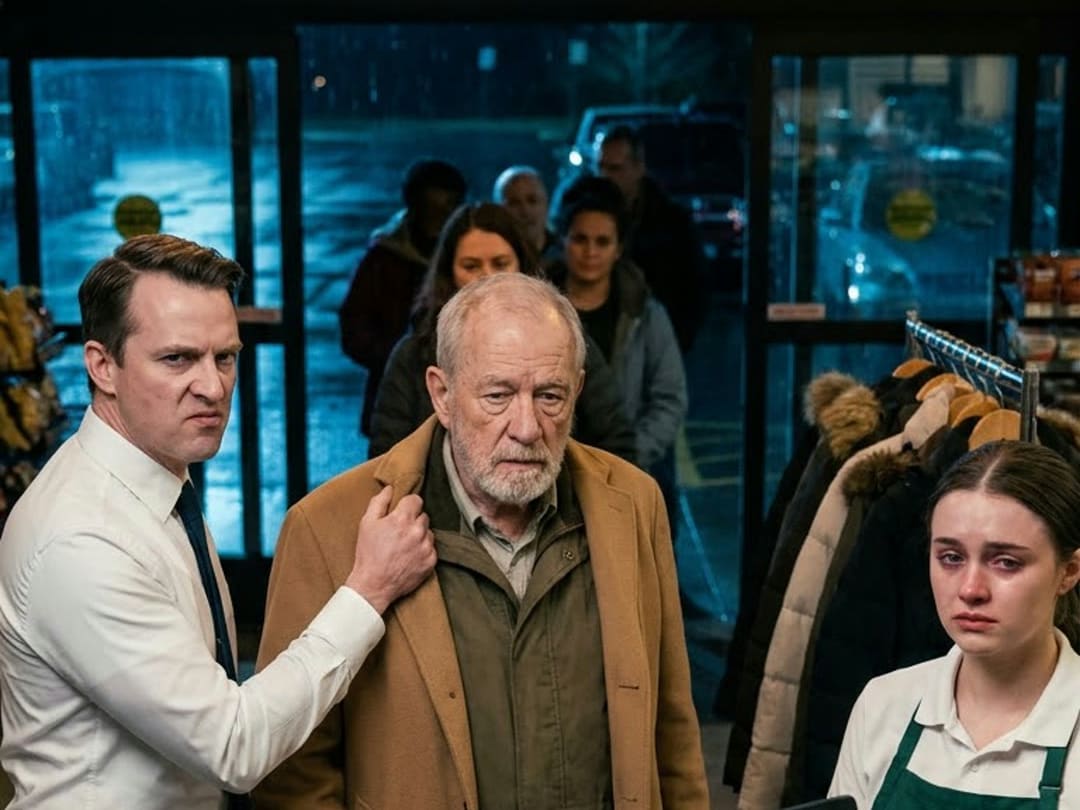
Grady reached him and grabbed the coat at the back of the collar.
The man turned, startled, his olive jacket showing beneath it.
Grady yanked the camel coat off his shoulders.
Then he flung it toward Jordan.
It struck her chest and dropped onto the black belt.
“You stole this. You’re fired.”
The line fell quiet.
Jordan stared at the coat lying between the groceries and the register.
Grady came around the belt, his mouth set in a cold sneer.
He reached for her apron and ripped off the small white badge.
The pin snapped, and he closed the badge in his fist.
Jordan’s hand pressed against the apron pocket.
The folded receipt was still there.
She pulled it out and held it up, the paper shaking slightly.
“I paid for it myself.”
The old man stepped toward the belt.
He lifted the coat with both hands and turned toward Jordan.
Then he laid it around her shoulders.
The wool settled over her apron and covered the bare place where the badge had been.
Grady’s hand lowered a few inches.
The old man looked at him.
“I’m Walter Harlow. I own this store.”
For a moment, Grady did not answer.
His jaw slackened, and his eyes moved to Walter’s face.
Walter raised his right arm and pointed toward the doors.
“Grady, you’re done. Walk out.”
Jordan stood behind the register, the coat wrapped around her.
Grady still held her badge.
He backed away, then turned for the entrance.
The doors slid open, and cold air stirred the loose papers on the belt.
Through the glass, Jordan watched him cross into the wet parking lot.
He kept walking until the doors closed behind him.
The line stayed still.
Jordan lowered the receipt, though she did not fold it yet.
Walter’s name remained in the air between them.
She looked at the coat around her shoulders, then at the bare apron.
The customers watched without speaking.
The register screen had gone dark again.
Walter did not step closer.
“What do you need right now?” he asked.
Jordan’s throat tightened before she could answer.
She pressed the receipt flat against the belt.
“I need what happened written down correctly.”
Walter nodded once.
“And I need my firing corrected.”
The words sounded smaller than the scene had felt.
Still, she had said them clearly.
“I understand,” Walter said.
Jordan glanced toward the entrance.
Grady had disappeared into the rain beyond the doors.
The customers remained in line, holding baskets and folded arms.
No one offered to explain what they had seen.
No one needed to.
They had heard the accusation, the firing, and Jordan’s answer.
Walter looked at the paper in her hand.
“May I see the receipt?”
Jordan kept it between her fingers.
The ink had begun to smudge where her thumb rested.
She read the total again, though she already knew the amount.
The coat, the tax, the card payment, and the date were printed plainly.
Nothing on it changed what Grady had done.
It did show she had paid.
She passed it to Walter.
He held the paper carefully by its edges.
His eyes moved across the lines, then stopped at the payment.
“It confirms the purchase,” he said.
Jordan watched him read.
The coat felt heavy around her shoulders, warmer than she expected.
Walter returned the receipt without folding it.
“I saw you help me,” he said. “I should have spoken before Grady acted.”
Jordan looked at the badge-shaped mark on her apron.
“You were there.”
“I was.”
“And you knew I paid.”
“I did.”
Her eyes stung again, and she blinked once.
“Then you watched him call me a thief in front of everyone.”
Walter lowered his gaze.
“Yes.”
The answer held no excuse.
Jordan gripped the receipt until its edge bent.
His name and title changed the balance in the store.
They did not remove the sound of Grady’s voice.
“I’m sorry,” Walter said.
Jordan did not answer immediately.
A customer behind the belt shifted a grocery bag onto the floor.
The paper handles had begun to tear.
Jordan reached out automatically and moved the bag closer to the register.
Then she stopped with her hand on the counter.
Her shift had been ordinary a few minutes earlier.
Now every person in line knew she had been fired.
“I don’t want to pretend it didn’t happen,” she said.
“I won’t ask you to.”
“And I don’t know if I trust you yet.”
Walter nodded again.
“You don’t have to decide that now.”
She studied his face for some sign that he wanted quick forgiveness.
His expression stayed grave.
Behind him, the framed photograph on the wall caught her eye.
It showed a younger man cutting a ribbon outside the store.
The face resembled Walter’s: same long nose, same set of the eyes.
Jordan had passed that photograph many times without noticing it.
Walter followed her gaze.
“That was the first store,” he said. “The name on the ribbon was Harlow.”
Jordan looked back at him.
She had heard the name in his introduction.
The photograph made it harder to mistake his claim.
Still, she was not ready to treat the framed picture as a solution.
“What happens to the record?” she asked.
“I’ll make sure your account is entered.”
“By you?”
“If that is what you want.”
Jordan folded the receipt along its existing crease.
She wanted the purchase recorded somewhere official.
She wanted the firing taken back in the same place where it had been announced.
She also wanted more than a quiet correction made after everyone left.
The customers had watched it happen.
They should not go home thinking she had stolen the coat.
“I want it corrected in front of them,” she said.
Walter looked toward the waiting line.
“Would you rather speak to them yourself?”
“I don’t know yet.”
“That’s all right.”
He did not tell her what she ought to say.
The coat collar rested against the back of her neck.
Jordan touched the folded receipt through her fingers.
“What about my job?”
“Grady’s order has no standing. You’re still employed.”
“That’s not the same as reversing it.”
“No,” Walter said. “It isn’t.”
She appreciated that he did not pretend otherwise.
Her badge remained in Grady’s hand, somewhere beyond the glass.
She looked down at the empty spot on the apron.
The ripped fabric had a small snag beside the pinhole.
“Do you want to move somewhere quieter?” Walter asked.
Jordan looked at the line.
The people there had waited through the whole scene.
A boy leaned against a cart, his hood pulled over his ears.
An older woman held a jar against her chest.
They were not a crowd demanding a speech.
They were simply people who had heard what happened.
“Not yet,” Jordan said.
Walter waited.
“I want to finish this conversation here.”
“All right.”
The register’s dark screen reflected a blurred version of her face.
Her lips were pressed together.
The coat made her look different, though the apron underneath was still hers.
Jordan set the receipt beside the register.
The paper lay open enough to show the purchase and payment.
“Can you record that I paid for it?” she asked.
“Yes.”
“And that he fired me before asking?”
“Yes.”
She let the silence sit for a moment.
Walter did not reach for the receipt.
Neither did the customers.
Jordan picked it up and held it again.
“Then I’ll stay until that’s done.”
Walter looked at her, careful not to make her choice for her.
“We can do it when you’re ready.”
“I’m ready to stay,” she said. “I’m not ready to call this settled.”
“That makes sense.”
She did not know if it did.
She only knew that leaving would let the accusation stand in the room without her.
The automatic doors opened for a customer coming in from the rain.
Cold air moved along the floor, then faded as the doors shut.
Jordan drew the coat closer around her shoulders.
Walter remained beside the belt, his hands at his sides.
The customers were still waiting.
Her badge was still gone.
The receipt proved the purchase, but it could not repair the public humiliation.
Her job remained hers by Walter’s word, but the correction had not yet happened.
Jordan stood at the register, holding the paper flat.
She would stay long enough to make the truth part of the record.
Whether the store would make it right in front of everyone was still unanswered.