The two Military Police sergeants—Sergeant First Class Vance Dorian and Staff Sergeant Rachel Thorne—did not hesitate for even half a second.
Both MPs stepped directly behind Major Garrett Cross and Staff Sergeant Keegan Strickland, placing their right hands squarely on the snaps of their black holsters.
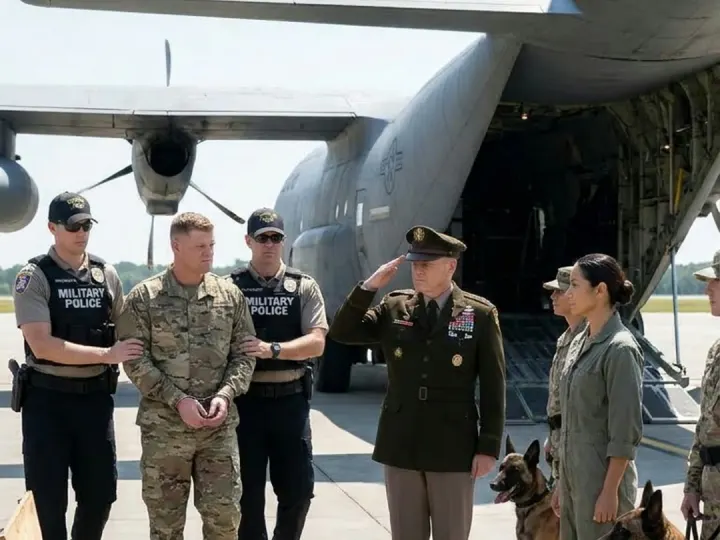
“Stand still and keep both hands where the General can see them, Sir,” Sergeant First Class Dorian said in a flat, no-nonsense baritone.
Major Cross froze with his heel half-lifted toward the utility pickup, a bead of cold sweat rolling down from his temple onto the collar of his flight jacket.
Beside him, Staff Sergeant Strickland looked as if his legs were about to fold underneath him, the wet black clipboard slipping an inch lower against his camouflage blouse.
“Corporal Reeves,” I said, keeping my eyes on the base of Pallet Four. “Go to the hydration cart by the hangar bay and bring me the canvas ledger from under the rubber mat, along with the steel pry-bar from the ramp toolkit.”
“Right away, Master Sergeant!” Corporal Reeves said, sprinting across the concrete apron at a dead run.
While Reeves ran toward the hangar, I gave Bramble a two-finger upward tap and guided him three paces back to stand beside Vesper, Talos, and Kestrel.
“Specialist Miller,” I called to the second handler on the line. “Bring Vesper up downwind and run a blind secondary verification on Pallets Four, Five, and Six.”
“Yes, Master Sergeant,” Specialist Miller answered, stepping forward with the sleek female Belgian Malinois at his left knee.
“General Pennington, you are violating Joint Logistics Chain of Custody by allowing an unscheduled dog team to hold up this ramp!” Major Cross protested, though the bluster in his voice was hollow and ragged.
“Those pallets contain delicate avionics calibration modules bound for the Mid-Atlantic depot at Fort Belvoir,” Major Cross insisted. “If you pry open the moisture seal on the tarmac in forty-degree mist, you will void two million dollars in contractor warranties!”
“Is that what is inside Pallet Four, Major Cross?” General Pennington asked, stepping close enough that the gold stars on his dress coat shoulders reflected in the Major’s sweating face. “Delicate avionics modules with contractor warranties?”
“Yes, Sir! Signed and sealed under Logistics Voucher Nine-Zero-Eight at midnight!” Major Cross stammered.
“That’s funny, Major,” I said quietly as Vesper glided past Pallet Three with her nose low to the concrete.
“Because three seconds ago, when Vesper passed Pallet Four, she locked into the exact same dead sit on the bottom wooden runner—and now she’s pulling toward Pallet Five.”
Everyone on the apron watched as the second Belgian Malinois sat motionless for three seconds at the base of Pallet Four, then rose on Specialist Miller’s silent hand cue and moved six feet left to Pallet Five.
At the base of Pallet Five, Vesper inhaled once along the bottom pine slat and dropped immediately into a second rigid, unblinking sit.
“Two independent Anchor-certified dogs, two identical primary alerts on the wooden sub-frames of Pallets Four and Five,” I announced clearly across the quiet tarmac.
Corporal Reeves arrived back at the chalk line, breathing hard as he handed me the heavy steel crowbar and my oilcloth-wrapped canvas field ledger.
“Before I put this iron bar under that wood, Staff Sergeant Strickland,” I said, walking up to stand four feet in front of the trembling kennel master, “do you want to tell General Pennington why you shoved me across the concrete when I walked near Pallet Four?”
Strickland’s lips quivered, his eyes darting frantically to Major Cross for a lifeline, but the Major was staring straight ahead at the aircraft fuselage with his jaw clenched white.
“I—I was just enforcing the clean apron rule, Master Sergeant!” Strickland babbled, his voice high and thin. “Major Cross told me at zero-four-hundred that Pallets Four and Five were high-priority command cargo and that the dogs weren’t supposed to linger near the moisture wrap!”
“Shut your mouth, Strickland!” Major Cross barked, spinning halfway toward the kennel master. “I gave you a standard scheduling brief, nothing more!”
“Oh, you gave him a lot more than a scheduling brief, Major Cross,” I said, flipping open the oilcloth cover of my field ledger and holding it up between General Pennington and Sergeant First Class Dorian.
“For the past eleven days, while I was scrubbing runs in the kennel compound and emptying trash bins behind the airfield operations shack, I pulled the carbon copies from your midnight shredder bin and cross-referenced them with the Fort Overton K9 sweep logbooks,” I said.
General Pennington took the open ledger from my hand, his silver brows drawing together as he read the columns of serial numbers, pallet weights, and handler signatures written in my neat block handwriting.
“Every Tuesday and Friday for the last four months, whenever a flag officer or priority courier flight departed Ramp Two at dawn, Staff Sergeant Strickland assigned himself as lead sweep supervisor,” I explained to the MPs and handlers.
“Why only flag officer flights, Master Sergeant?” Sergeant First Class Dorian asked, his eyes narrowing on Major Cross.
“Because cargo loaded onto a Brigadier General’s transport under an Operations Officer’s ‘Diplomatic Courier’ stencil bypasses customs and destination X-ray screening at the receiving airbase,” I answered.
“Look at the tare weight listed on the flight manifest for Pallet Four, General Pennington,” I said, pointing to the third page of my ledger.
General Pennington ran his finger down the column. “The manifest lists a standard forty-eight-by-forty-inch heat-treated pine pallet at thirty-eight pounds tare weight, carrying four empty avionics return cases totaling ninety pounds.”
“A hundred and twenty-eight pounds gross weight,” I said, stepping over to Pallet Four and fitting the flat chisel end of the steel crowbar into the seam between the upper and lower deck boards of the wooden pallet.
“Corporal Reeves, when the forklift driver set Pallet Four down at zero-five-fifteen, how low did the front mast tires compress?” I asked.
“They flattened almost to the rim, Ma’am,” Corporal Reeves said immediately. “That pallet weighs at least four hundred pounds.”
I braced my soaked black combat boot against the bottom pine runner and threw my weight downward onto the steel pry-bar.
With a loud, dry screech of ring-shank nails pulling out of oak blocks, the false side fascia board of the pallet base popped loose and clattered onto the concrete apron.
General Pennington, Sergeant First Class Dorian, and all four K9 handlers leaned forward to look into the hollowed-out four-inch cavity inside the heavy double-thick pallet base.
Packed tightly from edge to edge inside vacuum-sealed aluminized mylar sleeves were rows of gray military-grade thermal weapon sights, encrypted tactical lithium-sulfur battery packs, and laser target designators—each one bearing the stenciled property serial numbers of the Fort Overton Special Operations Armory.
And tucked right into the front corner sleeve, where a punctured lithium-sulfur cell was venting trace electrolyte vapor through the mylar seam, was the exact chemical signature that Bramble and Vesper had been trained to catch under the Anchor protocol.
General Pennington knelt on one knee in his dark green dress trousers, pulled the first vacuum-sealed sight assembly from the cavity, and read the stamped aluminum property tag aloud.
“AN/PAS-35 Thermal Weapon Sight, Armory Lot Overton-Four-Nine-Zero, reported ‘destroyed in field training exercise’ on October twelfth under the signature of Major Garrett Cross,” the General read in a voice vibrating with lethal fury.
“And what is the black-market resale value of two pallets full of unserialized Special Operations thermal optics and lithium-sulfur cells once they land outside the gate at Fort Belvoir, Master Sergeant Dempsey?” General Pennington asked, rising slowly to his full height.
“Roughly three hundred and eighty thousand dollars per flight, Sir,” I answered, flipping to the back page of my ledger where three bank wire receipts were taped cleanly in place.
“And over the past sixteen flights where Staff Sergeant Strickland rushed the K9 sweep and pulled the dogs off the pallets in under ten seconds, they have moved over four million dollars in stolen military optics off this installation.”
A dead, suffocating silence hung over Ramp Two as all four young handlers stared at the open pallet cavity and then back at the kennel master who had screamed at them every morning for “moving too slow.”
“Wait—General, listen to me!” Strickland suddenly cried out, dropping his wet clipboard onto the concrete a second time and raising both hands in the air.
“I didn’t take a single crate out of the armory, Sir! I swear to God!” Strickland shouted, his voice breaking into a ragged sob as he pointed both shaking fingers at Major Cross.
“Major Cross came to me in April after he found out I had gambling debts in town! He told me all I had to do was sign the K9 pre-flight sheet and keep the Malinois moving past the center pallets on Friday mornings!”
“He paid me four thousand dollars in cash for every sweep I rushed!” Strickland babbled, tears of sheer terror tracks down his red cheeks. “And when Corporal Reeves sent that first anonymous letter to the kennel office, Major Cross told me to write up any handler who slowed down on the line!”
“You pathetic coward!” Major Cross snarled, lunging sideways toward Strickland before Sergeant First Class Dorian and Staff Sergeant Thorne grabbed both of the Major’s arms and wrenched them behind his green flight jacket.
“That’s a full confession heard by six military witnesses and a Brigadier General, Sergeant Dorian,” General Pennington said, his lined face carved out of granite.
“Put both of them in steel irons right now, strip the rank off their collars, and call the Provost Marshal’s armored van to Ramp Two,” the General ordered.
“With pleasure, General,” Sergeant First Class Dorian said.
The sharp, metallic ratchet of steel handcuffs clicked four times across the quiet concrete apron—twice around Major Garrett Cross’s wrists, and twice around Staff Sergeant Keegan Strickland’s wrists.
As Staff Sergeant Thorne unfastened the Velcro rank patch from the front of Strickland’s pressed camouflage blouse, Strickland hung his head, his knees sagging as he stared down at the puddle of water still shining around his tan combat boots.
“Wait a second before you put him in the truck, Sergeant Dorian,” General Pennington said, raising one finger.
Sergeant Dorian halted with his hand on Strickland’s shoulder and turned the handcuffed former kennel master back toward us.
General Pennington looked down at the dented five-gallon steel water bucket still lying on its side where it had rolled when Strickland shoved me off the line.
Near the bucket lay Strickland’s own black aluminum clipboard, its blank clearance sheets soaked through with dirty tarmac water.
“Twenty minutes ago, Strickland, you shoved a Master Sergeant of the United States Army across this concrete and called her a ‘water girl’ because you wanted to look tough in front of your squad,” General Pennington said quietly.
“Sir, I didn’t know who she was—“ Strickland whispered, his voice barely audible.
“You knew she was a human being carrying forty pounds of water for your working dogs, and you put your hands on her anyway,” General Pennington cut him off coldly.
“Master Sergeant Dempsey,” the General said, turning to me with deep respect in his eyes. “This is your flight line now. Do you have a final instruction for the former kennel master before he goes to the stockade?”
I looked at Strickland’s pale, sweating face, and then I pointed down at my dented steel bucket lying on the concrete and the empty hydration trough beside the cooldown post.
“The four dogs on this line just uncovered a four-million-dollar smuggling ring, Sergeant Dorian,” I said calmly.
“Before Strickland gets into the MP van, unclip one of his wrists so he can pick up that steel bucket, walk it back to the hangar spigot, fill it to the brim, and carry it back here to fill all four water bowls for the dogs,” I said.
“And if he spills a single drop on my flight line, he gets down on his knees and wipes it dry with his own blouse.”
“You heard the Master Sergeant, Strickland,” Sergeant First Class Dorian said, unlocking one cuff and clamping it to Strickland’s belt loop so he had one hand free. “Pick up the bucket and move.”
Under the silent, unblinking gaze of Bramble, Vesper, Talos, Kestrel, and the four young handlers he had mistreated for months, Keegan Strickland bent down in his rankless uniform and lifted the dented steel bucket.
His face burned dark crimson as he trudged all the way to the hangar wall spigot, filled the five-gallon bucket with fresh cold water, and hauled it slowly back across the apron with his boots squelching.
One by one, with his head bowed and his hands shaking, he poured fresh water into all four stainless-steel bowls at the cooldown post, then set my bucket upright and neat beside the chalk line before Sergeant Dorian snapped the steel handcuffs back onto his wrists and led him and Major Cross into the waiting Provost van.
As the van’s doors slammed shut and drove away toward the base stockade, the golden morning sun finally broke over the horizon, warming the concrete apron.
General Pennington stepped up in front of me, straightened the lapels of his dark green dress coat, and snapped his heels together.
In front of all four handlers on Ramp Two, the Brigadier General raised a crisp, textbook salute to my grease-smudged brow.
“Thank you for protecting my aircraft and my dogs, Master Sergeant Dempsey,” General Pennington said warmly. “By noon today, the Anchor training protocol goes back into active service across every K9 compound in my command—with you at the head of the schoolhouse.”
I returned the General’s salute crisply, then knelt down on one soaked knee as Bramble trotted over and pressed his warm, dark muzzle against my cheek, his tail thumping happily against the clean concrete of our flight line.
When someone uses their title to bully the quiet workers at the bottom, is there anything better than watching them have to carry the water bucket themselves when the truth comes out?


