As I walked past Strickland toward the four Belgian Malinois lying flat on the concrete, the silence on the apron broke.
Behind me, I heard the wet slap of Strickland’s palms as he scrambled down to snatch his black clipboard out of the puddle.
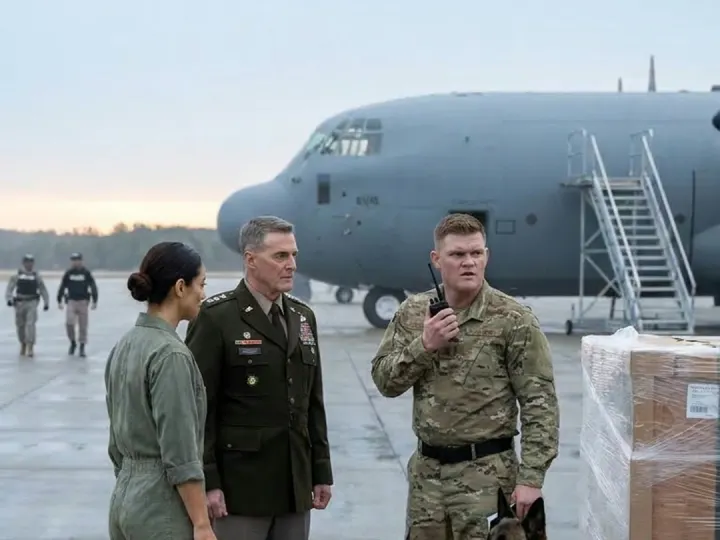
Water dripped from the bottom clip of the board as he lurched upright, his face blotchy red and his chest heaving under his pressed camouflage blouse.
“Wait just a second!” Strickland shouted, his voice cracking across the damp air as he spun toward the boarding stair.
“General Pennington, with all due respect, you can’t hand an active flight line over to an unbadged kennel worker!” Strickland protested, waving his wet clipboard.
General Pennington did not take a single step down the stair; he simply rested his hands behind his back and looked down at Strickland like a hawk studying a field mouse.
“I just addressed her as Master Sergeant Inez Dempsey, Staff Sergeant,” General Pennington said in a voice cold enough to frost the tarmac.
“Are you telling a Brigadier General that he does not know the woman who wrote the manual for his own command’s K9 unit?” Pennington asked.
“Sir, I don’t care what manual she wrote three years ago in Virginia!” Strickland blurted out, panic overriding every ounce of military bearing he had left.
“On Fort Overton’s roster, she is listed as a GS-4 temporary kennel attendant!” Strickland insisted, pointing a shaking finger at my back.
“She has no flight-line security badge, she has no weapon card on file with the Provost Marshal, and she just interfered with four active explosive-detection dogs during a flag officer pre-flight sweep!”
I stopped two paces in front of Bramble, Vesper, Talos, and Kestrel, who remained flat on their bellies with their dark eyes fixed on my boots.
Without turning around, I raised my right hand to waist height and gave a small upward curl of my thumb and index finger.
All four dogs rose smoothly to a standing heel at the exact same second, shaking the dampness from their coats without a single bark.
Corporal Mateo Reeves stared at Bramble and let out a quiet breath of pure awe. “Ma’am... we spent four months trying to figure out why these four dogs paused before every verbal sit command.”
“Because you were giving them the fleet vocal word without clearing the hand-horizon first, Corporal,” I told him gently, checking the collar tension on Bramble’s neck. “They were waiting for the release finger.”
“Nobody moves those dogs!” Strickland bellowed from three yards behind me, his hand flying up to the black tactical radio clipped to his left shoulder lapel.
“Step away from my handlers right now, Dempsey, or I am calling in a perimeter breach!” Strickland threatened, his thumb pressing down on the transmit key.
“Take your thumb off that radio, Staff Sergeant Strickland,” General Pennington commanded sharply, stepping down from the metal boarding stair onto the concrete apron.
Strickland didn’t listen; his eyes darted toward Pallet Four at the center of the staging row, and the sheer terror of what would happen if I ran those dogs past that pallet made him desperate.
He keyed the shoulder mic hard and shouted into the speaker.
“Airfield Operations, Airfield Operations, this is Kennel Master Strickland on Ramp Two! Call out the Quick Reaction MP detail and get Major Cross to the C-130 immediately!”
Static crackled from his shoulder speaker before a sharp male voice answered. “Ramp Two, this is Major Cross in the tower annex. What is your situation, Strickland?”
“Sir, I have an unauthorized kennel attendant interfering with the K9 sweep and attempting to tamper with the cleared cargo pallets!” Strickland shouted into the mic, his eyes wild on mine. “Requesting immediate arrest under Airfield Security Directive Four!”
“On my way with two MPs, eighty seconds out,” Major Garrett Cross’s voice snapped back through the speaker. “Hold the line and do not let anyone touch those pallets!”
Strickland released the radio key, a sweaty, triumphant sneer creeping back onto his pale face as he looked at me and then at General Pennington.
“Major Cross is the Installation Airfield Operations Officer, General,” Strickland said, trying to steady his shaking voice. “Under Fort Overton regulations, once a pre-flight sweep clearance is signed and transmitted to the tower, no outside personnel—not even a visiting flag officer—can break the cargo seal without the Operations Officer’s countersignature.”
General Pennington stopped beside me, his silver hair glinting under the rising dawn light as he looked down at the wet clipboard in Strickland’s hand.
“You signed that clearance sheet awfully fast this morning, Staff Sergeant,” General Pennington observed quietly.
“My team is the fastest on the eastern seaboard, Sir,” Strickland bragged, squaring his thick shoulders. “Seven pallets cleared and certified clean in five minutes and forty seconds.”
“Seven pallets in five minutes and forty seconds,” I repeated, turning to face him with my wet coverall leg still dripping onto the grey concrete.
“Do you know how long it takes a Belgian Malinois’s olfactory membrane to process air volume around a standard forty-eight-by-forty-inch shrink-wrapped pallet in forty-degree morning mist, Sergeant?” I asked.
Strickland’s jaw twitched. “A good dog knows if powder is there on the first pass.”
“In forty-degree mist with a six-knot crosswind from the east taxiway, vapor settles in the bottom three inches of the wooden pallet runners,” I said clearly so every handler on the line could hear.
“A dog moving faster than ninety seconds per pallet only samples the upper shrink-wrap plastic,” I continued, taking one step toward him.
“And according to my watch, when Corporal Reeves brought Bramble up to Pallet Four ten minutes ago, you grabbed the dog’s harness strap and yanked him to Pallet Five after eleven seconds.”
Corporal Reeves nodded immediately from the end of the line. “That’s true, General. Bramble dropped his nose to the bottom slats of Pallet Four and took a double inhale, and Staff Sergeant Strickland pulled us off.”
“Because Pallet Four was already inspected inside the hangar at zero-three-hundred!” Strickland shouted, his voice rising an octave as a green military utility pickup with flashing amber roof lights turned onto the apron from the tower annex.
“Nobody goes near those pallets until Major Cross arrives!” Strickland added, stepping sideways to block the gap between the dog line and the row of seven cargo pallets.
“Master Sergeant Dempsey,” General Pennington said, never taking his cold eyes off Strickland. “When I gave you his flight line, was that a suggestion or a direct order?”
“A direct order, Sir,” I answered.
“Then run the sweep on my aircraft’s cargo, Master Sergeant,” General Pennington commanded. “And if Staff Sergeant Strickland places one boot in front of your dog, the four handlers on this line have my direct authority to put him face-down on the concrete.”
All four young handlers—Reeves, Miller, Chen, and Alverez—straightened their spines and took half a step forward, their eyes fixed hard on the kennel master who had bullied them for half a year.
Strickland swallowed hard, his Adam’s apple bobbing above his collar as he realized his own squad would gladly pin him to the tarmac if he touched me again.
He backed up two steps toward the approaching utility pickup just as its brakes squealed to a halt twenty feet outside the yellow chalk line.
The driver’s door flew open, and Major Garrett Cross stepped out onto the concrete in a green flight jacket with gold oak leaves on the shoulders, followed by two Military Police sergeants in black duty belts.
Major Cross was forty-one, sharp-featured with slicked-back dark hair, and he marched straight across the apron with his hand already raised.
“General Pennington, excuse the interruption on your ramp,” Major Cross said smoothly, throwing a quick salute before turning a glare onto me. “Strickland, is this the civilian maintenance worker who disrupted the sweep?”
“That’s her, Major!” Strickland called out eagerly, pointing his wet clipboard at my coveralls. “She walked right across the active line with a water bucket, gave an unauthorized signal to the dogs, and now she’s trying to tear into your diplomatic pallets!”
Major Cross didn’t even ask for my name; he snapped his fingers at the two Military Police sergeants behind him.
“Sergeants, escort this woman to the gatehouse holding room and log her for flight-line interference,” Major Cross ordered brusquely. “And Corporal Reeves, get those pallets pushed up the cargo ramp right now—we have a zero-six-thirty wheels-up!”
“Hold where you are, Sergeants,” General Pennington’s voice boomed across the apron, stopping both MPs dead in their tracks.
Major Cross blinked, turning back toward the sixty-two-year-old general with a tight, forced smile. “General Pennington, I promise you we won’t delay your departure to Fort Belvoir by more than three minutes. Once my men clear this janitor off the tarmac—“
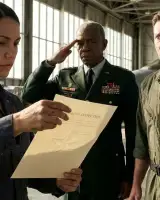
“That ‘janitor’ is Master Sergeant Inez Dempsey of the Department of the Army Inspector General’s Directorate, Major Cross,” General Pennington said, each word dropping like a hammer on an anvil.
Major Cross’s forced smile froze on his lips, and his eyes flicked downward to the soaked hem of my coveralls and the dented steel bucket still resting near the line.
“Inspector General?” Major Cross repeated slowly, his gaze darting for half a second toward Pallet Four before returning to the General. “Sir, my office received no notification of an IG inspection team at Fort Overton.”
“When the Inspector General investigates systematic falsification of pre-flight K9 sweeps on military transport aircraft, Major, we don’t send a courtesy memo to the airfield office first,” I said calmly.
I turned to Corporal Reeves and extended my right hand palm-up. “Corporal Reeves, hand me Bramble’s lead.”
“Yes, Master Sergeant,” Corporal Reeves said without hesitation, placing the black leather loop into my palm.
“Wait—General, I have to object!” Major Cross stepped forward, his smooth composure cracking as sweat broke out along his hairline. “Pallet Four and Pallet Five are sealed under Joint Communications Security Protocol! Even an IG NCO cannot delay a scheduled flag transport without probable cause!”
“Probable cause inside a K9 sweep lane is determined by the dog’s nose, Major Cross, not by your clipboard,” General Pennington replied coldly. “Proceed, Master Sergeant Dempsey.”
I didn’t use the leather leash to pull Bramble; I draped the slack strap loosely over my left forearm and brought my right hand down by my thigh, two fingers tapped once against my soaked coverall leg.
Bramble’s ears pricked forward, his amber eyes shining with the focused intensity of the top graduate of Belvoir Class Four.
I gave a tiny sideways flick of my wrist toward the cargo line.
Silently, with his nose half an inch above the damp concrete, the ninety-pound Belgian Malinois glided out of the formation and began working the downwind side of the cargo row.
He circled Pallet One in a tight, methodical figure-eight, inhaling deeply along the bottom wooden slats before moving smoothly to Pallet Two, then Pallet Three.
Nobody on the apron breathed.
The two Military Police sergeants stood beside the utility truck with their hands at their sides, watching the dog work without a single spoken word from me.
Beside Major Cross, Staff Sergeant Strickland’s knees were visibly trembling inside his pressed camouflage trousers, his wet clipboard clutched against his chest like a shield.
Then Bramble reached the downwind corner of Pallet Four—the heavy crate wrapped in triple layers of opaque black shrink-wrap and stamped with a bright orange DIPLOMATIC COURIER — EXEMPT FROM MANUAL SEARCH stencil.
The moment Bramble’s dark muzzle passed the bottom eastern corner of the wooden pallet runner, his body stopped as if he had hit a concrete wall.
His nostrils flared wide, drawing in three rapid, audible sniffs along the gap between the double-stacked bottom pine boards.
Then, without looking back at me, Bramble folded his hind legs and dropped into a rigid, textbook dead sit directly against the corner of Pallet Four, his nose pointing like an iron spear at the lower wooden deck.
In the Anchor program, a flat belly-drop was the emergency stabilization command—and a silent, frozen sit with the nose locked to the base was the unmistakable primary alert for energetic compounds or lithium-thermal batteries packed in high density.
A dead hush fell over Ramp Two.
Corporal Reeves’s eyes went wide. “That’s a hard primary alert on Pallet Four, Master Sergeant. He’s locked solid.”
“The dog is confused by jet fuel residue on the tarmac!” Strickland shouted wildly, taking a frantic step forward before one of the MPs raised an arm to block him. “That pallet was cleared at three in the morning! Tell them, Major!”
Major Garrett Cross’s face had gone the color of wet cement inside his green flight jacket.
“The dog was just startled by the water bucket earlier, General,” Major Cross said rapidly, his voice tight and thin. “We can pull Pallet Four off your flight manifest and put it on the noon logistics truck if it makes you more—“
“Nobody is putting Pallet Four on a truck, Major,” I said, walking over to stand beside Bramble and resting two fingers lightly between his shoulder blades to acknowledge his find.
“Because Bramble didn’t just alert on the cargo box on top of the pallet, General Pennington,” I said, pointing down at the three-inch gap between the wooden forklift runners.
“Look at where his nose is pointed, Sir—he is alerting on a sealed false deck built inside the wooden pallet base itself.”
General Pennington stepped right up to Pallet Four, looked down at the dog’s locked muzzle, and then turned slowly to face Major Cross and Staff Sergeant Strickland.
“Sergeants of the Guard,” General Pennington said to the two MPs. “If either of these men moves one foot toward that truck, put them in steel cuffs.”