I have been in firefights where there was less noise.
Chairs scraped.
Boots hit the carpet.
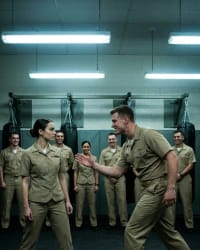
Two military policemen who had been standing outside came through the double doors, because someone in the corridor had understood the order before the people inside did.
It was Corporal Lindqvist.
She had stood up from her desk the moment she heard the General’s voice, and she had called the number she had written on the back of her hand that morning.
I learned later she had been carrying that number for three weeks.
“Nobody leaves,” General Whitlock said.
He did not shout this time.
He did not have to.
He walked down the center aisle with the cane tapping on the navy carpet, and officers drew in their feet to let him pass.
Some of them were standing at attention.
Some had gone gray in the face.
Some were looking at Pryce, and that was the part that mattered.
Pryce had not moved.
He stood beside the table with his hands at his sides, staring at the glove like it might bite him.
“Sir,” he said.
“General Whitlock. Sir, I had no idea you were.”
“No,” the General said.
“You didn’t.”
He stopped in front of the table.
He was a head shorter than Pryce and he looked down at him anyway.
He did not look at the glove.
He looked at me.
I will tell you what his face did, because I have never forgotten it.
First it softened.
Then it shook.
Then he did a thing I did not expect.
He set the cane against the table.
He straightened his back.
He raised his right hand to his brow.
It was a salute, slow and complete, and it held.
“Captain Reyes,” he said.
I flinched.
It was my own rank, and I had not heard it said aloud in six years.
“Sir,” I managed.
“I’m a Specialist now.”
“You are whatever I say you are until this room is cleared,” he said, and there was iron under the wet in his voice.
“Lower your hand, Captain. I will not have you saluting me. It should be the other way around.”
His hand did not shake.
His eyes did.
“I have been looking for that glove for six years.”
I could not speak.
My throat had closed.
“I held it in my own hand that night. I never knew whose it was. I only remembered the code.”
He turned to the room.
“Specter Six,” he said.
“A special-operations team. Seven soldiers. On the fourteenth of March, six years ago, they were cut off on the Anvil Road when a quick-reaction force that was supposed to reach them was recalled by order of the staff.”
The room had stopped breathing.
“I was in that vehicle,” General Whitlock said.
“A visitor on a patrol. A tired old officer in the back seat.”
He lifted his cane an inch and let it fall.
“The truck burned. I was trapped in the back. A voice said my name and pulled me out through the flames and carried me through the dark to a ditch.”
He looked at his own left hand.
“That person put a glove over mine to cover the burns and dragged her entire team out of that valley alive. Five people, on foot, forty minutes under fire, with one more dead in the dirt behind them whom she would not leave.”
Nobody breathed.
“She told me she was the team leader. She told me her name was a call sign. She told me to forget her and save the others.”
“And then she vanished,” he said.
“The patrol logs vanished with her. The report said the team had abandoned its post.”
He turned his head slowly toward the bench.
“Abandoned its post.”
The word hung in the lamp-warm air.
“Colonel Pryce,” General Whitlock said.
“You were a major then. You were the staff officer who recalled that force.”
Pryce had gone the color of old paper.
“Sir, the logs showed.”
“The logs showed what you wrote on them. Where are the original logs, Colonel?”
“Sir, they were lost.”
“Lost in which fire?”
Pryce said nothing.
The General looked at the captain beside him.
“Captain Frame. You were his aide then too, were you not?”
Frame’s mouth worked.
His eyes flicked left to the door, to the two military policemen filling it.
“Sir,” he said.
“I.”
“Careful,” General Whitlock said, almost gently.
“Choose your next words as though you will be repeating them under oath. You will be.”
They cleared the room in eleven minutes.
I watched it from a chair someone had pulled up for me.
It was the first time anybody on that base had ever pulled up a chair for me.
I sat with my hands between my knees.
They were shaking now, a fine steady tremor I could not stop.
The adrenaline had gone out of me like water out of a tub.
One by one the officers filed out under military police escort.
The ones who had done nothing were told to wait in the corridor.
The ones who had done something were taken to a separate room.
There were four of them.
I counted.
Pryce was last.
He did not go quietly.
At the door he turned around, and I saw the contempt come back into his face like a mask put on over a crack.
“She left her team,” he said, loud enough for the whole room.
“You can put on any show you like, Sir. She walked off that road.”
My blood went cold.
The old fear came up through the floor of me.
Six years of it.
Because there was one thing in that sentence that was true.
I had walked off that road.
I had walked off it with five alive and one dead.
And I had never gone back for the body of Sergeant Owen Hargrove, because it was a question of who could still be carried.
General Whitlock heard it too.
He came and stood beside my chair.
He did not touch me.
He stood between me and the door, and he did not say a word.
“That is not what happened,” I said.
My voice was a croak.
“I know,” he said.
“I did leave him there, Sir. Owen. I left him in the ditch because I had a broken wrist and a medic who could not stand and a boy who was bleeding out in my arms.”
“I know.”
“I have thought about it every day.”
“Captain,” General Whitlock said.
“I have thought about it every day, too. I was the one in the ditch, and I watched you decide.”
I looked up.
His eyes were red, and he was not hiding it.
“There was never a right choice that night. There was only the choice you made, and five families who got their children back because of it.”
“I would like you to hear one more thing from me, and then I will not say it again.”
“Yes, Sir.”
“The mistake was never yours. The mistake was Colonel Pryce’s. And he has just told every person in this room that he knows exactly which road we are talking about.”
I turned my head.
Pryce, at the door, had gone still.
He had heard himself.
A man who has not been in that valley should not know it was a road at all.
Corporal Lindqvist stepped out of the corridor and held out the sealed envelope I had noticed on her desk.
“Sir,” she said, and her voice shook.
“I wrote you three weeks ago, when the charge came across my desk. You never answered. I thought the letter hadn’t reached you.”
“It reached me,” General Whitlock said.
“It reached me Tuesday. I came as fast as I could.”
“There is a second thing, Sir. I did not mail it. I wasn’t sure.”
She opened the envelope.
Inside there was a small key and a folded page of her own handwriting.
“The original logs were never destroyed. Someone moved them to the safe in Captain Frame’s office. He told me to shred the ledger and I didn’t. I copied the ledger instead.”
I will never forget the sound Captain Frame made.
It was not a word.
It was the sound a man makes when a wall he has been leaning on turns out to be a door.
The next three days were the strangest of my life.
They put me in the officers’ guest quarters, because there was nowhere else to put a Captain who had been living in a barracks room for six years.
The bed was too soft.
The window looked out at a parade ground, and I stood at it every night until the sun came up.
They brought me a uniform on the second morning.
It was a real one, dark green, with a captain’s bars on the shoulders and generic rows of colored ribbons that I had not earned in the last six years and had earned in the six before that.
I held it for a long time.
I put it on the bed, and I did not put it on.
Teddy Okafor found me sitting beside it.
He had come to the guest quarters with a duffel full of my things from the barracks.
He stood in the doorway and did not know where to look.
“Captain,” he said, and tried the word out.
“Ma’am.”
“Teddy. It’s Dana. Please.”
“They told us,” he said.
“The whole motor pool. We heard it from the guy who was outside the doors.”
“I should have said something.”
“No.”
He shook his head.
“I figured you had a reason. Everybody has a reason, ma’am. You just had a bigger one.”
“I was ashamed,” I said.
It came out before I could stop it.
“That’s the reason. Not fear. I was ashamed I had walked away from the unit and from Owen. I thought if I fixed trucks for long enough I might earn it back.”
He sat down on the edge of the bed, which a corporal is not supposed to do.
“My brother’s in the service,” he said slowly.
“Third Infantry. He told me once the worst part of coming home isn’t what you did over there.”
“What is it?”
“It’s that nobody asks you what you carried.”
I laughed.
It cracked in the middle.
I had not cried since March six years ago.
I did not cry then, either.
My eyes just stung and then I wiped them with the back of my wrist and went to work.
The General arrived at noon.
He knocked on the door himself and waited for me to answer, which no general in my experience had ever done.
He walked in with his cane tapping.
He sat in the chair by the window and looked out at the parade ground.
“They have started talking,” he said.
“Frame first. He broke on the second morning. He would not sit across from me for an hour before he began to confess.”
“What did he say?”
“That Major Pryce recalled the quick-reaction force on his own authority, six years ago, to protect a convoy that carried something Pryce had no business moving. A private shipment. Contraband, sold on the side to a contractor.”
He said it flatly.
“When your team was ambushed on the Anvil Road, it was because the escort Pryce had promised for the convoy was the same escort he had pulled off your road. He took the troops that would have saved you and used them to guard his own shipment.”
I put my hand over my mouth.
“Then he rewrote the logs, and he had them say your team had abandoned its post. That way no one would ever ask why the support never came.”
“And when I disappeared.”
“It was convenient. A scapegoat who left the service and stopped answering letters. A woman nobody would defend.”
“Why now?”
“Because I asked for the logs.”
His mouth twisted.
“I am writing something. A small memoir, for the Army museum. I wanted to describe that night accurately. I requested the original patrol logs four weeks ago, and within a week a charge appeared against a Specialist Reyes.”
I understood.
“He moved to bury it. He did not know you were alive, and he thought if he pinned the old charge on a living woman who could not defend herself, the file would be closed forever.”
“And he picked me.”
“He picked the one name in his own files he thought no one would fight for.”
The General stood up.
“He picked wrong.”