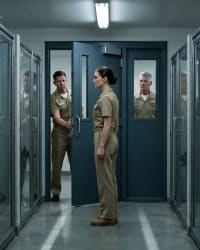
The court-martial took seven weeks.
I will not describe all of it.
Most of it was paper, and most of the paper was the work of Corporal Tessa Lindqvist, who copied a ledger by hand in her lunch hour for three weeks and hid it in a school lunchbox.
The ledger was the whole case.
Pryce’s lawyers fought it for a month, and it did not move.
Because every time they pushed on one page, another page said the same thing.
The quick-reaction force had been recalled at 0214.
Pryce’s own initials were beside the order.
The convoy had been rerouted the same hour.
The escort’s fuel receipts were in the same folder.
Evidence that had been sitting in a locked safe for six years, waiting for someone brave enough to open a door.
They called me on the fourth day.
I wore the dark green uniform.
I had decided in the end that I would.
It fit.
That surprised me.
I had thought six years of motor-pool lifting might have changed my shoulders.
I walked into the courtroom and I did not look at anyone but the judge.
“State your name for the record.”
“Captain Dana Reyes, Specter Six.”
I said the words aloud for the first time in six years.
I felt the whole room hear them.
I felt Pryce hear them, from the defendant’s table, where he sat in his dress jacket with his hands folded and his face carved from wood.
I told the court what happened on the road.
I did not exaggerate.
I did not soften.
I said that I had left Sergeant Owen Hargrove in a ditch with his boots toward the road because I could not carry him and the others both.
I said that I had gone back the next day with two soldiers and found nothing, and that I carried that for six years.
My voice broke once.
The judge waited.
I finished.
Pryce’s attorney stood up for cross-examination.
He was a smooth man in a good suit.
“Captain Reyes, is it not true that you chose to leave your team and your post that night?”
“I did not leave my post, sir.”
“You abandoned a wounded man.”
“I made a choice between one life and five. If you would like to tell me which of them I should have left, counselor, I will listen.”
The room was very quiet.
“Nothing further,” said the attorney.
Pryce did not testify.
He did not need to.
The ledger testified for him.
The verdict came on the fortieth day.
Guilty on every count.
Falsification of official records, misuse of military resources, conspiracy, and dereliction of duty resulting in death.
His rank was taken from him.
His retirement, his pension, his name on the list for the star he was due to pin on that summer, all of it gone in a single sentence.
He was sentenced to twenty-two years.
He stood at attention to hear it.
His jaw did not move.
But when they led him out, he passed the table where I sat, and for one second his eyes met mine.
I thought he would curse me.
He did not.
He looked at me the way you look at a stranger who has known your name the whole time.
“I did not think anyone was left,” he said, so low only I heard it.
“That,” I said, “was the mistake.”
The five of them came on a Saturday in November.
They arrived in two cars and a pickup truck, in jeans and civilian jackets, with the stiff, uncertain look of men and women who have walked into an old room.
I stood on the front step of the guest quarters and watched them climb out.
Staff Sergeant Marcus Doyle was first.
He had a limp now, and gray in his beard.
He had been twenty-three on the road.
Then Specialist Wren Castillo, who had lost the hearing in one ear.
Then Sergeant Abel Nwosu and his wife.
Then the youngest, a boy called Pike who was no longer a boy.
They did not say anything.
They stood on the lawn and looked at me.
Doyle crossed the grass in six uneven steps and stopped in front of me.
“Captain.”
“Marcus.”
He did not salute.
He put his arms around me instead, hard enough to hurt, and I felt something in my chest that I had kept locked for six years come loose and fall all the way down.
I held on to him.
I held on to all of them, one at a time, and nobody said a word, and all of us were crying like children.
“We looked for you,” Wren said at last, into my shoulder.
“We looked for years.”
“I know.”
“We thought you were dead.”
“I thought you would hate me.”
“For what?”
Pike said.
“For carrying us out?”
I had no answer.
That afternoon we drove, all of us, in the three vehicles, to a small town forty minutes from the base.
General Whitlock rode with me.
He had insisted.
He sat in the passenger seat with the cane between his knees and said nothing for the whole drive.
It was a white house with a porch and a flag.
An old woman answered the door.
She was small and bent, with thin white hair, and she looked at us, at the five soldiers and the old general and me, and she knew.
She knew from the way we stood.
“Mrs. Hargrove,” I said.
“My name is Dana Reyes. I led your son’s team.”
She put her hand on the doorframe.
“I have something that belongs to you.”
I took it out of my breast pocket.
Not the glove.
The glove was already in a case in the General’s car.
I took out a small metal tag on a chain, scratched and dull, stamped with a name I had memorized.
“I took it from his neck that night,” I said.
“I should have brought it to you six years ago. I was afraid. I am sorry. I am so sorry.”
She took the tag.
She turned it over in her hand.
“Owen’s,” she said.
“Yes, ma’am.”
“He wrote me a letter once. He said the best soldier he ever served under was a woman who never raised her voice.”
She looked up at me with eyes the same color as his.
“He said she would carry anyone.”
I could not stand up straight anymore.
I knelt on her porch in my dress uniform, in front of her and in front of the others, and she put her small dry hand on the top of my head the way you bless a child.
Nobody on that porch said anything for a very long time.
In December the Army offered me everything.
They offered me my rank, with back pay.
They offered me a posting of my choice.
They offered a medal that I did not want, in a ceremony that I would not attend.
General Whitlock sat across the kitchen table from me and laid it all out in a quiet voice.
“The decision is yours,” he said.
“I only ask that you do not make it from guilt.”
I looked at the burned glove, which sat between us on the table in its glass case.
“I think I would like to stay in the motor pool,” I said.
He raised a silver eyebrow.
“For a while. Teddy’s short on a mechanic. I like the trucks. They tell me the truth about what’s wrong with them.”
“And after a while?”
“After a while,” I said, “I would like to run something. A team. A real one. I would like to teach the people who come in like I did, scared and ashamed, that rank is a thing you carry and not a thing you wear.”
He smiled.
It was the first real smile I had ever seen on his face.
“Captain Reyes,” he said.
“I believe I will let you.”
He stood.
He took his cane.
At the door he turned and looked at the glass case.
“You never told me why you kept it,” he said.
“I told myself it was proof.”
“And it was not?”
“It was a promise,” I said.
“I promised Owen that someone would know. I just did not think it would take six years and a stranger’s courage.”
“Not a stranger,” said General Whitlock.
“A corporal with a lunchbox.”
I laughed.
It was the loosest laugh I had had in years.
That night I hung the dress uniform in the closet.
Then I put on my olive coverall, the old faded one with the grease at the cuffs, and I walked down to the motor pool in the cold.
The lights were off.
The trucks stood in rows like sleeping animals.
I switched on one lamp and found a wrench, and under that lamp, with diesel on my sleeve and my hair in a tight low bun, I felt something I had not felt since March six years ago.
I felt at home.
The base woke up around me.
Boots on the gravel.
Engines coughing awake.
Somebody laughing at the other end of the yard.
Teddy came in at six with two cups of coffee and handed me one without a word.
“Captain.”
“Dana,” I said.
“Dana,” he agreed.
“There’s a Humvee with a bad fuel pump that wants a word with you.”
I took the coffee.
It was too hot and too bitter and absolutely perfect.
I think about that morning in Building 12 more than I should.
The cap on the carpet.
The door banging open.
A man who had written my sentence before he met me.
And one burned leather glove, laid flat on a table, doing what I never could in six years of silence.
Maybe I should have spoken sooner.
Maybe I should have shown it to someone the very first year, instead of keeping it under a sheet of plywood while a liar climbed the ranks.
Or maybe the glove only works when the room is full and the right man is sitting at the back.
I still do not know.
So I will ask you.
Was I right to say nothing and let the glove speak for me, or should I have told the truth out loud years ago?