Chapter 1
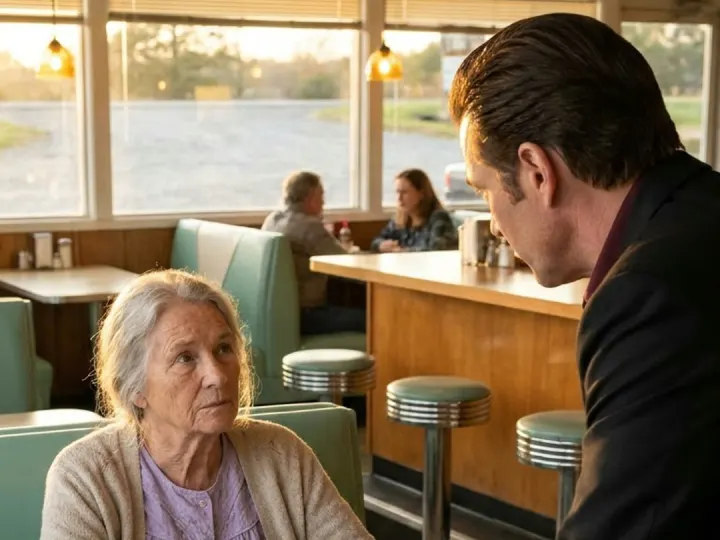
Every Sunday at sunset, I sat in the corner booth of the Oak Ridge Diner.
The vinyl beneath me was mint-green, faded at the edges from forty years of Sunday suppers.
Outside, the golden-hour sun cast long amber shadows across the gravel lot Arthur and I paved in 1984.
My late husband built this place from a secondhand six-burner grill and a stack of pine lumber.
My knees had given out five years ago, forcing me to step back from the daily grind.
I had handed the operating keys to our son, Dalton, hoping he would honor his father’s name.
On the cream formica table, a fresh chicken pot pie rested inside a piping-hot white ceramic ramekin.
I reached into the pocket of my darned oatmeal cardigan to pull out my worn floral coin purse.
Along with the faded cloth pouch, two heavy metal objects tumbled onto the clean table surface.
The first was Arthur’s notched brass master foundation key, cut specifically for the original floor safe beneath the register.
The second was the heavy brass parcel token issued by the county tax assessor forty years ago.
Those two pieces of metal had anchored this property long before Dalton ever wore a tailored suit.
I laid the heavy brass key and the parcel token beside my napkin, right against the chrome trim.
Then I unzipped the cloth purse and began counting out my silver quarters onto the formica.
My social security deposit had been delayed by the holiday weekend.
When I finished stacking the coins, I realized I was exactly two dollars short for the meal.
Before I could call for a cup of coffee and ask to cover the balance tomorrow, heavy footsteps approached.
Dalton stood over my booth, towering tall in a sharp black blazer and charcoal trousers.
His slicked-back hair gleamed under the amber pendant lamps, graying slightly at the temples.
He did not look at my face; his cold gaze dropped straight to the small pile of silver change.
With a swift, dismissive flick of his arm, Dalton swept his forearm across the tabletop.
The cloth purse and every single quarter flew off the front edge in a blinding blur.
They struck the black-and-white checkered floor with a sharp, clattering crash that silenced the entire dining room.
I sat motionless, my work-worn hands resting empty on the bare cream table.
Dalton straightened his cuffs and adjusted the heavy gold wristwatch gleaming on his left arm.
“Full price or get out, Mom.”
His clipped baritone rang out toward the counter, carrying clearly to every regular patron in the room.
My chin trembled slightly, but I kept my spine straight against the vinyl seat.
“I am two dollars short tonight, Dalton,” I whispered.
Before Dalton could sneer, quick footsteps sounded from the direction of the service station.
Twenty-two-year-old Tessa Alvarez stepped between Dalton and my table, her dusty-rose waitress dress crisp and tidy.
Her dark eyes flashed with quiet indignation as she reached into her white apron pocket.
Tessa laid two neatly folded dollar bills flat on the formica beside my hot pot pie.
“Keep your money, dinner’s on me.”
Her voice was bright, steady, and loud enough for the old farmers at the counter to hear.
Dalton’s face tightened into an ugly scowl as he glared down at the two green bills.
He snatched the folded bills off the cream table, clutching them tightly in his right fist.
He turned his head toward the young girl, his jaw clenching hard.
“Then this is your last shift.”
Tessa stiffened where she stood, but she refused to back down or drop her gaze.
A hush fell over the room as Pete, our longtime line cook, froze behind the order window.
I did not bend down to gather my scattered coins from the linoleum floor.
Instead, I slid my right hand into the opposite pocket of my cardigan.
I pulled out my old silver clamshell flip phone and flipped it open with a soft click.
Dalton looked down at the scratched plastic casing and let out a dry, mocking laugh.
“Calling who, Mom, you’ve got two dollars.”
I met his contemptuous gaze with eyes that did not blink.
My thumb pressed the green send button on the speed dial I had saved years ago.
I raised the open silver phone to my right ear as the dial tone clicked through.
“Miriam, it’s me, end my son’s lease tonight.”
I spoke the words calmly, without raising my voice a single fraction of a decibel.
Dalton’s mocking grin vanished in an instant, snapping shut into a tight, bloodless line.
His knuckles went slack, and Tessa’s two folded dollar bills slipped from his fingers onto the table.
He stared at me as if the floor beneath his polished oxford shoes had suddenly given way.
For five years, Dalton had mailed his monthly commercial lease checks to Oak Ridge Holdings LLC.
He believed the company was an faceless investment firm that bought the diner to spare me debts.
He had no idea that Oak Ridge Holdings belonged entirely to me.
Nor did he realize that Miriam Vance, my lifelong estate attorney, was the sole corporate officer.
Ten seconds of dead silence hung over the restaurant like a suffocating cloud of dust.
Then Dalton’s shock twisted into sudden, desperate rage.
He brought his open palm down on the formica, smashing it over my flip phone.
The plastic case snapped under his weight, cutting the open phone call instantly dead.
“You crazy old woman,” Dalton hissed, leaning over the table until his face was inches from mine.
Spittle flecked his lower lip as his eyes darted nervously around the crowded room.
Old Mr. Henderson at the counter set his coffee mug down with a sharp clink.
Dalton whipped his head toward the kitchen pass-through where Pete was watching wide-eyed.
“Pete! Front doors! Now!” Dalton barked, his voice cracking with sudden panic.
“Go lock the deadbolts and turn the sign to closed!”
Pete hesitated, his spatula dripping grease onto the stainless-steel grill.
“Dalton, that’s your mother,” Pete said quietly from behind the heat lamps.
“I said lock the damn doors before I fire you too!” Dalton bellowed.
Pete wiped his hands on his apron and reluctantly stepped out into the dining room.
He walked to the double glass entrance and turned the brass deadbolts with a heavy thud.
The regular patrons began murmuring, glancing toward the locked exit in alarm.
Dalton turned back toward the dining room, raising both hands to project his voice.
“Listen to me, everybody!” Dalton announced, putting on a forced, theatrical display of concern.
“My mother has suffered a severe psychological break! She has acute, advanced dementia!”
He tapped his temple with a manicured index finger, looking around at our longtime neighbors.
“She doesn’t know where she is or who owns this building,” he declared loudly.
“She’s been hallucinating about deeds and properties that were liquidated years ago.”
I sat quietly, watching my son perform his desperate little show for strangers.
Dalton pointed an accusing finger at Tessa, who remained standing beside my booth.
“And this girl took advantage of an elderly woman’s mental state!” Dalton shouted.
“Tessa has been stealing cash straight out of my register all week!”
Tessa gasped, taking a step backward against the wood counter railing.
“That’s a lie and you know it, Dalton!” Tessa said, her cheeks flaming red.
“I put my own tip money on that table to buy your mother supper!”
“Tell that to the county sheriff!” Dalton snarled, pulling a sleek smartphone from his suit coat.
“I’m calling Sheriff Miller right now to have Tessa booked for grand larceny!”
He waved the phone in the air so the entire room could see the glowing screen.
“And I’m having my mother removed in restraints for an emergency psychiatric hold!”
Several patrons shifted uncomfortably in their seats, whispering among themselves in hushed, nervous tones.
“You can’t lock us in here, Dalton,” Mr. Henderson called out from the counter.
“We just came in for our Sunday dinner, son. Unlock those front doors.”
“Nobody leaves until the deputy arrives to take my official statement!” Dalton snapped.
He backed away from my booth, tapping numbers rapidly into his touchscreen keypad.
He held the phone to his ear, pacing back and forth in front of the counter stools.
I did not move from my mint-green vinyl seat.
My hands remained rested on the table beside Arthur’s brass key and the parcel token.
Arthur had always told me that when a bully begins to shout, he is already defeated.
Forty years ago, Arthur had poured the concrete footing of this very foundation with his bare hands.
He had measured every timber and leveled every beam while I ran the sandwich board outside.
When Dalton was seven, he used to sit in this very booth doing his third-grade arithmetic.
We had bought him his first car and paid every nickel of his four-year college tuition.
When he returned to town with an expensive suit and empty pockets, I gave him a chance.
I had stepped back so he could learn what it meant to earn an honest living.
Instead, he had installed brass fixtures, inflated the prices, and treated our loyal staff like dirt.
And tonight, he had swept his mother’s coin purse onto the floor over two dollars.
“Clint? It’s Dalton,” he said into his phone, turning his back toward the booth.
“I need you out at the diner immediately. Bring transport cuffs and a medical transport unit.”
He paused, listening to the voice on the other end with a cruel smirk spreading across his face.
“Yes, exactly like we planned,” Dalton whispered into the receiver.
“My mother had a public episode. She’s completely lost her mind. Come through the side entrance.”
He hung up the phone and slipped it back into his blazer pocket, his composure returning.
He walked back over to my table, planting both fists on the cream formica surface.
“Did you really think your little bluff would work, Mom?” he asked in a low whisper.
“You don’t own anything anymore. You’re an old woman living off a fixed government check.”
“I let you sit here on Sundays out of charity, but that charity ends tonight.”
“By midnight, you’ll be resting comfortably in a locked room at Pine Ridge Sanitarium.”
“And once the court appoints me your legal conservator, this diner gets leveled for good.”
I looked up into his cold, gray eyes, seeing nothing of Arthur in them.
“This land is protected, Dalton,” I said softly. “You never read what you signed.”
Dalton laughed, a harsh, grating sound that bounced off the wood-paneled walls.
“I don’t need to read ancient history, Mom. Progress doesn’t care about your sentimental junk.”
Behind him, the heavy metal handle of the rear kitchen service door rattled sharply.
The door swung inward with a firm, deliberate creak that caught Dalton’s attention.
Footsteps echoed on the back hallway tiles, steady and unhurried.
Dalton turned toward the doorway, expecting one of the dishwasher boys returning with trash cans.
Instead, a tall, elegant woman of seventy-one stepped into the dining area.
Miriam Vance wore a tailored charcoal wool coat over a navy silk blouse.
Her silver hair was swept up in a neat, professional French twist.
Under her left arm, she carried a thick navy-blue leather legal folder with brass corners.
Her sharp blue eyes swept across the dining room, taking in the locked entrance and the gathered crowd.
Then her gaze landed squarely on Dalton Fairchild.
“Unlock those front doors this instant, Dalton,” Miriam said, her voice cutting through the diner like glass.
Dalton took half a step back, his smirk faltering for a brief second.
“Miriam?” Dalton blustered, trying to recover his footing. “What are you doing here?”
“My mother broke her phone making prank calls. This is a private family matter.”
“There is nothing private about commercial real estate fraud, young man,” Miriam replied coldly.
She walked straight to my booth, setting her leather folder down beside my chicken pot pie.
She touched my shoulder gently with a gloved hand. “Are you alright, Harriet?”
“I am fine, Miriam,” I said. “My son just swept Arthur’s quarters onto the floor.”
Miriam looked down at the linoleum where my silver coins still lay scattered across the checkered tiles.
A look of cold disdain settled over the lawyer’s face as she turned back to Dalton.
“Five minutes ago, Harriet contacted me in my official capacity as corporate counsel,” Miriam stated.
“She exercised her executive authority to terminate your commercial tenancy for gross moral turpitude.”
Dalton let out an angry, spluttering laugh, crossing his arms over his chest.
“You’re her estate attorney! You don’t have any jurisdiction over my lease!”
“I lease this property from Oak Ridge Holdings in Chicago!”
“I pay twenty-eight hundred dollars a month directly to their corporate bank account!”
Miriam unzipped the navy leather folder and pulled out a certified municipal document with a gold seal.
“Oak Ridge Holdings LLC is not in Chicago, Dalton,” Miriam said calmly.
“It is a registered domestic trust chartered right here in this county forty years ago.”
She held up the original operating agreement, pointing to the bold black signature at the bottom.
“Harriet Fairchild is the sole managing member and hundred-percent equity owner of Oak Ridge Holdings.”
A loud collective gasp rippled through the diner patrons sitting along the counter.
Pete the cook stepped closer from the kitchen aisle, his jaw hanging completely open.
“What?” Dalton gasped, his face flushing crimson. “That’s... that’s impossible!”
“She sold this place to pay off Dad’s medical bills! She told me she sold it!”
“I told you the building was placed under a management corporation,” I said quietly.
“You assumed I sold it because your only thought has ever been what things are worth in cash.”
“Arthur and I created the holding company to protect this land from commercial developers.”
“We gave you a subsidized five-year trial lease to see if you had the character to run it.”
Dalton lunged forward, trying to snatch the document from Miriam’s hands.
Miriam pulled the paperwork smoothly out of his reach, stepping between him and the table.
“Under Section 14 of your commercial lease, default is triggered immediately upon tenant misconduct,” Miriam said.
“Clause B explicitly cites physical harassment of staff, public nuisance, and breach of peaceful assembly.”
“Sweeping your mother’s purse and unlawfully imprisoning your customers qualifies under all three.”
“Your lease is null and void as of six-fifteen this evening, Dalton.”
Dalton stood frozen, his chest heaving under his black tailored blazer.
The gold watch on his wrist shook as his hands balled into tight, furious fists.
“You think you can just write me out?” Dalton snarled, his voice rising in pitch.
“I built this business! I brought in the dinner crowd! I am not walking away from five years of work!”
“You didn’t build anything, Dalton,” Tessa said firmly from the counter.
“Mrs. Fairchild built this place. All you ever did was count the money and cut our hours.”
“Shut your mouth, you little thief!” Dalton shouted, turning on her with bared teeth.
“You’re both going to jail tonight! Neither of you is leaving this room!”
Outside the diner’s large picture windows, brilliant red and blue emergency flashers ignited the twilight.
The siren let out a single, aggressive yelp that rattled the glass panes in their frames.
A dark county cruiser pulled up over the curb, parking sideways across the front walkway.
Dalton’s panicked expression instantly transformed into a triumphantly sinister grin.
“You’re too late, Miriam,” Dalton sneered, pointing toward the flashing red lights outside.
“The law is already here, and he isn’t here to read your little contracts.”
Before anyone could move toward the front entrance, the heavy metal side service door banged open.
A bulky man in a tan county sheriff’s uniform stepped heavily into the dining room.
Deputy Clint Miller, fifty-two, stood in the doorway, his hand resting casually on his leather sidearm holster.
His silver badge caught the yellow glow of the pendant lights above the counter.
In his left hand, Miller held a set of steel handcuffs and a clip of official white county paperwork.
He took two heavy steps into the diner, his cold eyes scanning the frozen patrons.
“Nobody move and nobody touch anything,” Deputy Miller ordered in a harsh, gravelly rasp.
He looked straight at Dalton, exchanging a quick, knowing nod that sent a chill through the room.
“I have an emergency psychiatric committal warrant for an Harriet Fairchild,” Miller announced loudly.
“And an active arrest warrant for grand theft against waitress Tessa Alvarez.”
Deputy Miller unclasped the handcuffs from his belt with a sharp metallic click.
“Everyone step away from that corner booth right now, or you will be charged with felony obstruction.”