Chapter 1
By three-thirty that Friday, I had not eaten since a slice of toast at seven.
Valerie had skipped my lunch again. She said the kitchen was “staged” for her guests.
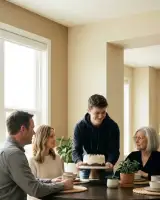
I sat in my black wheelchair at the oak dining table, six weeks out from hip surgery. Four red apple slices waited on a saucer near the edge.
They came from the orchard my late husband, Walt, planted behind Oakridge Manor forty years ago.
The country club had offered three times to buy that orchard for a golf course. I had said no three times.
Oakridge Manor was mine. I had never signed it over to anyone.
Still, everyone assumed I had. My son Briggs and his wife Valerie moved in to help me recover, and Valerie called it “our house” to anyone who would listen.
Briggs was a Marine sergeant coming home from deployment. His flight was due at six-thirty tonight.
Before he left, he set a small white camera on the china hutch so we could video call. Valerie pulled its plug last month and said the light bothered her.
Walt’s cherrywood cane hung on the coat rack in the front hall. Valerie had moved it to the highest hook. She called it a fall risk.
Her friends were coming for the club’s Harvest Gala weekend. Three guests, three guest rooms, and no place for me in her plans.
I slipped my hand into my right cardigan pocket and touched the folded hospital bracelet.
Hollis Memorial Hospital, admitted September 14. They wheeled me into surgery at ten past two that afternoon.
September 14 was Walt’s birthday. That was why I couldn’t throw the bracelet away.
I reached for the first apple slice.
Valerie’s heels clicked across the floorboards. She did not say a word.
She swept her bare forearm across the tabletop in one hard stroke.
The saucer skidded. The four red slices flew off the edge and landed on the hardwood beside my wheel.
One slice rocked once and lay still, white side up.
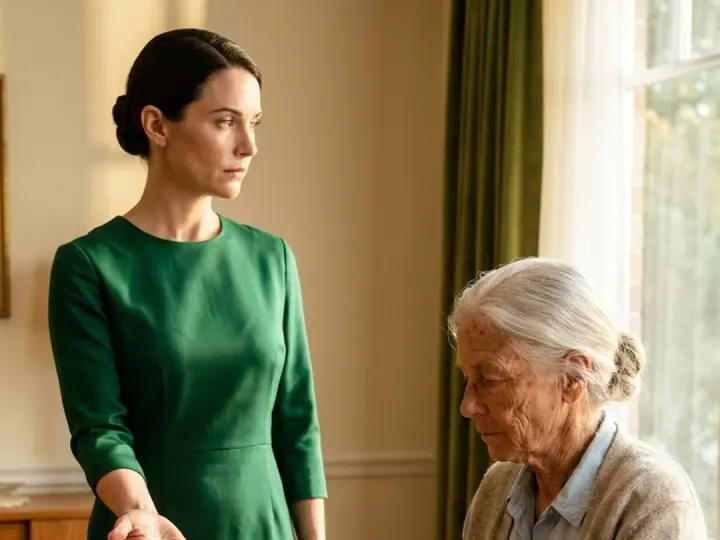
Valerie crossed her arms over her emerald-green silk dress and looked down at me.
“Eat what’s on the floor.”
I clutched the lapels of my cardigan. My fingers would not hold still.
“Please, I’m hungry.”
She stepped behind my chair. Her hands clamped onto the rubber push handles.
She yanked me backward so hard my head snapped forward. The wheels squealed toward the hallway arch.
“Wait in the garage.”
Then the wheels stopped dead.
A big hand in a dark-navy sleeve had clamped onto my front armrest. Red trim ran along the cuff.
I knew that hand. I had held it when it was the size of a walnut.
Briggs stood in the arch in his dress uniform, right behind his wife. He had landed three hours early.
From the look on his face, he had watched every second from the front hall.
Valerie let go of the handles. She raised both empty hands as if someone had pointed a gun at her.
“Honey, your mother dropped it!”
Briggs didn’t look at her. He slid his hand back along the armrest and covered my shaking fingers.
Then he dropped to one knee beside my chair. His knee hit the hardwood with a thud.
He turned his head and looked at his wife.
“Get out of Mom’s house.”
The color left Valerie’s face. Her lipstick looked painted onto paper.
Briggs stood, walked to the foyer closet and pulled out her two designer suitcases.
He had them halfway to the front door, maybe ten seconds later, when it swung open.
Three people rolled in with suitcases of their own, laughing about the drive.
Grant Pruitt, a lawyer from the club. His wife, Tessa. And Joan, who never went anywhere without her pearls.
They stopped. They stared at the Marine holding Valerie’s luggage.
I watched Valerie’s face change. The color came back, and something hard came with it.
She crossed to the hall table and opened her designer purse. She pulled out a thick stapled packet with a notary’s gold seal.
She smiled. It did not reach her eyes.
“She stays in the state ward tonight, or I call the sheriff and have her committed right now.”
The state ward meant Cedar Ridge County Care, the county home where people went and did not come back.
Grant cleared his throat. “Valerie, what’s going on?”
“Guardianship papers,” she said. “Iris isn’t safe here. Ask Briggs why he’s throwing my things around.”
Grant took the packet and flipped two pages. Then he pulled out his phone.
“I’ll call county intake,” he said. “Get this handled properly.”
He put the call on speaker and planted himself in the middle of the hallway. His rolling suitcase stood beside him like a fence post.
Briggs couldn’t wheel me past him without shoving a man into the wall.
Hold music played from the phone. Tessa and Joan waited by the door, still gripping their handles.
Valerie lowered her voice, the way people do at funerals.
“I didn’t want you to see her like this,” she told them. “Some days she thinks Walt is still alive. She talks about his apples like he picked them this morning.”
Joan glanced at the slices on the floor.
I said nothing. I folded my hands in my lap and felt the bracelet through the cardigan wool.
An old woman who argues loudly looks exactly like the woman Valerie was describing. I had learned that much this autumn.
Briggs’s jaw went tight. A muscle jumped in his cheek, and he took one step toward Grant.
I reached up and touched his wrist with two fingers.
He stopped. He looked down at me, and I shook my head once.
The hold music clicked off.
“County intake,” a tired woman said.
“Yes, I’m calling about an emergency placement for an elderly woman,” Grant said. “Iris Beaumont.”
“Do you have a court case number, sir?”
Grant flipped through the packet. He flipped through it again.
“I have a notarized petition.”
“A petition isn’t an order. I need a case number and an order signed by a judge before anyone is transported.”
Grant looked at Valerie. Valerie looked at the packet as if it had betrayed her.
“It’s being handled,” she said. “It’s Friday. These things take time.”
“Then I can’t open a placement,” the woman said. “Anything else?”
Tessa rubbed her arm. Joan checked her watch.
I cleared my throat. “Grant.”
He looked at me as if the furniture had spoken.
“Since you have the county on the line,” I said, “would you pull up the public property record for Oakridge Manor? It’s free. Anyone can look.”
Valerie laughed too quickly. “Grant, don’t indulge her.”
But Grant was a lawyer. Lawyers like records.
“Ma’am, can you hold one minute?” he asked the phone. Then he opened the county website and typed with his thumb.
His face changed before he spoke. He read it aloud slowly, the way people read a test result.
“Owner: Iris M. Beaumont, sole.”
Nobody moved. Then Tessa turned to Valerie.
“You told us you two owned this place.”
Valerie opened her mouth.
Joan didn’t wait. She turned her suitcase around and wheeled it back out the front door without a word.
Grant took the phone off speaker. “Never mind, ma’am. We’re done here.” He hung up.
He handed the packet back to Valerie without looking at her.
“I’m sorry, Mrs. Beaumont,” he muttered to me, and stepped out of the hallway.
Tessa followed him, her wheels rattling over the threshold.
Valerie stood in the hall holding her packet. Her mouth opened again. Nothing came out.
She walked out after her own bags.
Briggs picked up the two suitcases, carried them down the porch steps and set them on the gravel driveway. Then he came back in and shut the door.
Through the front window, I watched her stand alone on the gravel in her green silk dress.
Her luggage sat beside her. Down the driveway, her friends’ cars pulled away one after another.
Briggs went to the fruit bowl on the sideboard and chose a fresh apple from Walt’s trees.
He sat at the oak table and sliced it the way his father used to, eight even pieces. He set the plate in front of me.
I ate every slice. He watched each one go.
When I finished, he stood and studied the china hutch.
The little white camera sat where he had left it. Its power cord hung loose, the plug lying on the shelf.
But a tiny light on the front was still blinking.
Briggs picked up the plug, turned it over and set it back down. He stared at that light a long moment.
“What is it?” I asked.
“Maybe nothing.” He tucked his phone into his pocket. “Later.”
By five, Valerie was gone from the driveway. A car I didn’t recognize had picked her up.
I didn’t ask where she went. I should have.
At sunset, headlights swept across the front windows.
Three sets. A black sedan. A sheriff’s cruiser with its lights dark. And a long white medical transport van.
Briggs went to the door. I rolled myself out behind him onto the porch.
A tall silver-haired man stepped out of the sedan. Harlan Kessler, president of the Oakridge Country Club.
The man who had asked for Walt’s orchard three times.
He held up a folded paper with a court stamp.
“Emergency guardianship order,” he said kindly. “Judge Hale signed it this afternoon. Dr. Mercer’s examination letter is attached.”
No Dr. Mercer had ever examined me. No doctor had set foot in this house.
Valerie stepped out after him. Her hair was smoothed, and her face was calm again.
A gray-faced man stayed in the sedan’s passenger seat, staring at the dashboard.
A deputy climbed the porch steps. His name tag read RUIZ.
“Ma’am, I’m sorry. I’m ordered to transport Iris Beaumont to Cedar Ridge County Care tonight.”
He turned to my son. “Sergeant, step aside, or I’ll have to arrest you.”
Two attendants in white came up behind me. Their hands closed around my rubber push handles.
Briggs didn’t step aside. He didn’t move at all.
My wheels began to roll toward the porch steps.
Deputy Ruiz moved his hand to the cuffs on his belt.