Our son was born on the ninth of December, three days early, at four in the morning, during the first real snow of the year.
I named him Henry, after my grandfather, who used to tell me you learn everything about a person by watching how they treat someone who can’t do anything for them.
Grant came to the hospital that afternoon.
He stood in the doorway of my room with his coat still on, the way he had stood in the kitchen doorway that night.
“Can I?” he asked.
I nodded at the nurse.
She put Henry in his arms.
He held him for a long time by the window, with the snow coming down behind them.
He cried without making any sound.
I believe he loves him.
I believe he’ll try to be a good father, in the weekends he has.
But he learned he had a son at the far end of a table, as the last sentence of his marriage.
That moment is gone.
He’ll never get it back, and he knows exactly whose hand pushed it away.
Patricia drove two hours in the snow.
She came in with flakes melting on her silver hair and a paper bag held against her chest.
Inside was a yellow blanket she had knitted herself.
Soft, thick, a little uneven at one corner.
She stood at the foot of my bed holding it with both hands.
“I laughed,” she said.
“At his first picture. I’m going to be sorry about that for the rest of my life. Will you forgive me? Please let me be his grandmother anyway.”
I didn’t answer right away.
I looked at her hands on the yellow wool.
They were shaking.
“Come here,” I said.
“Hold him.”
She wrapped Henry in the blanket and held him against her shoulder, and she wept into the yellow wool without any sound at all.
I let her.
That counted for something.
Neil came last, close to midnight.
He came straight from his shift at the airport, still in his work jacket, still smelling of jet fuel.
Corinne was home with a cold.
He held Henry very carefully, with his big scrubbed hands, like he was holding an engine part that cost a fortune.
Then he gave him back and said, “Can I talk to you for a minute? Out there?”
The nurse said I could walk a little.
We went down the hall to the family lounge.
A vending machine hummed in the corner.
Outside the window, the snow was coming down orange under the parking lot lights.
Neil didn’t sit.
He stood by the window with his hands in his jacket pockets.
“I knew,” he said.
I held onto the back of a chair.
“In September,” he said.
“The hotel is right across the road from the cargo gate. I cut through that lot sometimes on the way to the night shift. One Tuesday I saw Grant’s car. Simone’s was parked right next to it.”
He didn’t look at me.
He looked at the snow.
“I went to see him that weekend. He swore it was the only time. He said it was closure. He said if I told you, the stress would hurt you and the baby, and it would be on me.”
Neil’s jaw worked.
“And I believed him. Because I wanted to.”
“Two weeks later, the cars were there again,” he said.
“Same spot. Same Tuesday.”
I thought about the basement.
“Already made up.”
I thought about him at the table, starting to say something, and Corinne’s hand on his arm.
“You looked at Marcus’s phone for two seconds,” I said slowly.
“Your face didn’t move.”
“I’d already seen it,” he said.
“Not those photos. The cars. A lot of times. I’d made up the basement in September, because I knew one day he’d need it.”
The vending machine clicked and hummed.
Somewhere down the hall a baby that wasn’t mine was crying.
“I couldn’t tell you myself,” he said.
“He’s my brother. And I’m a coward, Rach. So I did the only brave thing I could do where nobody would see me.”
He finally looked at me.
“I drove to Marcus’s house. He was out front, in the garden, tying up his tomato plants. I said, ‘Look at your card statement. Tuesdays.’ And I got back in my truck and left.”
I thought of a turn signal clicking in a parked car.
I thought of Marcus’s flat, careful voice.
“I looked.”
I sat down in the chair.
My legs just decided for me.
“Why him?”
I asked.
“Why not me?”
“Because you’d have asked Grant,” Neil said.
“And Grant would have told you that you were jealous. And you’d have believed him. You’d been believing him for a year.”
He swallowed.
“Marcus was the one person Grant couldn’t call jealous.”
I put my face in my hands.
Not crying.
Just holding my own face, the way you hold something that has been dropped and might still be in one piece.
“You let him move my card,” I said into my hands.
“You sat there.”
“I know.”
“You watched her take the picture.”
“I know.”
His voice cracked on it.
“I had already done my one brave thing in somebody’s driveway. I didn’t have a second one in me at that table. That’s the truth, and I’m not proud of it.”
I took my hands away from my face and looked at him.
A big man in a grease-stained jacket, standing in a hospital lounge at midnight with snow melting on his boots, waiting to be told what he was.
I thought about the far end of the table.
About how it feels to sit there while everyone you love looks somewhere else.
He hadn’t looked somewhere else.
He had just looked from very far away.
“Come on,” I said, and held out my hand so he could help me up.
“Come hold your nephew again. You were doing it wrong.”
He laughed, a wet, broken laugh, and pulled me up very gently, like I was an engine part too.
Marcus sent a card the next week with a packet of tomato seeds tucked inside.
“For when he’s old enough to dig,” it said.
I called him.
I told him I knew about Neil.
He was quiet for a second.
“He made me promise not to tell you,” he said.
“I said I wouldn’t. I didn’t say I wouldn’t be glad when you found out.”
The ultrasound print is in a small gold frame on Henry’s dresser now.
Same picture.
His little nose.
His fist up by his cheek.
Tucked behind it, inside the frame, is one cream place card with a thin gold edge.
Mine.
The other one, with her name on it, I threw away the night of the party, in the gas station trash can where I pulled over the first time.
Sometimes, when I’m rocking Henry at two in the morning in the glider, wrapped in Patricia’s yellow blanket, I look at that frame.
I think about how close it came to ending up in someone else’s clutch.
Someone who said, “Is this mine to keep?” and got a laugh for it.
It was never hers to keep.
Neither was Grant, it turns out.
Neither was my seat.
The crib Tessa and I built holds.
Henry sleeps in it now, arms up over his head like he’s surrendering to something.
Grant takes him every other Saturday for a few hours and brings him back on time, with a clean diaper and a too-big hat.
On Sundays Patricia comes for lunch.
She always sits beside me.
Neither of us has to ask anymore.
Neil comes on Wednesdays, before his shift, and fixes something in the house whether it needs fixing or not.
Last week it was a cabinet hinge that was perfectly fine.
In the spring, I’m going to plant Marcus’s tomatoes in a pot on the back step.
Henry will be too little to dig.
I’ll do the digging, and he can watch.
When he’s older, he’ll ask about his dad and me.
I’ll tell him the truth, gently.
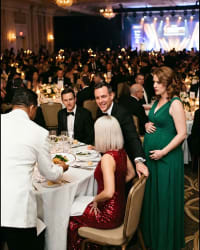
That his mother once gave a man one last chance, at a long table, in front of everyone he loved.
And that when he didn’t take it, she stood up, walked to the head of the table, and took her son’s picture back.
Some of my friends say I should have confronted Grant at home the night Marcus called, and spared everyone the scene.
Others say the birthday table was the only place he would ever have told the truth.
Should I have confronted him at home, or was his birthday table the right place?