Chapter 1: Family Only
I met Owen at two in the morning, in a hospital hallway, wearing a gown that tied in the back and dragging an IV pole on squeaky wheels.
It was the night after my surgery. The nurses wanted me up and walking, so I was walking. Slowly. Holding my right side the way you hold a bag of groceries that might rip.
The family lounge at the end of the sixth floor had one lamp on. A man about my age was asleep sitting up in a vinyl chair, with a paper cup of lemon ice melting on the table next to him.
The wheel of my IV pole squealed and he woke up.
“Sorry,” I said.
“No, it’s fine.” He rubbed his face. “I’m supposed to be awake anyway. My mom’s down the hall.”
He told me his mother had been on dialysis for three years. The day before, she’d gotten a kidney.
“From a stranger,” he said. “Some person just decided to do it. Walked in and gave it away. Somebody we’ll never meet.”
Then he started to cry, quietly, the way men do when they think nobody’s looking. I sat down in the chair next to his and didn’t say anything. After a while he offered me the lemon ice.
I did not tell him why I was on that floor.
I’m a seventh-grade science teacher. I’m not brave, and I’m not rich.
But my grandmother spent the last four years of her life hooked up to a dialysis machine three days a week, waiting for a kidney that never came. I was twenty when she died.
At twenty-six, I called a transplant center and asked if I could give a kidney to someone I didn’t know.
It took most of a year of tests and talks, and everyone kept reminding me I could change my mind. I didn’t. I asked to stay anonymous. I didn’t want a thank-you. I didn’t want anyone to feel they owed me. I just wanted, somewhere, one less family sitting in a lounge at two in the morning.
The surgery was last October. It left three small scars and one longer one, low on my side.
Owen texted me a month later. We’d swapped numbers in the lounge so he could tell me how his mom was doing.
“She’s home,” he wrote. “She’s complaining about the food again. That’s how I know she’s okay. How are you? I never asked what you were in for.”
“Just a procedure,” I wrote back. “I’m fine.”
We got coffee. Then dinner. Then it was spring and we were together, the kind of together where you leave a toothbrush.
And somewhere in there, I knew.
Same hospital. Same floor. Same day. “A stranger.” I’d done the math in my head a hundred times and told myself it was a coincidence.
Then in April, the transplant center forwarded me a letter from my recipient, no names, two pages of beautiful, careful handwriting.
“My son sat beside my bed every single night,” it said. “He brought me lemon ice from the cafeteria because it was the only thing I could keep down. I don’t know who you are. I think about you every day.”
It was signed only with an M.
I sat on my kitchen floor and held that letter for an hour.
Owen’s mother is Margot.
She is sixty-one, a widow, and she owns half the commercial buildings on her side of town. She is elegant in the way that makes other people check their shoes.
For eleven months, she refused to meet me. “She’ll come around,” Owen kept saying. “She just thinks every woman I date is after my dad’s money.”
What Margot knew was that I taught middle school, that I had student loans, and that I’d grown up in a two-bedroom apartment over a dry cleaner’s. Owen had made the mistake of telling her all three, proudly.
I never told Owen. It was mine, the one completely clean thing I’d ever done, and I didn’t want it to turn into a debt. I didn’t want him to love me because of it. And I really didn’t want Margot to have to be polite to me because of it.
So when Owen told me his mother was having a small dinner at home for the first anniversary of her transplant, and that he’d insisted I come, I almost said no. Then I bought a plain sage-green dress, put my hair in a low ponytail, and went.
She opened the door herself.
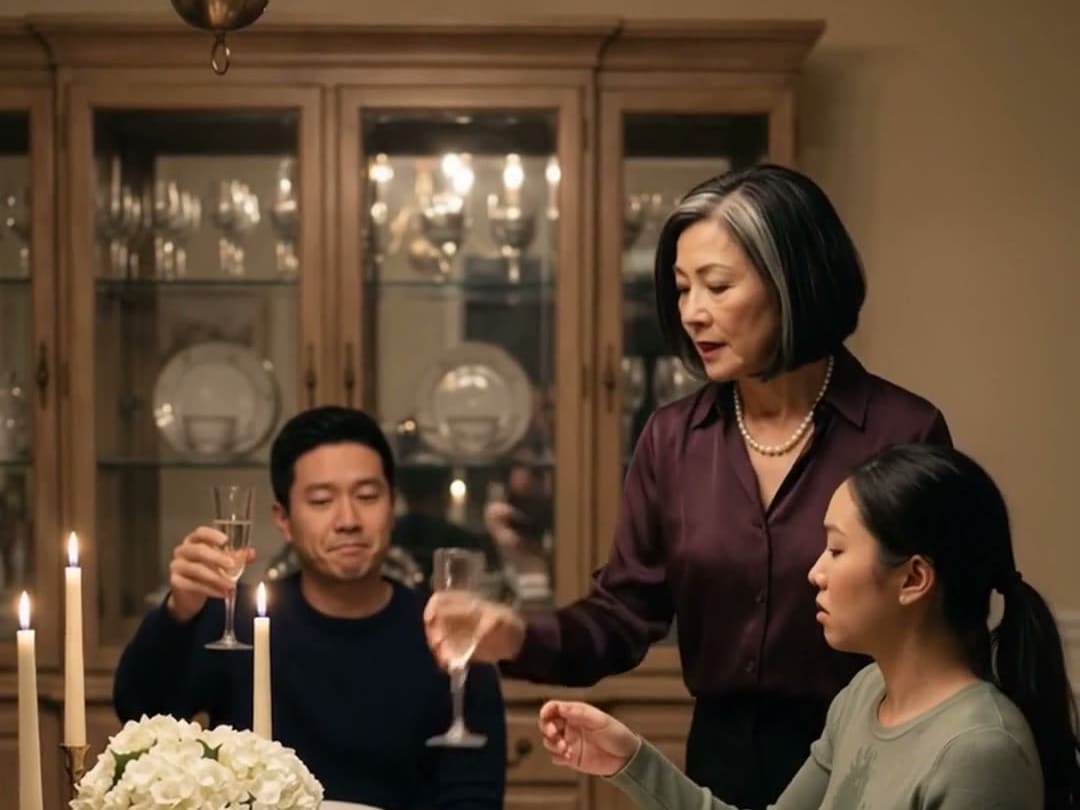
Silver-streaked bob. Pearls. A deep plum blouse. She looked at me from my shoes to my ponytail.
“You’re the teacher,” she said.
“Hannah. It’s so nice to finally meet you, Mrs.—“
“Margot is fine.” She turned and walked inside. She didn’t take my coat, so I hung it on a hook by the door myself.
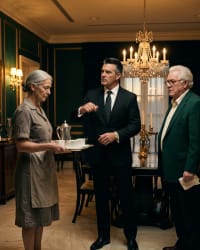
Three places were set at a long dark table: white hydrangeas, tall ivory candles, a roast chicken on a silver platter, champagne in a bucket.
Dinner was forty-five minutes of questions that weren’t questions.
“Seventh grade. How much do they pay you for that, these days?”
“Mom,” Owen said.
“I’m just curious. And your parents are in... retail?”
“My mom manages a dry cleaner’s,” I said.
“How nice.”
I kept smiling. Under the table, my hand went to my right side, the way it has whenever I’m nervous since the surgery.
At eight-thirty, Margot stood up and poured the champagne herself. Three crystal flutes.
“I want to make a toast,” she said. “It’s been exactly one year.”
Owen raised his glass. I raised mine.
Margot reached across the corner of the table and plucked the flute right out of my fingers. Champagne sloshed over my hand and soaked my sleeve to the wrist.
“Not you,” she said. “This toast is family only.”
She set my glass down by her own plate, out of my reach.
Owen’s glass was still in the air. He looked at me. He looked at his mother. He didn’t put it down.
Margot lifted her own glass high, and turned so she was looking straight at me while she spoke.
“To my kidney donor,” she said. “More class than Owen’s latest girl.”
And Owen laughed.
It was a small, nervous laugh, the kind that just falls out of you. I know now that he hated himself for it before it was even over. But I heard it. And Margot heard it, and she smiled.
My hand was on my side.
I could feel the scars under the knit of my dress. Three small ones and one longer one.
I thought about my grandmother. I thought about the lemon ice. I thought about the letter signed M, folded in the wallet in my purse by my chair, where it had been since April.
I stood up.
“You’re welcome, Margot,” I said. “It was my kidney.”
Her glass stopped in the air.
It tipped, just slightly. Champagne ran over the rim and down over her fingers and dripped onto the linen, and she didn’t notice.
“Yours?” she said.