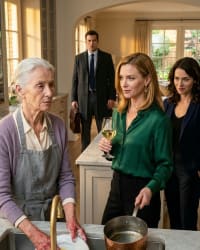
Three weeks later, on a gray Sunday afternoon, Margot climbed the two flights of stairs to my apartment.
She came alone. She didn’t bring flowers or a gift. I’d told Owen to tell her not to.
She stood in my tiny kitchen in her good wool coat, next to my wobbly table and my secondhand chairs, and for the first time since I’d known her, she didn’t look like she owned the room.
“I read your note,” she said.
“Okay.”
“I’ve been rude to a lot of people in my life,” she said. “Waiters. Contractors. My late husband’s secretary. I always thought it didn’t matter, because they weren’t anyone to me.” She looked at the window. “And I stood at my own table, toasting a stranger for being kind, and insulted the stranger to her face.”
“You didn’t know,” I said.
“Owen told me about your grandmother,” she said. “The dialysis. Four years.” She was quiet for a moment. “I had three. Three days a week, four hours a chair. I used to look at the other people in that room and think, at least I’m not like them. At least I have money. At least I have a son who visits.”
“You did have a son who visited.”
“I had a son who visited,” she said, “and a stranger who walked in off the street and fixed it. And I spent a year thinking about that stranger, imagining her. I imagined someone like me, I suppose. Someone with a nice coat.”
She almost smiled. “Owen says that’s the problem. He’s right. He doesn’t say it often, so I have to give it to him.”
Then she said it. Plainly. No speech.
“I’m sorry, Hannah. For the glass. For the questions. For the check. For what I said about you in front of my son.”
“Thank you,” I said. And I meant it.
We stood there for a moment. It was awkward. It was going to be awkward for a long time, probably. That was okay.
I had a bottle of sparkling cider in the fridge, left over from a school potluck. I took it out and got down two mismatched glasses, one with a chip in the rim.
Before I could pour, Margot reached over and took the bottle out of my hand.
She filled my glass first, carefully, all the way. Then her own.
She didn’t make a toast. Neither did I.
We just stood at my little counter, in our coats, and drank.
Owen came by that evening with takeout. He found the two glasses in my sink, one of them with a faint plum lipstick mark on the rim.
He picked it up and looked at it for a long time.
“She drank out of the chipped one?” he said.
“She picked the chipped one,” I said.
Should Hannah have kept her secret forever, or was the dinner table the right time to tell her?