It’s a small tin lunchbox, dull sage green, with a bent wire handle and a latch worn silver by thumbs.
There is a dent in the lid the size of a half dollar. It came from a toddler in house number four, who threw it down a flight of stairs in 1998. My mother kept it anyway. When she died, it was the one thing I asked for.

I have carried it to every job since. Eleven placements, one lunchbox. It sits on whatever table I am allowed to sit at, and when I am not allowed to sit, it sits on the dryer.
I unlatched it. Tuna on rye, cut corner to corner. A pickle spear in wax paper.
I took one bite. A few crumbs fell on the tablecloth. I was reaching to brush them into my palm when I heard heels in the hall, and the clink of a wineglass, and two women laughing about somebody’s husband.
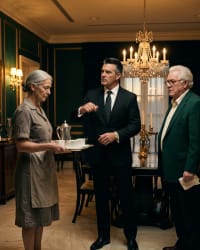
Audrey came in first, in an emerald silk dress, with a bottle of white wine in her hand. Priscilla was behind her. Mid-forties, wavy ash-blonde hair, a coral blouse, pearl earrings, a glass already poured.
Audrey stopped. The laughing stopped with her.
“What is that smell?” she said.
“Tuna, Mrs. Sullivan. I’ll be quick.”
“At the table. With the crumbs.” She set the bottle on the sideboard. She walked toward me, and I felt it in my stomach, the way you feel a step that isn’t there.
I truly thought she might be about to brush the crumbs off the cloth herself.
Her right hand closed around the bent handle of my mother’s lunchbox. She lifted it off the table, swung her arm out to the side, and dropped it into the steel wastebasket by the sideboard.
The sound was not soft. It was a flat tin clang, like a dropped pan, and the lid bounced once against the inside of the basket and settled.
“No staff food at my table,” Audrey said.
Priscilla laughed.
It was a short dry puff of a laugh, through her nose, into the rim of her wineglass. She did not look at me when she did it. She looked at Audrey, the way you check that a joke has landed.
Nobody spoke after that. The refrigerator hummed through two walls. Her gold bracelet clicked once against the edge of the sideboard.
My hands were flat on the cloth. I could feel my pulse in my palms. I was not angry yet. That came later, in the car. In that second I was only very, very still.
I looked at the empty place where the lunchbox had been. A pale rectangle in the crumbs. I did not look at either of them. I did not trust my face.
“That was my mother’s,” I said.
It came out quieter than I meant. It was the one sentence of the whole afternoon that I had not planned, and the only one I would take back for nothing.
Audrey gave a short breath through her nose. She folded her arms and looked down at me, chin high, the window behind her.
“I’m sure it was very sentimental,” she said. “I’m sure you’ll find another.”
“The Household Terms say a nanny is entitled to a seat at lunch.”
“The what?”
“Page three. You signed them in March.”
“I don’t remember signing anything about lunch. I remember paying a great deal of money for staff who do their jobs and stay out of my way.”
She unfolded one arm and pointed one gold-ringed finger at my face. “I will not argue with the help in my own dining room. I’ll replace you with ten new girls.”
I heard it clearly. I heard every word.
And something in me, very quietly, went calm. It wasn’t the calm of giving up. It was the calm of my mother with her hands in a sink full of other people’s dishes, deciding.
Priscilla’s glass was halfway to her mouth. She was enjoying it. She had settled into the chair at the near side of the table like a woman at a play.
I put my right hand to my chest. My fingers found the navy cord at my neck, and I lifted it, and I turned the card over so it lay face up against my cardigan.
A plain white card. No printing on it, only a small teal crest in the center. A shield with an open book across it, the sign my mother drew on a napkin the year she started the agency.
I held it out toward Audrey, on its cord, at the length of my arm.
“I run the agency,” I said.
It seemed to take her a second to understand that it was a sentence. Her finger was still pointing. It stayed in the air as if she had forgotten it was attached to her.
Then her face came apart.
Her chin dropped half an inch. Her eyes widened and then widened more.
Her lips came apart and the color left her cheeks all at once, from the forehead down, like a tide going out.
Her pointing hand came down and found the gold chain at her throat and held on to it.
Priscilla’s glass stopped. It stopped an inch from her lips, tilted, and a drop of white wine ran down the outside and fell onto the cloth. She lowered it, very slowly, without taking a sip.
“You’re off our list,” I said.
I let the card fall back against my chest. I folded my hands on the white linen where the lunchbox had been.
Audrey laughed.
It came out thin and high, one note, like a glass being tapped. She let go of her necklace and pressed her fingers flat against her collarbone, as if to check that she was still dressed.
“Cute,” she said. “Pack your things.”
Nobody moved. The sun had slid a few inches along the tablecloth and it lay across my wrist now, warm on the skin.
Priscilla was staring at the card on my chest.
“Audrey,” she said. It was the first thing she had said since we met. “That’s the crest on the Terms. It’s in your kitchen drawer. I saw it in March when you were complaining about the fee.”
“It’s boilerplate.”
“Page three,” I said. “You signed it in March. A nanny gets a seat at lunch.”
“My mother wrote those pages in the spare bedroom of our apartment, after a family made her eat in a car,” I said.
Audrey said nothing. Her eyes went to the card, then to me, then to the steel wastebasket with a dented green corner showing above the rim.
She stepped back and her hip touched the sideboard. The gold mirror above it trembled, and so did the reflection of her face in it.
Then her hand went to her pocket. She pulled out her phone and held it in front of her like a shield.
“I’m calling my husband.”
“Call him, Mrs. Sullivan,” I said. “The dining room camera records sound. You showed me the app on my first morning.”
She looked up. She looked past me, at the little white dome in the corner of the ceiling above the sideboard. I had noticed it on day one and had never stopped noticing it. A small black eye, always open.
I think that was the moment it finally reached her. Not who I was. What she had just done, out loud, in the one room of her house where she had made sure that everything was kept.
Priscilla set her wineglass down on the cloth, hard enough that it rang. She stood up. She did not look at Audrey. She walked to the wastebasket, reached in with both hands and lifted my mother’s lunchbox out.
She wiped the lid with her napkin, the way you wipe a child’s face. She carried it down the length of the table and set it in front of me, with the handle turned toward my hand.
“I’m sorry,” she said, very low. “I laughed. I’m so sorry.”
I could not say anything. I put my palm on the dent and held it there.
Audrey did not say another word. She turned and walked out with her phone against her chest, her heels very quick on the hall floor, and then the stairs, and then a door somewhere above us closing hard.
Priscilla took her bag from the back of her chair. At the dining room door she stopped.
“For what it’s worth,” she said, “I’m not having lunch in this house again.”
Then I was alone with a plate of salad nobody would eat, and my mother’s lunchbox, and the sun on the cloth. I latched it. I ate the pickle spear, because it was mine.
I looked in on Owen at one. He was asleep on his side with the giraffe in the crook of his arm and one fist open on the pillow.
I stood in the doorway until my knees stopped shaking.
Then I went down to the laundry room and called Priya.
“Is it done?” she whispered, as though she were the one in trouble.
“It’s done.”
“Are you okay?”
“No,” I said, and then I laughed, because my mother used to answer that question the same way. “Not yet. But I will be.”
I told her everything in under two minutes. She said very little. When I got to the bag in the wastebasket she made a sound I have only heard from her twice before.
At a quarter past one Audrey came down.
She had changed her dress. Same silk, a different green. She had redone her lipstick and her bun, and her hands were perfectly steady, which told me she had spent twenty minutes upstairs making them so.
She found me in the kitchen washing Owen’s lunch dishes. I had put my badge back around my neck, face out.
“Let’s be adults about this,” she said.
“All right.”
“I’m sure there’s been a misunderstanding. Some kind of test. Fine. I failed your test.” She said the word as if she were holding it with tongs. “What would make this go away?”
I put the cloth down.
“Name a number, Lena. Your agency, your fee, a bonus for the staff. Anything. Gordon doesn’t need to hear about this.”
My mother used to tell me about families like that. They always reached for the checkbook first, because it had always worked, and they were always sincerely baffled when it didn’t.
“There isn’t a number,” I said.
Her face changed. The softness slid off it, and what was underneath was fast and cold, and I realized I was seeing the woman Tess had seen on day eleven.
“Then understand this,” Audrey said. “I know every mother in Hartwell Hills. I have lunch with them every Thursday. By the end of the week they will all know that the agency sent a young woman into my home under false pretenses and that something went missing.”
“Missing.”
“I have a ring that has gone missing before. I’m sure it will again.”
I stood there with the damp cloth in my hand and it felt, for a moment, like the floor of the kitchen was tilting.
“That’s what you told Priya about Tess,” I said. “Your ring turned up four days later. Nobody called to tell her.”
“I don’t know what you mean.”
“The kitchen camera does.”
She went absolutely white. Not the way she had in the dining room, from shock. This was calculation. I watched her work it out: a year of footage on her own server, every hallway, every drawer.
She picked up her phone again. Her thumb moved. I think she meant to open the app and start deleting.
Then Owen’s monitor crackled on the counter. A small cough, a rustle, a giraffe being squeezed.
Audrey stopped. She looked at the monitor. Whatever else she is, she is his mother. She put the phone face down on the marble and stood there breathing.
At ten past two her phone rang. The screen said Gordon.
I walked to the far end of the kitchen, to the window above the sink, and I looked at the garden while she answered. I did not listen. Then I listened to all of it, because the kitchen is a large room but not that large.
“The agency is spying on us,” she said. “The new girl is a fraud. She’s the owner, Gordon. She came into our house to trap me. Nobody would do that unless they wanted money.”
There was a long silence. I could hear his voice, small and tinny, asking a question I couldn’t make out.
“No. I only moved a lunch,” Audrey said.
Another silence. A longer one.
“Tonight? Gordon, you don’t have to. It isn’t a... Fine. Fine. Yes.”
She put the phone down on the island. She did not look at me.
“My husband is coming home tonight,” she said. “He lands at nine. He would like you to be here.”
“I’ll be here,” I said. “I’m not leaving Owen with anyone else.”
She flinched at that. It was the smallest thing, a muscle by her mouth. Then she walked out of the kitchen and left me with the monitor and the dishes.