Chapter 1
The C-130 transport plane touched down on the rain-slicked tarmac at Fort Overton twenty-two minutes before the annual command dinner was scheduled to begin.
I unbuckled my harness, grabbed my canvas flight bag, and stepped down the rear steel ramp into the sharp autumn wind.
My plain olive-drab field utility jacket still smelled like hydraulic fluid, diesel exhaust, and the dry red dust of the Nevada proving grounds.
A faint smudge of grey tarmac grit clung to my right cheek, and my black combat boots were scuffed at the toes from forty-eight hours of continuous field inspections.
I had spent the last two days crawling beneath armored recovery vehicles and auditing depot maintenance logs for the Pentagon’s Logistics Readiness Board.
There was no time to stop at the visiting officers’ quarters to press a dress uniform or polish my brass before the banquet doors closed.
Three-star General Leland Kinsella had personally requested that I brief the garrison leadership right after the dinner’s opening toast.
In my right hand, I carried the folded cream command-orders sheet signed that morning by the Chief of Staff’s office.
A young corporal in a rain poncho met me at the edge of the flight line with a dark green staff sedan.
“Ma’am, the officers’ banquet hall is already filling up,” the corporal said as he held the rear door open for me.
“Thank you, Corporal. Just drop me at the side colonnade,” I replied, sliding onto the vinyl seat and setting my flight bag on the floorboard.
As the sedan rolled past the brick barracks and the floodlit parade ground of Fort Overton, I glanced down at my olive-drab sleeves.
To anyone who did not know why I had flown in from Nevada, I looked like an overworked maintenance technician who had wandered out of the motor pool.
That had never bothered me during my fourteen years of service, and it certainly did not bother me tonight.
When you spend your career rebuilding broken supply chains in combat zones, you learn very quickly that crisp tailoring never pulled a stranded convoy out of a mudslide.
The sedan pulled up beside the tall arched windows of the Fort Overton officers’ banquet hall at 1852 hours.
Warm golden light from brass wall sconces and crystal chandeliers spilled across the wet flagstones outside the entrance.
I left my canvas flight bag locked in the trunk with the corporal, kept only my folded cream command-orders sheet in my right hand, and walked inside.
The foyer smelled of lemon oil, roasted prime rib, and expensive cologne.
Dozens of captains and majors stood in clusters along the dark walnut wood wall paneling, wearing immaculate charcoal and navy dress uniforms with gleaming leather belts.
Laughter and the clink of water goblets echoed off the high coffered ceiling.
The moment I stepped past the double oak doors onto the polished oak wood floor, the nearest conversations dropped to a low murmur.
Several junior officers glanced at my worn black combat boots, my plain olive-drab utility trousers, and the tan crew-neck undershirt visible at my collar.
Nobody wore unit patches or name tapes on the plain field utility jackets issued to the inspection team, which left my chest completely bare of rank insignia.
I ignored the stares, kept my spine straight, and walked down the center aisle toward the long head banquet table at the front of the hall.
The head table was draped in a crisp white tablecloth that reached nearly to the polished oak floor.
Along its front edge stood a row of upright folded cream tented reservation cards marking the seats for the command staff and visiting evaluators.
I spotted my tented reservation card third from the center podium, right beside the silver water pitcher.
I stepped behind the front corner of the white-tablecloth head table, holding my folded cream command-orders sheet in my right hand just above the upright tented card.
Before I could even reach for the back of the walnut chair, a broad shadow fell across the white linen.
Captain Heath Iverson, the garrison’s thirty-five-year-old headquarters company commander, stepped sharply into my path from the right side of the table.
He was a broad, muscular man with short cropped blond hair and a clean-shaven jaw that jutted out with practiced arrogance.
His dark charcoal dress uniform jacket was pressed to a razor edge, cinched with a mirror-polished black leather belt over matching dark charcoal dress trousers.
For a split second, his left hand rested near the edge of the white tablecloth while his cold blue eyes raked over the smudge of dust on my cheek.
Then, without a word of warning, Heath lifted his left hand fifteen centimeters and slammed his open palm down onto the white tablecloth right beside my upright tented reservation card.
The sharp thud of his palm against the table made the silver forks chime against the china plates.
Two lieutenants standing near the wall flinched and went silent.
Across the room, near the dark walnut paneled doorway at the rear of the head table, a tall sixty-year-old man with silver close-cropped hair paused on the threshold.
It was three-star General Leland Kinsella in his dark navy dress uniform jacket, colorful service ribbons gleaming on his chest and gold insignia on his shoulders.
Heath had his back angled away from the doorway and never noticed the general stop to watch.
Instead, Heath lifted his left palm from the white tablecloth, tilted his chin down, and let out a sharp nasal scoff as he sneered at my dusty olive-drab jacket.
“You push papers in the motor pool.”
His loud, clipped baritone voice carried clear across the front three rows of tables, turning twenty heads in our direction.
A couple of young staff captains near the buffet table exchanged uncomfortable glances, waiting to see if I would apologize and retreat.
I did not take a single step backward.
I squared my shoulders in my plain olive-drab field utility jacket, kept my voice calm and measured, and met his glare without blinking.
“Headquarters assigned my seat here, Captain.”
Heath’s jaw tightened at the steady tone of my voice, and an ugly flush crept up his neck above his stiff dress collar.
He raised his right hand in a dismissive wave toward the rear service doors at the back of the banquet hall, then lowered his arm back to his side.
“That field jacket embarrasses us. Back row.”
Calmly, I folded my cream command-orders sheet into my jacket pocket and stood at attention with empty hands at my sides.
At that exact second, firm dress-shoe footsteps echoed across the polished oak wood floor.
General Leland Kinsella stepped forward into the center gap right between us, his lined face carved in stone beneath the warm tungsten light of the brass sconces.
Heath’s posture stiffened immediately, an eager, self-satisfied smirk tugging at the corner of his mouth.
He clearly assumed the commanding general had walked over to reprimand the dusty clerk who was holding up the seating at the head table.
Instead, General Kinsella walked right past Heath without giving him a glance.
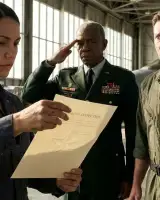
The sixty-year-old three-star general stopped eighty centimeters in front of me, squared his shoulders toward my olive-drab field jacket, and snapped his right hand up to his brow in a crisp, rigid military salute.
The snap of his dark navy uniform sleeve sounded like a pistol shot in the dead silence of the banquet hall.
Every whispers in the room died instantly.
Heath’s arrogant smirk vanished as if someone had struck him across the face.
All the color drained from his cheeks, his eyes widened in disbelief at the general’s raised hand, and he stammered in a shaken baritone voice.
“Why salute a motor-pool clerk, General?”
General Kinsella held the salute for one more beat of absolute silence before lowering his right hand cleanly to his side.
He turned his head twenty degrees toward Heath, his deeply furrowed brow and hard eyes locking onto the captain like a targeting radar.
“Colonel Gillespie’s task force saved my battalion.”
The general’s deep, gravelly bass voice rolled through the walnut-paneled hall, heavy enough to make the junior officers in the front row straighten their spines.
Heath’s mouth fell slightly open, his chest rising and falling in shallow, panicked breaths as the words registered.
I turned my steady gaze onto Heath, keeping my voice low, even, and unmistakable.
“Report to dawn duty, Captain.”
Heath’s shoulders slumped and he took an involuntary half-step backward on the polished oak floor, frozen in front of the entire garrison staff.
For three seconds, nobody in the banquet hall moved a muscle.
Then the walnut side door behind the podium vibrated as General Kinsella’s aide hurried over with a secure landline handset blinking red.
“General Kinsella, urgent call from the Pentagon duty officer on line one,” the aide whispered.
General Kinsella gave me a brief nod. “Excuse me for ninety seconds, Colonel Gillespie. Hold my seat.”
The moment General Kinsella stepped into the adjacent communications alcove and pulled the paneled door shut, the stunned paralysis on Heath Iverson’s face curdled into reckless panic.
Heath knew what an incoming Pentagon logistics colonel meant for the headquarters motor pool—and more importantly, what it meant for the monthly readiness ledgers bearing his signature.
Before I could take my seat beside the upright tented reservation card, Heath lunged across the front aisle toward the heavy double oak entrance doors.
With a metallic clack that echoed through the hall, he threw the heavy brass deadbolt into the doorjamb, locking the main entrance from the inside.
Gasps rippled across the round banquet tables as officers half-rose from their chairs.
Heath spun around, his face slick with sweat under the chandelier light, and hammered his fist twice against the service corridor glass beside the doors.
Two burly garrison security sergeants whom Heath had stationed in the outer hallway earlier that evening pushed through the side service door with batons on their belts.
Heath marched back toward the head table with the two security sergeants flanking him, pointing a trembling finger straight at my olive-drab chest.
“Nobody leaves this hall!” Heath barked, his voice cracking with desperation as he tried to project authority over the stunned room.
“This woman walked off the flight line with no unit patches, no base ID badge on her lapel, and an unverified paper slip!”
He stopped two paces from me, blocking my path to the podium and reaching out as if to demand the folded cream command-orders sheet from my pocket.
“Under Fort Overton security protocol, I am placing this individual under temporary detention for impersonating a field-grade officer and forging transfer orders,” Heath announced loudly.
He turned to the two startled security sergeants. “Confiscate that paper from her jacket pocket immediately and escort her to the guardhouse before the General returns!”
The two sergeants looked from Heath’s sweating face to my calm eyes, their hands hovering uncertainly above their belts.
“Captain Iverson,” I said quietly, my hands resting loosely at my sides beside the white tablecloth. “Think very carefully about what happens the second you touch that pocket.”
“I am the headquarters company commander of this post!” Heath shouted, stepping closer to block the aisle. “Hand over those forged papers right now, or you leave this banquet hall in handcuffs!”
Before either sergeant could take another step, the brass handle of the side alcove door turned with a sharp click.
General Leland Kinsella stepped back into the banquet hall—and he was not alone.
Marching directly behind the three-star general were four military police investigators in crisp duty belts, led by a major from the Army Criminal Investigation Division carrying a thick red-tabbed motor-pool audit binder.
The entire banquet hall went so quiet that you could hear the hum of the ventilation ducts high in the rafters.
The two garrison security sergeants froze in their tracks, their eyes darting to the gold oak leaves on the CID major’s shoulders.
Immediately, both sergeants stepped back and snapped to attention, leaving Captain Heath Iverson standing completely alone in the center aisle.
General Kinsella walked slowly back to the head table, his silver close-cropped hair gleaming beneath the chandelier light and his lined face dark with cold fury.
“Did I just hear you order garrison security to detain Colonel Gillespie, Captain Iverson?” General Kinsella asked, his deep bass voice vibrating across the floorboards.
Heath swallowed hard, a bead of sweat rolling down his temple and soaking into the stiff collar of his dark charcoal dress uniform jacket.
“General, sir,” Heath stammered, gesturing wildly toward my olive-drab field utility jacket. “I was only enforcing post access protocols! She arrived in unverified field utilities without a garrison pass!”
“She arrived on a priority military airlift that I authorized at 0600 hours this morning,” General Kinsella replied coldly.
He gestured toward the folded cream command-orders sheet resting inside my left jacket pocket.
“And if you had bothered to read the headquarters dispatch sitting on your own orderly room desk at 1400 hours today, you would know why she came straight from the tarmac.”
General Kinsella turned toward the sixty officers seated across the banquet hall, making sure every lieutenant, captain, and major in the room heard every word.
“Three years ago, in the Kunar valley, my mechanized battalion was cut off after a bridge collapse during a winter flash flood,” General Kinsella said clearly.
“Our fuel bladders were punctured, two recovery cranes were deadlined, and we had less than fourteen hours of generator diesel left for the forward surgical tent.”
Across the room, several senior majors nodded grimly, recognizing the infamous winter extraction that was still taught at the staff college.
“The officer who reorganized the air-drop rigging in forty-knot winds and rebuilt two winch assemblies with her own hands in freezing mud was then-Major Beatrice Gillespie,” the General said.
“She personally led the relief convoy across the gorge when nobody else thought the road would hold.”
A murmur of awe rippled through the banquet tables as dozens of eyes turned toward the faint smudge of dust on my cheek and my worn black combat boots.
“She did not do it from behind a polished mahogany desk,” General Kinsella continued, his eyes narrowing as he looked back at Heath’s pristine dark charcoal dress jacket.
“She did it in a grease-stained field utility jacket while officers twice her age argued over paperwork in the rear tent.”
Heath’s lips trembled as he tried to salvage a shred of dignity in front of his peers.
“Sir, with all due respect, I did not recognize her without name tapes,” Heath muttered, his voice dropping an octave. “It was an honest mistake at the door.”
“Was it an honest mistake, Captain?” I asked calmly, stepping out from behind the corner of the white-tablecloth head table.
I reached into my olive-drab field utility jacket pocket, drew out the folded cream command-orders sheet, and unfolded it cleanly with two fingers.
“Because I did not fly into Fort Overton tonight just to eat prime rib at the head table, Captain Iverson,” I said.
“I flew in from the Nevada proving grounds because five heavy recovery vehicles transferred out of your headquarters motor pool failed their hydraulic pressure tests on Tuesday morning.”
Heath’s knees visibly locked beneath his dark charcoal dress trousers, and his hand twitched toward the brass belt buckle at his waist.
“Those vehicles were certified Green-One fully mission capable on the monthly readiness report signed by Captain Heath Iverson,” I said, my alto voice carrying to the back wall.
“Yet when my inspection team opened the transmission housings in Nevada, we found corroded factory seals from 2019 that had never been replaced.”
A sharp intake of breath came from Major Vane, the battalion executive officer seated at Table Two.
“That is impossible,” Heath blurted out, his voice rising in a shrill pitch that betrayed his panic. “My motor-pool clerks logged every single replacement part into the digital maintenance system!”
“Yes, they logged the serial numbers,” I said evenly, stepping one pace closer while holding his gaze.
“Which is why you were so eager to treat me like a motor-pool paper pusher and shove me out the back doors before dinner ended.”
I gestured toward the CID major standing beside General Kinsella with the thick red-tabbed motor-pool audit binder tucked under his arm.
“You heard that an unannounced auditor from the Logistics Readiness Board was arriving on the evening transport,” I said.
“And when you saw a woman in dusty field utilities holding a cream orders sheet, you thought you could intimidate a junior technician into missing the briefing.”
Heath backed up until the small of his back hit the edge of the walnut podium.
“I didn’t intimidate anyone!” Heath insisted, looking desperately toward the other captains at the front tables, none of whom would meet his eyes.
“You slammed your palm onto this white tablecloth two inches from my reservation card and ordered me to the back row,” I said coldly.
“And ten seconds after General Kinsella stepped into the alcove, you bolted the double oak doors and ordered two armed sergeants to seize my command orders before they could be read into the garrison record.”
General Kinsella’s jaw clenched so hard a muscle jumped beneath his cheek.
“Major Vance,” General Kinsella said to the CID investigator beside him. “Unlock those double doors and bring that audit binder to the head table right now.”