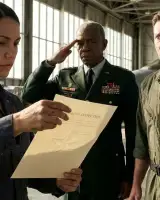
Major Vance stepped briskly to the main entrance, drew back the heavy brass deadbolt that Heath had thrown, and stationed two military police corporal guards just inside the threshold.
Then the CID major walked up to the white-tablecloth head table and set the heavy red-tabbed motor-pool audit binder down right beside my upright folded cream tented reservation card.

The leather cover landed with a solid thump that made Heath flinch all over again.
Not a single officer in the banquet hall touched their silverware or reached for their water glass.
Sixty men and women in dress uniforms sat in pin-drop silence, watching the drama unfold beneath the warm glow of the brass wall sconces.
I placed my folded cream command-orders sheet flat on the white tablecloth and flipped open the front cover of the red-tabbed audit binder.
“Let’s talk about what really happens inside the Fort Overton headquarters motor pool after 1700 hours, Captain Iverson,” I said.
Heath wiped his damp palms against the seams of his dark charcoal dress trousers.
“Colonel, whatever discrepancies the Nevada depot found, that is the fault of the civilian supply clerks and the third-shift mechanics,” Heath said quickly, immediately trying to throw his enlisted soldiers under the bus.
“I am a company commander. I don’t personally turn wrenches or count hydraulic gaskets on the shop floor. I rely on the paperwork they put on my desk.”
A disgusted murmur came from the back tables where several prior-enlisted captains sat near the wall.
I looked at Heath without a trace of sympathy.
“I expected you to blame your mechanics, Captain,” I said calmly. “Bullies who sneer at people in work clothes always blame the lower ranks the second the spotlight turns on them.”
I turned to the first red plastic tab inside the binder and pulled out a laminated printout of digital access logs from the garrison maintenance server.
“Before my C-130 took off from Nevada this afternoon, my cyber-logistics analysts pulled the terminal login records for Building 14—your headquarters motor pool,” I said.
“Specifically, we pulled the override logs for nineteen sets of Class-IX heavy hydraulic assemblies, turbocharger cartridges, and recovery winch motors worth four hundred and eighty thousand dollars.”
Heath’s throat bobbed as he swallowed, his eyes fixed on the red plastic tabs.
“Those nineteen assemblies were delivered to Fort Overton between April and September,” I continued, reading directly from the verified manifest.
“On the sixteenth of each month, Sergeant First Class Miller—your shop foreman—flagged those vehicles as Red-Deadlined waiting for installation.”
“And on the seventeenth of each month, between 2230 and 2345 hours, someone logged into the command terminal after the mechanics went home and manually changed the status codes to Green-One Installed.”
I lifted my eyes from the page and looked straight at Heath Iverson.
“Whose Common Access Card and four-digit PIN authorized all nineteen midnight overrides, Captain?”
Heath’s face went from pale chalk to a blotchy crimson.
“My CAC card stays in my office reader sometimes when I work late!” Heath said, his voice cracking as he scrambled for an excuse.
“Anyone on the night cleaning crew or the duty desk could have used my terminal!”
“Really?” General Kinsella rumbled from beside me, his arms folded across his dark navy dress jacket with its rows of colorful service ribbons.
“Did the night cleaning crew also use your personal fingerprint fob to open the west perimeter gate at 0015 hours on each of those nights, Captain?”
Heath froze as if his boots had been nailed to the oak floorboards.
I turned to the second red tab in the binder and slid three high-resolution infrared security photographs across the white tablecloth.
“Fort Overton installed automated license-plate and thermal cameras at the west industrial gate in March as part of the Pentagon’s perimeter modernization program,” I explained.
“Because the camera feed routes directly to the regional logistics cloud rather than the local guardhouse monitor, you didn’t know it was recording.”
I tapped the first photograph with my index finger.
“Here is a white commercial box truck registered to Tri-County Heavy Equipment Salvage backing up to Bay Four of your motor pool at 2350 hours on August seventeenth.”
I tapped the second photograph.
“And here is Captain Heath Iverson—wearing a plain black windbreaker over his uniform trousers—standing on the loading dock while two civilian drivers load unopened Army crate pallets into that box truck.”
A collective gasp broke out across the banquet hall.
Major Vane at Table Two stood halfway up from his chair, his eyes wide with outrage. “He was stripping our reserve mobilization stock and selling it to civilian salvage?”
“Every single crate,” I confirmed in a steady voice.
“New-in-box hydraulic pumps and winch motors meant for Fort Overton’s deployment readiness were sold off the back dock for thirty cents on the dollar.”
“Meanwhile, Captain Iverson left the old, cracked seals inside the trucks and falsified the digital inspection logs so the vehicles looked combat-ready on paper.”
“Then he shipped five of those defective trucks to the Nevada proving grounds for live-fire recovery drills.”
General Kinsella took a slow step toward Heath, the three gold stars on his shoulders catching the chandelier light as his voice dropped to a lethal whisper.
“Do you realize what happens when a hydraulic recovery winch fails on a forty-degree shale incline with a thirty-ton armored vehicle on the cable, Captain?” General Kinsella asked.
“Soldiers die in the rollover. That is what happens.”
Heath’s knees buckled slightly, and he grabbed the edge of the walnut podium to keep himself upright.
“Sir, nobody was supposed to take those five trucks onto the incline!” Heath pleaded, all trace of the arrogant officer who had mocked my field jacket completely gone.
“They were supposed to sit in the Nevada reserve lot until the next fiscal quarter! I was going to replace the parts once the quarterly budget reset!”
“You weren’t going to replace anything, Captain,” Major Vance from CID spoke up, stepping forward and opening a smaller manila folder.
“Under a federal magistrate’s warrant executed at 1730 hours today, Treasury agents subpoenaed the bank records of Tri-County Heavy Equipment Salvage.”
Major Vance read from the warrant summary in a crisp, detached voice.
“Over the past six months, seven wire transfers totaling one hundred and forty-two thousand dollars were deposited into an LLC registered in Delaware—where Captain Heath Iverson is listed as the sole managing member.”
“Forty thousand of that went toward the down payment on a lakefront boat slip and a luxury coupe currently parked in the officers’ reserved lot outside this building.”
Across the room, officers who had previously laughed at Heath’s jokes at the bar looked at him as if he were something scraped off the bottom of a boot.
And then I turned to the third red tab in the binder—the one that made this personal for every mechanic on the base.
“There is one more thing, General Kinsella,” I said quietly.
“Two weeks ago, Sergeant First Class Miller—a nineteen-year veteran with a Bronze Star and three combat tours—noticed the missing crate serial numbers in Bay Four and confronted Captain Iverson.”
I looked directly into Heath’s bloodshot eyes.
“Instead of reporting the discrepancy, what did you do to Sergeant Miller, Captain?”
Heath stared down at the polished oak floor, his jaw trembling, refusing to answer.
“I’ll tell the room what you did,” I said, holding up a copy of an administrative disciplinary packet bearing Heath’s signature.
“You accused Sergeant Miller of losing the inventory sheets due to ‘clerical incompetence,’ stripped him of his shop foreman position, flagged his retirement packet, and reassigned him to the midnight-to-dawn wash rack.”
“And when Sergeant Miller filed a whistleblower complaint with the Pentagon Logistics Readiness Board four days ago, you told the orderly room that ‘nobody in Washington reads complaints from motor-pool paper pushers.’”
I closed the red-tabbed audit binder with a crisp snap that echoed off the walnut walls.
“Well, Captain Iverson,” I said, my voice ringing clear in the quiet hall. “Someone in Washington read every single word. And then I got on a plane.”
For a long moment, the only sound in the Fort Overton banquet hall was the faint clatter of rain against the tall arched windows.
Every officer in the room stared at Heath Iverson as the full weight of his betrayal settled over the tables.
He had not merely mocked a superior officer because of a dusty olive-drab field utility jacket.
He had stolen critical equipment from his own soldiers, sent defective recovery vehicles to a live training range, and tried to destroy the career of a nineteen-year combat veteran to cover his tracks.
Heath looked around the head table with wild, darting eyes, searching for a single sympathetic face among the command staff.
He found none.
Even the two junior lieutenants from his own headquarters company stepped back from the table, folding their arms and looking away in disgust.
“General Kinsella,” Heath whispered, his voice hoarse and trembling as he reached toward the general’s dark navy sleeve.
“Sir, my father served with your predecessor at Fort Bragg.”
“Surely we can handle an inventory accounting error through an administrative board without involving CID here in front of the entire garrison—“
General Kinsella did not budge an inch.
“Do not mention your father’s name in this hall, Captain,” General Kinsella said, his gravelly bass voice colder than winter iron.
“Your father was an honorable artilleryman who spent thirty years making sure his soldiers had working equipment before he ever sat down to a hot meal.”
“If he were standing in this room tonight, he would be the first one to rip those captain’s bars off your shoulders.”
General Kinsella turned slightly toward Major Vance and the two military police corporals waiting beside the podium.
“Major Vance, what is the status of the charge sheet?” the General asked.
“The staff judge advocate reviewed the digital override logs, the gate camera footage, and the Treasury wire records twenty minutes ago, General,” Major Vance replied crisply.
“Preliminary charges under the Uniform Code of Military Justice have been drafted for larceny of military property, fraud against the United States, signing false official readiness statements, and retaliatory obstruction against a whistleblower.”
At the words larceny and false official statements, Heath’s face sagged as if the bones had melted out of his cheeks.
He knew that each of those specifications carried years of confinement at Fort Leavenworth and a dismissal that would strip him of every benefit, pension dollar, and title he had ever held.
“However,” I interjected calmly, stepping between the podium and the edge of the white-tablecloth head table.
Both General Kinsella and Major Vance turned to look at me.
“Before Captain Iverson is escorted to the regional confinement facility at 0800 hours tomorrow morning,” I said, “there is still the matter of the lawful order I gave him two minutes ago.”
I looked straight at Heath’s immaculate dark charcoal dress uniform jacket and polished black leather belt.
“When I told you to report to dawn duty, Captain, I was not speaking metaphorically.”
“At 0500 hours tomorrow morning, a full wall-to-wall physical reconciliation of Building 14 begins under CID supervision.”
“Every single crate, hydraulic seal, winch cable, and transmission housing in that motor pool is going to be inventoried by hand against the master Pentagon ledger.”
I gestured toward the smudge of Nevada dust still resting on the sleeve of my plain olive-drab field utility jacket.
“And since you told this entire banquet hall that the motor pool is only for paper pushers, you have one last assignment.”
“You are going to spend your final three hours on this post at the steel duty desk in Bay One.”
“Under the guard of two military police NCOs, you will personally sign over every shop key, every digital property receipt, and every maintenance binder to the man who is taking back control of that shop.”
Heath blinked rapidly, his voice barely a croak. “Taking back control? Who?”
General Kinsella permitted himself a thin, granite-hard smile.
“Wait until 0500 hours, Captain,” General Kinsella said. “You will see for yourself.”
General Kinsella raised his voice so it carried to the back corners of the wood-paneled hall.
“Major Vance, place Captain Iverson under military police custody in the visiting quarters overnight and remove his dress belt and post access credentials.”
“Have him standing in front of the Building 14 duty desk at 0455 hours sharp.”
“Yes, General,” Major Vance answered.
One of the military police corporals stepped forward, unbuckled Heath Iverson’s mirror-polished black leather dress belt, and slipped his garrison ID card from his breast pocket.
Without the crisp leather belt cinching his dark charcoal jacket, the uniform suddenly looked loose and hollow on Heath’s frame.
Heath did not say another word as the two military police corporals took him by the elbows and walked him down the long center aisle toward the double oak doors.
As he passed Table Four, the captains and majors whom he had spent months lecturing about officer appearance sat upright in silence.
They watched the man who had tried to guard the head table get marched out into the autumn rain.
When the heavy oak doors clicked shut behind the military police escort, General Kinsella turned back to the white-tablecloth head table.
He reached down, picked up the walnut chair behind my upright folded cream tented reservation card, and pulled it out for me himself.
“Colonel Gillespie,” General Kinsella said loudly enough for the whole room to hear. “The head table is yours.”
Across the banquet hall, sixty officers rose to their feet in unison and stood at attention until I sat down in my dusty olive-drab field utility jacket.