Briggs left for the sheriff’s office at seven the next morning, the thumb drive buttoned into his shirt pocket.
He was back before ten, and he started talking before he sat down.
“Dr. Mercer called Sheriff Cole at six this morning. Before I even got there.”
I set down my coffee cup.
“What did he tell her?”
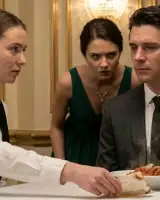
“Everything. The grill room, the club sandwich, the terrace.” Briggs shook his head. “She said he sounded like he hadn’t slept.”
Sheriff Dana Cole had watched last Tuesday’s clip twice. Then she asked for a copy and called a judge in the next county.
Deputy Ruiz had put his report on Judge Hale’s desk at eight o’clock. By ten, Hale still hadn’t thrown out his own order.
Judge Hale’s name was already on one bad order. The sheriff wanted a clean signature on the next one.
Deputy Ruiz had been in her office too. He told her he’d heard every word Harlan said beside the sedan.
That mattered. If Harlan called my son violent tonight, a sworn deputy could say otherwise.
Briggs had found Friday’s recording too, with the apples and the floor. He had given the sheriff that one as well.
“She asked what we planned to do tonight,” Briggs said.
“And what did you tell her?”
“That my mother was going to a party.”
At five o’clock, I took my good navy dress out of the closet.
I hadn’t worn it since Walt’s funeral. It hung a little loose on me now.
I buttoned the darned oatmeal cardigan over it anyway. It had been with me through every hungry afternoon.
The bracelet was still folded in the right pocket. I left it there.
For six weeks, my physical therapist Marla had driven me to her clinic while Valerie played tennis. Briggs had paid for every session from overseas.
Valerie thought I was napping on those mornings. I was walking between two parallel bars, one stubborn step at a time.
Briggs came downstairs in his dark-navy dress uniform. The brass buttons caught the late light from the French windows.
He looked at the black wheelchair folded by the garage door. Then he looked at me.
“Leave it,” I said.
He carried it into the garage himself and leaned it against the wall.
Then he handed me Walt’s cane.
The Oakridge Country Club ballroom smelled of roses and roast beef at seven o’clock that evening.
Three hundred members sat at round tables under crystal chandeliers. A string quartet played near the bar.
Beside the podium stood a wooden easel, and behind it a screen as tall as a garage door.
Across the screen, in bold green letters, were the words ORCHARD NINE.
Below them was a map. I knew those rows, because Walt had planted every one of them.
Someone had painted smooth green fairways straight over his trees.
Briggs and I stood just inside the doors. Nobody had noticed us yet.
Harlan meant to tell this room that my son had attacked a medical crew. I meant to speak before he could.
Near the podium, Valerie stood at Harlan’s side in a gold gown. She was talking to Tessa and Joan with one hand pressed to her chest.
Her voice carried across the polished floor.
“She’s declining fast, poor dear. We’re doing everything we can.”
Tessa glanced at Joan. Then both women took one step back from her.
Grant stood behind them holding his drink. He had read my property record aloud in my own hallway. He didn’t step forward to back her up.
Judge Hale sat at table one, closest to the podium, with a glass of red wine in his hand.
Dr. Mercer sat at table six. His face was gray, and he hadn’t touched his plate.
I set the rubber tip of Walt’s cane on the floor and started walking.
It was a long way to the front. I took it slowly, with Briggs a half-step beside me.
The quartet faltered. Then it stopped.
Table by table, the room went quiet. Soon the only sound was the cane tapping on the parquet.
Harlan saw me when I reached the podium steps.
He moved fast for a man of sixty. He came down the steps smiling and took hold of my elbow.
“Let’s get you somewhere quiet, Iris,” he said, loud enough for the whole room.
His fingers tightened. He began turning me toward the side door.
Briggs’s hand closed around Harlan’s wrist.
It was one brief, clean grip. It was the same hand that had stopped my wheelchair dead in the hallway arch.
Harlan let go of my arm. Briggs let go of his wrist. Neither man said a word.
I climbed the three steps with the cane and stood at the microphone.
I have never been a speaker, so I kept it plain.
“My name is Iris Beaumont. I own Oakridge Manor.”
I looked out at three hundred faces.
“I have never signed it over to anyone. And my husband Walt’s orchard is not for sale.”
For a moment, nobody moved.
Then Harlan laughed into the room, warm and easy, like a man smoothing over a spilled drink.
“Folks, I’m sorry. Her own doctor says she’s confused. This is exactly what we were afraid of.”
I didn’t look at him. I leaned closer to the microphone.
“Dr. Mercer is at table six. Ask him.”
Every head in the room turned.
Dr. Mercer sat very still. Then he laid his napkin on the table and stood up.
His voice shook, but it carried to the back wall.
“I never examined Mrs. Beaumont. I never even met her. Harlan brought me the form, and I signed it.”
He sat back down and covered his face with both hands.
Somebody at table four set down a fork. It sounded very loud.
Briggs walked to the AV technician at the side of the stage and handed him the thumb drive.
“Play the first file, please.”
The young man glanced at Harlan. Then he looked at Briggs’s uniform and plugged it in.
The Orchard Nine map vanished.
In its place was my own dining room, seen from the top of the china hutch.
Harlan sat in Walt’s chair with a glass of wine. His voice filled the ballroom.
“Keep her hungry. She’ll look the part.”
Beside the podium, Valerie went white. She had pulled that camera’s cord out of the wall herself.
Harlan took one step toward the AV table. Briggs turned his head, and Harlan stayed where he was.
The clip jumped ahead. Valerie stood by the kitchen trash can holding a full plate of pot roast.
She scraped every bite into the bin. Then she rinsed the plate and set it in the rack.
Nobody spoke. Nobody even reached for a glass.
At table one, Judge Hale set his wine down on the white tablecloth.
He stood, buttoned his jacket and walked out of the ballroom. He never once looked at Harlan.
A minute later, the ballroom doors opened again.
Sheriff Dana Cole walked in first, a short woman with close-cut gray hair. Deputy Ruiz was one step behind her.
They didn’t hurry. They didn’t need to.
“Harlan Kessler,” the sheriff said, “you’re under arrest for fraud and conspiracy.”
Harlan started to say something about his lawyer. Ruiz turned him around and cuffed him beside the dessert cart.
Then the sheriff turned to the gold gown by the podium.
“Valerie Beaumont, you’re under arrest for elder abuse and fraud.”
Valerie’s hand flew to her throat. Ruiz drew her wrists behind her and closed the cuffs just above the gold watch.
The club’s vice-chair, a tall woman in pearls, climbed the podium steps. I stepped aside and gave her the microphone.
“Effective tonight, Harlan Kessler is removed as president of this club. The Orchard Nine expansion is dead.”
She reached over and switched off the screen herself.
Ruiz led Harlan toward the doors first. Harlan kept his eyes on the carpet the whole way.
Valerie came next, with the sheriff’s hand on her arm.
She stopped in front of us. Her mascara had begun to run.
“Briggs, honey, I was going to...”
Briggs didn’t answer her. He only stepped closer to me, until his sleeve touched my shoulder.
Valerie looked at me then, for the first time all evening.
I kept my voice low. The words were meant for her, not the room.
“Those apples came from Walt’s trees, Valerie. From now on, I’ll eat them at my own table.”
Her mouth opened, but nothing came out.
As she passed table nine, Tessa and Joan turned their chairs and gave her their backs.
The ballroom doors swung shut behind Harlan and Valerie with a soft, heavy thud.
Briggs filed for divorce the following Monday.
That same week, the judge in the next county threw out Hale’s emergency order for good.
No assault complaint ever reached Briggs’s command. By then, Harlan was too busy paying lawyers of his own.
Dr. Mercer cooperated with Sheriff Cole from the first day. He handed over his phone, his calendar and the grill room receipt.
The black wheelchair stayed folded in the garage, right where Valerie had wanted to put me.
Dust settled on its rubber push handles, and nobody wiped it off.
On a cool morning in early November, the last late apples were still hanging in Walt’s orchard.
Briggs carried a bushel basket down the rows. I walked beside him on Walt’s cane.
We went slowly. Walt’s trees didn’t mind.
Briggs held the branches down, and I picked. My hands were steadier than they’d been in months.
Back at the house, he washed the apples at the sink and carried them to the oak table.
He sliced one into thin crescents, the way his father always had, and fanned them across a blue plate.
He set the plate in front of me and sat down across the table.
I ate every slice. Not one of them touched the floor.
When the plate was empty, I reached into my right cardigan pocket.
The hospital bracelet had gone soft from all the folding. Hollis Memorial. September 14. Walt’s birthday.
I carried it down the hall to Walt’s old desk and opened the top drawer.
I laid it inside, next to his reading glasses, and slid the drawer shut.
Then I walked back to the table, where my son was already cutting me another apple.
Was I right to walk into that gala myself, or should I have let my son handle it?