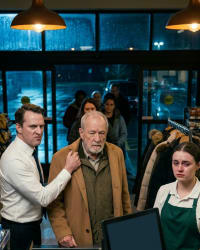
Nobody in the café moved.
The rain ticked against the tall windows.
Somewhere down the concourse, a gate agent called a name, twice, and nobody answered.
On the counter, a half-made latte had stopped steaming.
Kyle’s hand with the badge had sunk to his belt.
His mouth opened.
Nothing came out.
“I asked a question,” Gloria Pratt said.
“Yes, ma’am,” Kyle said finally.
His voice cracked on the second word, and he cleared his throat and tried again.
“Kyle Parrish. I’m the manager. Mr. Whitfield, sir, I didn’t know who you were. I had no idea.”
Harold held up one hand, and Kyle stopped.
“That’s the part that worries me,” Harold said.
“That you needed to know.”
He didn’t raise his voice.
He held out his hand, palm up, and waited.
For a moment Kyle didn’t understand.
He stared at the open palm, the deep lines across it, the old white scar at the base of the thumb.
Then he looked down at the badge in his own fingers.
He put it in Harold’s palm as if it were hot.
Harold closed his hand around it.
He turned to Jasmine.
He looked at the torn spot on her apron, and something in his jaw set hard.
“May I?” he asked.
She nodded.
She couldn’t have said a word if she had tried.
He leaned over the counter and pinned the badge back on her apron, just above the torn spot, carefully, the way you would pin a medal on someone.
His hands were steady.
Hers, flat on the counter, were not.
When he stepped back, she looked down at it.
The brass caught the lamplight.
She touched it with two fingers, as if to make sure it was real.
Then Harold turned to the director.
“Ms. Pratt, this young lady paid for my lunch with her own money. Five dollars.”
He looked at Jasmine.
“How much did you have left?”
Jasmine swallowed.
“Twenty-three. Until Friday.”
“Out of twenty-three,” Harold said, loud enough for the whole line.
The man in the golf shirt, the one who had sighed, looked at his shoes.
The young guy with the backpack lowered his phone an inch, then raised it again.
Then Harold turned to Kyle.
For a long moment he only looked at him.
Kyle tried to hold it and couldn’t.
His eyes went to the floor, to the bin, to the door.
“I started this company with one coffee cart in this airport in 1981,” Harold said.
“Four hundred dollars and a cart with a bad wheel. Rule one was feed people. I wrote it on the inside of the lid so I’d see it every morning.”
He nodded at the trash bin.
“Forty-five years, and it’s still rule one. You threw away a sandwich a nineteen-year-old paid for with her bus money. And you did it so a line full of people would watch.”
Kyle’s face had gone from pink to gray.
He touched the knot of his tie, then dropped his hand.
“Sir, with respect,” he said.
“The policy says no personal cash in the drawer. I’ve been here nineteen years. I started on that register. If I let one slide, they all—“
“The policy says every dollar gets a receipt,” Harold said.
“She’d have rung it up if you’d given her ten seconds. There is no policy at my company against kindness, son. There never has been.”
Kyle looked at Gloria Pratt, as if she might help him.
She didn’t.
She didn’t even blink.
Harold let the quiet sit.
Jasmine could hear the rain, the hum of the pastry case, her own breath going in and out too fast.
“Go home, Kyle,” Harold said quietly.
“Someone from our office will call you in the morning.”
He didn’t shout it.
He didn’t need to.
Somehow that was worse.
Kyle stood very still.
His jaw worked once, as if he were chewing on an answer he couldn’t swallow.
He looked around the café.
At the line.
At Beto behind the grill with his spatula in his hand.
At the two phones still pointed at him.
At Jasmine, last, and only for half a second.
Then he walked out from behind the counter and down the concourse, into the crowd.
His back was very straight.
His jacket was still hanging on the hook in the back room, right under his rule sheet.
He didn’t come back for it.
The café stayed quiet for a few seconds after he was gone.
Then the woman in the blue cardigan lowered her phone and started, very softly, to clap.
Nobody joined her, and she stopped, embarrassed, her cheeks pink.
But Jasmine never forgot it.
The older man in the dark suit stepped forward.
“Sir, the car’s out front whenever you’re ready.”
“Give me five minutes, Luis,” Harold said.
The line began to move again, slowly, like a room after a fire alarm.
People ordered in low voices.
Nobody complained about the wait.
Jasmine rang them up.
Her fingers knew the keys even when the rest of her didn’t.
Every few seconds she touched the badge.
Later, she would learn about the phone call.
Luis Ferrer had driven Harold for twenty-two years.
Four years earlier, Harold had collapsed in an airport restroom in Atlanta with a heart problem nobody had seen coming.
After that, the two of them made one rule.
If Harold pressed the first speed-dial button and said nothing, Luis came.
No questions.
Wherever he was.
That Tuesday, Luis had been waiting at the curb with the car.
Harold’s briefcase was on the back seat, his wallet inside it.
Gloria Pratt was with him.
She had spent the whole morning with Harold, going over the renewal of the terminal’s food contract, and she was walking him out.
At the last minute Harold had told them he wanted a sandwich and five minutes on his own.
“I like to see how a place feels,” he told Jasmine, standing at the end of the counter while Luis waited by the entrance.
“When nobody knows I’m there. You learn more in five minutes in line than in five hours of meetings.”
“You didn’t check your pocket first,” she said, before she could stop herself.
He laughed.
It was a short, surprised sound, as if it hadn’t come out of him in a while.
“No. Forty-five years in this business, and I walked into my own café without enough money for lunch.”
Beto came out from behind the grill with a fresh turkey sandwich, wrapped tight in brown paper, the way he had taught Jasmine to do it.
His big hands were careful with it.
“On the house, Mr. Whitfield,” he said.
Harold smiled for the first time.
“No, sir. Not today. Today I’m paying.”
He turned to Luis.
Luis sighed, the sigh of a man who had done this before, took out his own card and handed it to Jasmine.
Harold Whitfield, who owned every café in that terminal, paid full price for his own sandwich with his driver’s card.
Jasmine rang it up.
Her hands were shaking a little.
She printed the receipt and held it out.
Harold folded it carefully and put it in his jacket pocket, next to the flip phone.
Then he leaned toward Beto and said something too low for Jasmine to hear.
Beto glanced at the open drawer and nodded once.
Luis took a five from his own pocket and handed it to Beto without being asked.
“Jasmine,” Harold said.
“What do you want to be doing in five years? Really.”
Nobody had asked her that in a long time.
Teachers had, once.
Then everyone stopped, because the answer was always the same: work.
She thought about lying, saying something safe.
She looked down at the badge on her apron, a little crooked now, just above the hole.
She didn’t lie.
“I want to finish school,” she said.
“I take one class a semester at the community college. That’s all I can pay for. Business. I want to run a place like this one day.”
She hesitated.
“A good one.”
Harold looked at her for a long moment, the same way he had when she gave her name.
“Friday,” he said.
That was all.
Then he walked out with Gloria Pratt and the two men in dark suits, a small, tired old man in a worn olive jacket with a sandwich in his hand, and the line stepped aside for him again.
Jasmine watched him go until the crowd closed behind him.
Then she said to the next customer, “I’m sorry, give me one second,” and walked into the back room.
It was narrow and cold and smelled of bleach and coffee grounds.
One bare bulb.
Stacked milk crates.
The coat hooks, and on the last one, Kyle’s gray jacket, hanging exactly where he had left it.
Above it, the laminated sheet.
WE DON’T GIVE ANYTHING AWAY.
She sat down on a milk crate, which was against the rules, and put her face in her hands.
Nothing came.
Her body just shook, from the shoulders down, in long slow waves, as if she had been cold for hours.
After a minute the door swung open.
Beto came in with a paper cup of water and set it on the crate beside her.
He didn’t say anything.
He stood with his back against the shelf, close enough, until her shoulders stopped.
“Eleven years,” he said finally, low.
“Eleven years I watched him do things like that. You know what I did?”
He shook his head.
“I said, ‘Come on, man.’”
She looked up at him.
His eyes were wet.
He wiped them with the back of his wrist, the one with the old burn from the grill.
“You put five dollars in a drawer,” he said.
“That’s more than I ever did.”
The videos were online before her shift ended.
Jasmine didn’t watch them.
She knew because her phone kept buzzing in her locker, and when she took it out at one o’clock there were forty-one messages, half of them from numbers she didn’t know.
Her cousin had sent the link with six crying faces.
Someone from high school had written, “IS THIS U??”
On the bus home she turned the phone face down on her knee and watched the rain instead.
The badge was still on her apron.
She hadn’t taken it off.
The apartment was dim and warm and smelled of the rice her mother had left on the stove.
Tobias was at the kitchen table with his homework spread out and a pencil behind his ear.
“You’re famous,” he said, without looking up.
“Everybody at school saw. Miguel’s mom showed him.”
“I’m not famous.”
“You’re kind of famous.”
He looked up then, and his face changed when he saw the hole in her apron.
He didn’t say anything else.
He got up and poured her a glass of milk, which he had never done in his life.
Her mother woke at six, as always, to get ready for her night shift.
Jasmine heard her moving in the bathroom, the water running, the radio low.
At 8:40, while Elena was buttoning her work smock at the kitchen table, Jasmine’s phone rang.
The screen said KYLE.
She stared at it.
It rang four times.
Her mother looked at her over the rim of her glasses.
She answered.
“Jasmine.”
Kyle’s voice was different on the phone.
Lower.
Tired.
A television was on somewhere behind him.
“Don’t hang up. Just listen for one minute.”
She didn’t say anything.
She stood and walked to the window, so her mother wouldn’t see her face.
“They’re going to ask you about this morning,” he said.
“Somebody from regional. They’ll want a statement.”
She waited.
“All you have to say is it was a misunderstanding. I thought you were comping product. You hadn’t rung it up. That’s true, right? You hadn’t rung it up yet.”
He took a breath.
“That’s all. A misunderstanding. Nobody got hurt.”
Jasmine looked at the apron hanging over the back of the kitchen chair.
The hole was the size of her thumbnail.
“I’ve got a daughter,” Kyle said.
“She’s six. I’ve been at that airport nineteen years. You understand? Nineteen years. You’ve been there seven months.”
His voice tightened on the last words, the way it did at the register.
“And if this blows over,” he said, “remember who writes the schedule.”
Jasmine closed her eyes.
“Goodnight, Kyle,” she said, and hung up.
Her hand was shaking so hard she nearly dropped the phone.
She set it face down on the windowsill and kept her palm flat on top of it, as if it might ring again on its own.
“Who was that?” her mother asked.
“My manager.”
“The one from the video?”
Jasmine nodded.
Then she couldn’t stop nodding, and then she couldn’t breathe right, and then she was sitting on the kitchen floor with her back against the cabinet under the sink, crying the way she had refused to cry in front of the whole line.
It came from somewhere low.
It shook her chest and her jaw.
She pressed the heels of her hands into her eyes and it still came.
Her mother didn’t ask anything.
She knelt on the linoleum in her work smock, which she was not supposed to wrinkle, and pulled Jasmine’s head against her shoulder.
Tobias stood in the doorway in his socks.
After a while he came and sat on the floor too, on the other side, and leaned his shoulder against hers.
The radio was still playing in the bathroom.
The rice pot ticked as it cooled.
Nobody said anything for a long time.
“He wants me to lie,” Jasmine said finally, into her mother’s shoulder.
“He wants me to say it was a misunderstanding.”
Elena was quiet.
Her hand kept moving on Jasmine’s back, in slow circles, the way it had when she was small.
“Mija,” she said at last.
“When I worked at the hotel, before you were born, they fired a girl for taking home bread they were going to throw out. I saw it. They asked me what I saw.”
She stopped.
“I said I didn’t see anything.”
Jasmine lifted her head.
“I needed the job,” her mother said.
Her eyes were on the cabinet across the kitchen, not on Jasmine.
“I always needed the job. I’m not telling you what to do. I’m telling you I still think about that girl.”
She looked at the clock.
She was going to miss her bus.
She got up anyway, slowly, and took the apron off the chair, and found the sewing tin in the drawer by the stove.
She sat down under the kitchen light and threaded a needle on the second try, squinting.
“Ten minutes,” she said.
“I’ll take the later bus.”
She cut a small square of teal from the inside hem of an old shirt and stitched it over the hole, with tiny, even stitches, her glasses low on her nose.
Jasmine watched her hands.
They were rough from the cleaning chemicals and very sure.
When it was done, Elena pinned the brass badge back on, just above the patch, exactly where Harold had put it.
“There,” she said.
“Now it’s yours again.”