At 4:55 on Wednesday morning, the café’s lights were already on.
Through the glass Jasmine could see a woman she didn’t know at the little desk in the back room, the door propped open, a laptop in front of her and a paper cup of coffee she hadn’t touched.
Beto was at the grill.
He tipped his chin toward the back room.
“Regional,” he said.
“Flew in from Tampa last night. She’s talking to everybody. One at a time.”
“Did you talk to her?”
“Yeah.”
He pushed the spatula across the clean steel, though there was nothing on it.
“Some.”
Jasmine knew what “some” meant.
Her turn came at 5:20.
She hung her rain jacket on the hook next to Kyle’s gray one, which was still there.
The woman stood up when she came in.
She was maybe fifty, with reading glasses pushed up into short silver hair and a navy blazer over a T-shirt, as if she’d dressed in a hurry.
She held out her hand.
“Anita Shah. I run the region for Whitfield Provisions. Please, sit.”
There was no chair, only the milk crates.
Jasmine sat on one.
Anita, after a second, pulled the other crate over and sat on that too, so they were level.
Jasmine noticed that.
The laptop was angled so they could both see it.
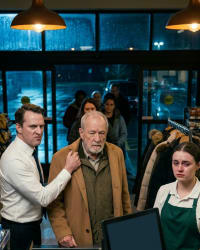
On the screen, paused, was the café from yesterday, filmed from the line.
Kyle’s arm.
The badge in his raised hand.
“I’ve watched both videos,” Anita said.
“Several times. I’m not going to ask you to watch them.”
“Thank you,” Jasmine said, and meant it.
“I’m going to ask you what happened, in your own words. And then I’m going to ask you if there’s anything else I should know.”
Jasmine told her about the old man.
The fourteen dollars.
The five.
She kept her voice flat and careful, as if she were reading back an order.
Anita wrote.
Her pen moved fast in small, neat letters.
When Jasmine got to the trash bin, the pen stopped for a second, then went on.
“Thank you,” Anita said.
“That matches the footage exactly. And the drawer.”
Jasmine looked up.
“Your drawer was nineteen dollars over yesterday,” Anita said.
“Fourteen of his and five of yours, with no sale rung up against them. That’s about the cleanest proof anyone could ask for that nobody gave anything away.”
She almost smiled.
“You paid for that sandwich. Twice, if you count what it cost you.”
She turned a page in her notebook.
“Now. Is there anything else I should know? About how this café is run.”
There it was.
Jasmine looked past Anita, at the wall.
The coat hooks.
Kyle’s gray jacket, one sleeve hanging lower than the other.
Above it, the laminated sheet, its tape gone yellow at the corners.
She thought about eighteen dollars.
About Tobias’s sneakers.
About remember who writes the schedule.
She thought about her mother on the kitchen floor saying, I still think about that girl.
Her hands were in her lap.
She realized she was touching the badge, two fingers pressed flat on the brass, the patch soft under her knuckles.
“He called me last night,” she said.
Anita’s pen stopped.
“At 8:40. He asked me to say it was a misunderstanding. He said he had a daughter. And then he said, if this blows over, remember who writes the schedule.”
She took out her phone and turned it so Anita could see the call log.
KYLE.
8:40 p.m.
Four minutes.
Anita looked at it for a long time.
She didn’t write anything.
She took off her reading glasses and folded them.
“Go on,” she said quietly.
So Jasmine went on.
She told her about Dani and the cup of ice.
The twelve dollars.
The crying toddler, and how Dani had cried too, in this same back room, on this same crate.
She told her about the tip jar with the masking tape.
How every day it went into the drawer.
How Kyle said tips were store property, and how nobody behind the counter ever saw a dollar of it.
“I don’t know how long,” she said.
“Since before me. Beto would know.”
Her voice caught on Beto’s name, because she knew what she was doing to him.
She was putting him in it.
Anita wrote it all down.
When she was done she capped her pen and laid it on the notebook, precisely, as if it mattered where it went.
“Jasmine,” she said.
“Would you be willing to sign this?”
The bulb hummed.
Out front, the espresso machine hissed for the first coffee of the day.
Jasmine thought about saying she needed time.
She thought about saying she’d only heard about the tips from other people.
The words were right there in her mouth.
“Yes,” she said.
“I’ll sign it.”
She signed it on her knee, on the milk crate, with Anita’s pen.
Her signature came out shaky and too big, the way it had on her first paycheck.
When she came out of the back room, Beto was standing at the grill with his back to her.
He had heard.
The door had been open the whole time.
He set the spatula down.
He wiped his hands on his apron, slowly, front and back, front and back.
Then he walked past her into the back room and closed the door as far as it would go.
He was in there forty minutes.
When he came out, his eyes were red and his shoulders sat lower than she had ever seen them, as if he had finally put something heavy down.
He went back to the grill and started humming again, very softly, a bolero she didn’t know.
“Two years,” he said to her later, while they wiped down the counter.
“Since he made Andre empty the jar in front of customers. Two years of tips. I counted once, in my head. Then I stopped counting.”
“Why didn’t you ever say anything?”
He shrugged.
It was a big shrug, his whole body in it.
“Same as your mom,” he said.
“Needed the job.”
Anita called Kyle at seven.
Jasmine was close enough to hear her side of it, polite and brief.
“Eight-thirty, please. Here. Yes, the café.”
He came at 8:25, early, the way he always came to work.
He wore a white shirt and the navy tie, pressed.
His hair was combed back.
From across the concourse he looked exactly the way he did every morning.
Up close his eyes were swollen, and he had nicked himself shaving, a small dark cut under his jaw.
He didn’t look at the line.
He didn’t look at the register.
He walked straight back, and the door swung shut behind him and bounced an inch open again.
Gloria Pratt arrived a minute later and went in too.
So for the next twenty minutes, Jasmine rang up coffees and muffins with half of what was said in the back room drifting out over the hiss of the machine.
She heard Kyle’s voice first, steady and fast.
Policy.
Shrinkage.
Setting an example.
Nineteen years.
He had made this the top store in the terminal three years running.
Then Anita’s voice, much quieter.
Jasmine couldn’t make out the words.
Then the sound from the laptop: the café, tinny and small, a line of strangers, a gasp.
A man’s voice saying, “You don’t give away product. You’re done.”
Kyle’s own voice.
Coming back at him through a laptop speaker.
The back room went silent.
Jasmine’s hand stopped over the register keys.
The woman in front of her, a toddler on her hip, followed her eyes to the door and then looked politely away.
The video kept playing.
The soft thump of the bin.
“And he’s leaving too.”
The nervous laugh from the line.
Then it stopped.
For a long time nobody back there said anything.
When Kyle spoke again, his voice was different.
Smaller.
“I didn’t know it looked like that.”
“That’s what it looked like,” Anita said.
“To a line full of people, and to a few million more since yesterday.”
A pause.
“But that’s not the part that keeps me up, Kyle. The tip jar. Two years.”
“Those go into sales. It’s all accounted for.”
“It’s accounted for as sales,” Anita said.
“That’s why this was the top store in the terminal three years running. Your bonus came out of your cashiers’ tips.”
Nothing from Kyle.
“And last night you called a nineteen-year-old employee and told her to remember who writes the schedule.”
A chair scraped.
Then nothing.
“She told you that?”
Kyle said finally.
His voice wasn’t angry.
It was something worse than angry, almost lost.
“She signed it,” Anita said.
“So did Beto. So did Andre, on the phone, an hour ago. So did a young woman named Dani, who doesn’t work for us anymore.”
Out front, the woman with the toddler paid and left.
Next in line was a pilot in a white shirt, who ordered a black coffee and stood very still while she poured it, as if he understood that something was happening.
“Effective today,” Anita said.
The rest was quieter.
Jasmine caught pieces.
For cause.
Not eligible for rehire at any Whitfield location.
Every dollar of tips repaid to the staff, by the company.
Two weeks’ severance, at Mr. Whitfield’s request.
Then Gloria Pratt, cool and formal.
“I’ll need your airport ID.”
Not eligible for rehire at any Whitfield location.
In that terminal, that meant every counter, every register, every café from the first gate to the last.
Nineteen years, and there was no door left in the building he could walk back through.
The back-room door opened.
Kyle came out with his gray jacket over his arm.
He stopped just inside the doorway and looked down at his belt, at the airport ID on its clip, his own face looking back at him from the plastic.
He unclipped it.
His fingers fumbled.
It took him three tries.
Nobody helped him, and nobody watched him do it except Jasmine, who couldn’t look away.
He turned and handed it to Gloria Pratt.
She took it without a word.
He didn’t let go right away.
For a second they both held it.
Then he did.
Then he walked toward the counter, because that was the only way out.
He had to pass her register.
He stopped there, two feet away.
The same spot where he had stood yesterday with her badge in his fist.
The lamplight was on his face, and for the first time Jasmine noticed the gray coming in at his temples, the lines at the corners of his mouth.
He looked at the badge on her apron.
At the small teal patch under it.
She held his eyes.
Her heart was pounding so hard she could feel it in her throat, but she held them.
“I started on this register,” Kyle said.
It came out hoarse.
“Nineteen. Same as you.”
“I know,” Jasmine said.
“You told everybody.”
He flinched, very slightly.
Then he nodded, once, as if she had told him something he already knew and had been trying not to.
“My first manager used to say it,” he said.
“We don’t give anything away.”
He swallowed.
“I thought that was how you got to the back room.”
She didn’t answer.
There was nothing to answer.
Kyle put on his jacket.
He looked around the café one last time: the pastry case, the warm lamps, the tall windows going blue in the rain.
Then he walked out into the concourse and didn’t look back, and the travelers flowed around him and closed behind him like water.
Jasmine finished pouring the pilot’s coffee.
Her hand was perfectly steady.
She didn’t know where that had come from.
“You okay?” the pilot asked quietly.
“Yes, sir,” she said, and found, to her surprise, that it was true.